Svyatogor Myth Meaning & Symbolism
A giant of impossible strength, bound to the earth by his own power, whose tragic fate reveals the profound limits of the heroic ego.
The Tale of Svyatogor
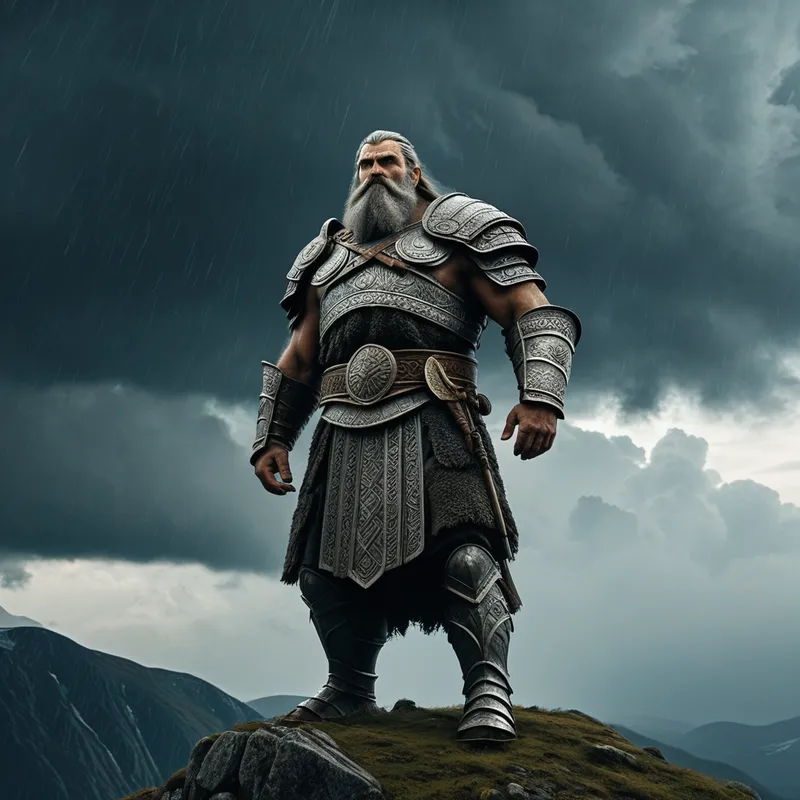
Hear now of the mightiest who ever walked the Yav. His name was Svyatogor, and his footsteps were earthquakes, his breath the wind that bent ancient oaks. He was a giant of the old world, a being of pure, unbridled power, born when the earth was still soft and the sky was close enough to touch. He lived not among men, but upon the very bones of the world—the highest, most desolate crags where eagles dared not nest.
His strength was his essence and his prison. The very soil trembled to bear him; no horse could carry his weight, no sword could pierce his skin. He was a force unto himself, a walking mountain. Yet, in his heart, a loneliness grew as deep as the chasms he straddled. He was a king without a kingdom, a warrior without a war, for what challenge could possibly meet his measure?
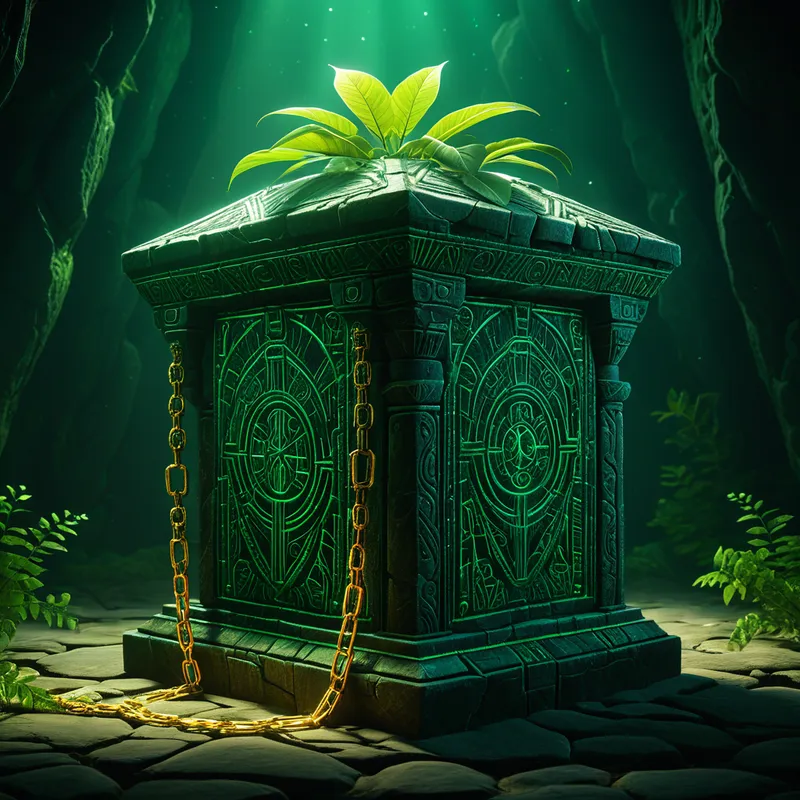
His fate was woven on a day when he rode—for ride he did, upon a steed as massive as a hill—across the boundless plain. There, he found a small bag lying in the grass. With a laugh that rumbled like distant thunder, he tried to flick it aside with his whip. It did not move. Intrigued, he dismounted, wrapped his vast hand around it, and strained to lift it. The bag remained fast to the Mat Syra Zemlya. He summoned all his world-shaking strength, veins like rivers bulging on his brow. He lifted it, but his legs sank into the earth up to his knees. The bag was not of this world; it contained the “Heavy Burden,” the very weight of all earthly sorrow.
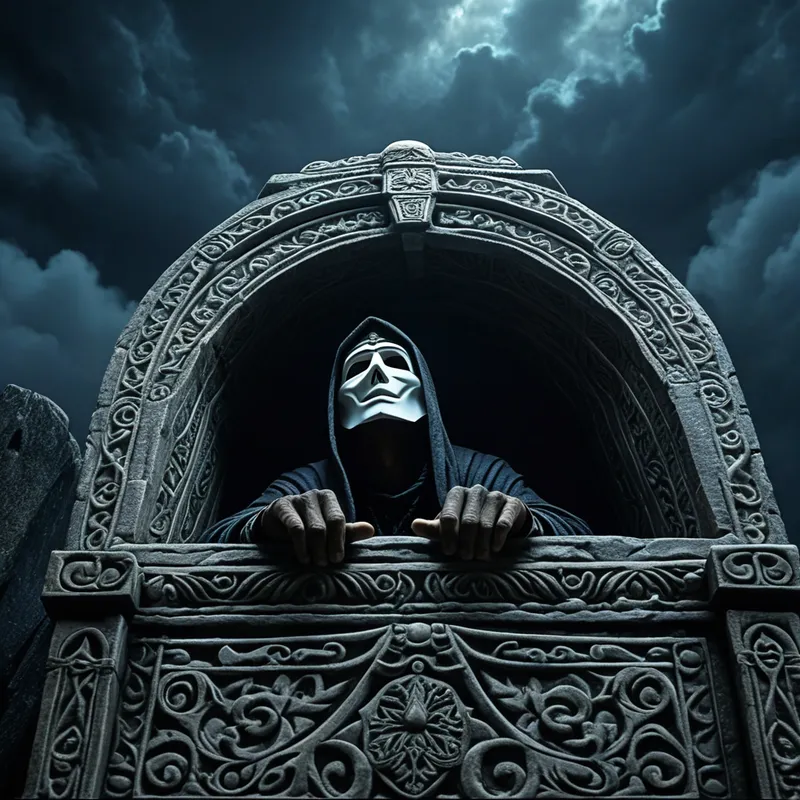
Shamed and bewildered, Svyatogor released it. His path then crossed with the mortal hero, [Ilya Muromets](/myths/ilya-muromets “Myth from Slavic culture.”/). In this man of humble birth but divine strength, Svyatogor saw a flicker of a kindred spirit. They swore brotherhood. In their travels, they came upon a marvel: a colossal stone coffin lying in a field. A prophecy was inscribed upon it: Whosoever fits this coffin, for him it is destined.
Ilya Muromets lay within; it was too large. Svyatogor, with a grim smile, took his place. The fit was perfect. As he lay there, a strange lassitude, a sweet and final peace, washed over him. “My brother,” he whispered to Ilya, “this is my fate. Slide the lid to cover me, but leave a narrow crack so I may still breathe.”
Ilya, heavy-hearted, obeyed. But when Svyatogor tried to push the lid open from within, he could not. His immeasurable strength was useless. The coffin was his destiny, and destiny cannot be overpowered. In a final act, he breathed his remaining life-force—his “righteous strength”—into Ilya Muromets through the crack, bequeathing his power to one who could still walk the world. Then, he asked Ilya to strike the lid with his sword to seal it shut. The blow closed the crack forever, and the greatest of the old giants passed from the world, entombed not by an enemy, but by the inescapable truth of his own nature.
Cultural Origins & Context
The epic of Svyatogor belongs to the byliny, the narrative songs of Kievan Rus’ and later regions. These were not mere stories but a living historical and ethical tapestry, performed by skilled singers for communal gathering. Svyatogor is a figure of profound antiquity, often considered a “pre-bogatyr,” a giant from an era before the more human-like knights such as Ilya Muromets. His tales are set in a liminal, mythic geography—the “Holy Mountains”—which represent the edge of the known world, the border between the age of primordial giants and the age of human heroes.
His function in the Slavic worldview was multifaceted. He embodied the untamed, raw power of the world itself, a force necessary for creation but too vast and impersonal for the emerging human-centered order. His stories served as a cautionary bridge between epochs, illustrating that the old, monolithic ways must give their essence to the new. He is a tragic personification of a world that is passing, whose very greatness makes it incompatible with the future. The singers who told his tale were not just entertainers but custodians of cultural memory, using his fate to explore themes of inevitable change, the acceptance of limits, and the solemn transfer of power and responsibility.
Symbolic Architecture
Svyatogor is the [archetype](/symbols/archetype “Symbol: A universal, primordial pattern or prototype in the collective unconscious that shapes human experience, behavior, and creative expression.”/) of the Ego in its most potent and isolated form. His immense [strength](/symbols/strength “Symbol: ‘Strength’ symbolizes resilience, courage, and the ability to overcome challenges.”/) symbolizes a [consciousness](/symbols/consciousness “Symbol: Consciousness represents the state of awareness and perception, encompassing thoughts, feelings, and experiences.”/) that believes itself to be absolute, self-sufficient, and capable of mastering any challenge through sheer will. He is the ultimate “self-made” being, but his creation is his cage.
The greatest prison is often constructed from the materials of one’s greatest gift.
The “Heavy Burden” he cannot lift is the [weight](/symbols/weight “Symbol: Weight symbolizes burdens, responsibilities, and emotional loads one carries in life.”/) of collective [human](/symbols/human “Symbol: The symbol of a human represents individuality, complexity of emotions, and social relationships.”/) suffering, of [fate](/symbols/fate “Symbol: Fate represents the belief in predetermined outcomes, suggesting that some aspects of life are beyond human control.”/) itself—realities that cannot be overcome by individual might, only carried or transformed. It is the first crack in his monolithic self-assurance. The [stone](/symbols/stone “Symbol: In dreams, a stone often symbolizes strength, stability, and permanence, but it may also represent emotional burdens or obstacles that need to be acknowledged and processed.”/) [coffin](/symbols/coffin “Symbol: A coffin represents endings, transitions, or significant changes, often associated with fears surrounding mortality and letting go.”/) is the ultimate [symbol](/symbols/symbol “Symbol: A symbol can represent an idea, concept, or belief, serving as a powerful tool for communication and understanding.”/) of his [destiny](/symbols/destiny “Symbol: A predetermined course of events or ultimate purpose, often linked to spiritual forces or cosmic order, representing life’s inherent direction.”/), which is synonymous with his own [identity](/symbols/identity “Symbol: Identity represents the sense of self, encompassing personal beliefs, cultural background, and social roles.”/). He does not find his [fate](/symbols/fate “Symbol: Fate represents the belief in predetermined outcomes, suggesting that some aspects of life are beyond human control.”/); he fits it perfectly because it is molded from the essence of who he is. His inability to lift the lid from inside is the central psychological [truth](/symbols/truth “Symbol: Truth represents authenticity, honesty, and the quest for knowledge beyond mere appearances.”/) of the myth: the ego cannot, from its own resources, transcend the boundaries of its own [nature](/symbols/nature “Symbol: Nature symbolizes growth, connectivity, and the primal forces of existence.”/). The [crisis](/symbols/crisis “Symbol: A crisis symbolizes turmoil, urgent challenges, and the need for immediate resolution or change.”/) that leads to growth or [dissolution](/symbols/dissolution “Symbol: The process of breaking down, dispersing, or losing form, often representing transformation, release, or the end of a state of being.”/) must come from an encounter with something beyond itself—here, symbolized by the [prophecy](/symbols/prophecy “Symbol: A foretelling of future events, often through divine or supernatural means, representing destiny, fate, and hidden knowledge.”/) and the [presence](/symbols/presence “Symbol: Presence in dreams often signifies awareness or acknowledgment of something significant in one’s life.”/) of Ilya.
His final act, the transfusion of his strength, is the myth’s alchemical core. It represents the necessary sacrifice of an outdated psychological [structure](/symbols/structure “Symbol: Structure in dreams often symbolizes stability, organization, and the framework of one’s life, reflecting how one perceives their environment and personal life.”/). The raw, undifferentiated power of the inflated ego must “die” so that its [energy](/symbols/energy “Symbol: Energy symbolizes vitality, motivation, and the drive that fuels actions and ambitions.”/) can be passed to a more adaptable, human-scale consciousness (Ilya) capable of engaging with the world in a relational, purposeful way.
The Dreamer’s Resonance
When the pattern of Svyatogor stirs in the modern Psyche, it often manifests in dreams of immense, futile strength. You may dream of trying to lift an impossible weight, or push against a wall that will not yield, or shout with a voice that makes no sound. The somatic sensation is one of profound, frustrating torque—all potential energy with no release.
Psychologically, this signals a confrontation with an aspect of the Self that has become monolithic and entrapping. This could be a towering ambition that has isolated you, a rigid identity (the successful one, the strong one, the independent one) that now feels like a sarcophagus, or a personal strength (endurance, intellect, willpower) that has become a burden because it allows for no vulnerability, no softness, no admission of limit. The dream is the psyche’s attempt to make you feel the contradiction your conscious mind avoids: that the very thing you considered your greatest asset is now what binds you. The dream of entombment is not a nightmare of persecution, but one of tragic, self-willed closure. The healing begins with the recognition felt in the dream-body: “I am doing this to myself.”

Alchemical Translation
The individuation process modeled by Svyatogor is the Nigredo of the heroic spirit. It is the darkening, the crushing realization that the persona of the invincible hero is a dead end. The first step is the encounter with the “Heavy Burden”—the confrontation with a reality (failure, grief, dependency, mortality) that one’s will cannot alter. This humiliation is essential; it punctures the inflation of the ego.
The acceptance of the coffin is the critical moment of surrender. It is not a passive defeat, but an active, conscious acquiescence to a truth larger than the ego’s narrative.
Transformation requires the death of the form, not the extinction of the essence.
The ego-hero must consent to its own deconstruction. The final, alchemical act is the conscious transfer of energy. In psychological terms, this is the process of withdrawing identification from the old, rigid complex (“I am only my strength”) and redirecting that libido into the service of the developing, more holistic Self. The power that was used to maintain the wall of separation is now available for connection, creativity, and true, grounded action in the world. One is no longer a giant bestriding a lonely peak, but a human being, inheritor of ancient power, walking a shared earth with purpose. The giant’s strength, transmuted, becomes the courage to be vulnerably, limitedly, authentically human.
Associated Symbols
Explore related symbols from the CaleaDream lexicon:
- Mountain — The immense, isolating stature of the ego and the lofty, lonely peak of a consciousness that believes itself above the world.
- Fate — The inescapable, personalized destiny that one grows to fit perfectly, representing the limits and ultimate purpose inherent in one’s own nature.
- Stone — The petrified, inflexible state of an identity that has become rigid and entombing, symbolizing weight, permanence, and immovable truth.
- Coffin — The perfect, self-shaped container of one’s destiny, representing the necessary death or dissolution of an outdated psychological structure.
- Hero — The archetypal identity of strength and independence which, when inflated, becomes a prison from which the true Self must be liberated.
- Strength — The primal power of the psyche which, when undifferentiated and self-referential, becomes a burden that sinks its bearer into the earth.
- Death — Not an end, but the essential transformative process in the myth, the sacrifice of form that allows for the transmission of essence.
- Earth — The Mat Syra Zemlya herself, who holds the Heavy Burden and ultimately receives the giant, symbolizing the grounding, fateful reality that ultimately contains all power.
- Journey — The path from isolated, monolithic power to integrated being, marked by encounters that force a confrontation with one’s own limits.
- Sacrifice — The voluntary relinquishing of an old, potent identity so that its core energy can be reborn in a new, more viable form, as when Svyatogor gives his strength to Ilya.