Surya's Rays Myth Meaning & Symbolism
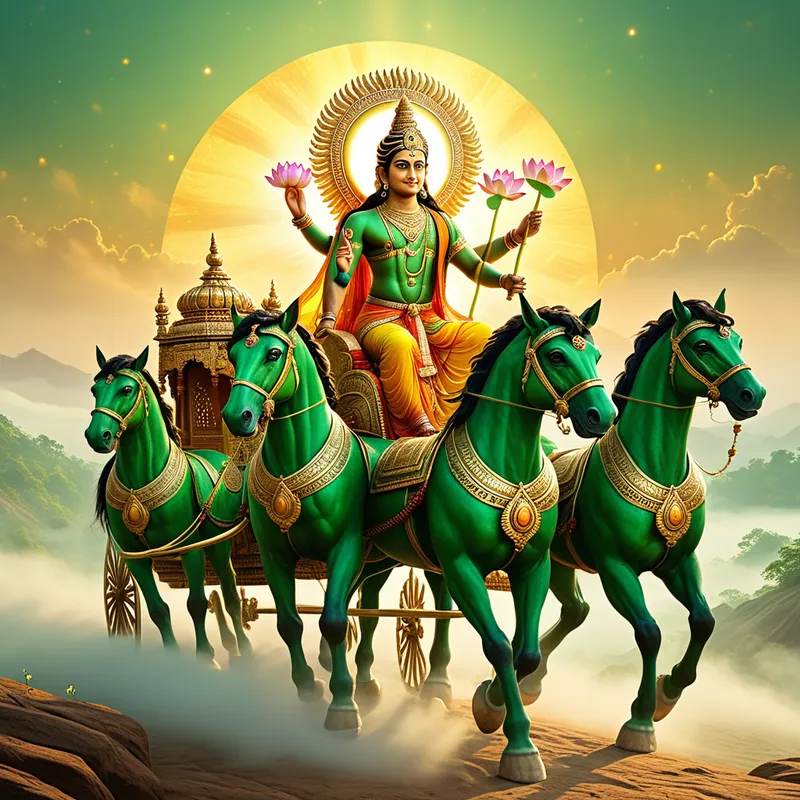
A myth of the Sun God Surya, whose seven rays are personified as celestial beings, embodying the spectrum of consciousness from primal energy to enlightened wisdom.
The Tale of Surya's Rays
Before time was counted in days, there was only the great ocean of potential, and from it, a longing for form. Then, a sound—a golden, resonant Om—and a point of light pierced the infinite dark. This was Surya, the Awakener, born of the primordial waters. He did not simply shine; he poured himself forth.
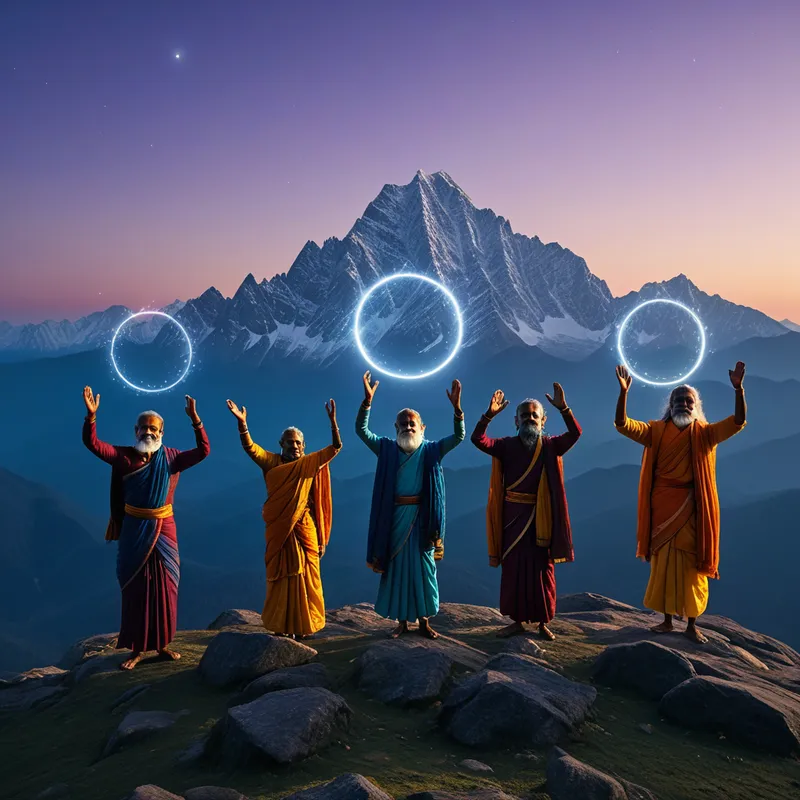
His light was not a single thing, but a symphony. From his very essence streamed seven rivers of radiance, each a distinct power, each a living intelligence. They were the Saptarishis: Angiras, Atri, Bhrigu, Gautama, Kashyapa, Vasishtha, and the great Marichi, the first spark. These were not old men with beards, but vibrant, celestial beings, his very children born of light.
Surya mounted his chariot, a blazing vessel of truth, and harnessed to it seven horses the color of emerald dawn, representing the seven days of the week, the seven musical notes. His charioteer was Aruna, the ruddy one, born without legs so he would never abandon his post. And so the journey began—not across a mere sky, but across the canvas of consciousness itself.
Each dawn was a birth. Surya’s rays, his Saptarishis, would reach down like luminous fingers. They touched the sleeping earth, and where they landed, knowledge sprouted. One ray taught the rhythm of the seasons, another the structure of sacrifice, another the laws of justice, another the secrets of healing herbs. One ignited the inner fire of aspiration, another cooled the mind for meditation, and the central ray, Marichi’s light, offered direct perception of reality, unclouded and pure.
But the light was too fierce, too total. Its undifferentiated glory scorched the worlds. The gods and creatures cried out, overwhelmed by this raw truth. Hearing their lament, the divine craftsman, Vishvakarma, took up his tools. He did not dim Surya, for that was impossible. Instead, he performed a sacred alchemy upon the light itself. With a celestial chisel, he faceted the sun.
He ground away the excess radiance, the blinding totality, and from the luminous dust that fell, he forged the discus of Vishnu, the trident of Shiva, and the weapons of all the gods. Surya, now refined, shone with a bearable brilliance. His seven rays remained, but they were now tempered—still potent, still the source of all life and law, but filtered through the prism of divine craftsmanship. They could nourish without destroying, illuminate without blinding, guide the seeker step by step from the darkness of ignorance to the dawn of wisdom. And so, Surya rides eternally, his faceted light a daily promise: that even the ultimate truth arrives in portions we can comprehend and embody.
Cultural Origins & Context
The myth of Surya and his rays is woven into the earliest strands of Vedic tradition. He is Savitar, the impeller, and Surya, the visible orb, invoked in hymns of the Rigveda for dispelling darkness, both literal and metaphorical. This was not merely nature worship; it was a sophisticated cosmological model. The sun was the palpable heart of the cosmos, the regulator of time (rita), and the witness to all actions.
The elaboration of the seven rays into the Saptarishis occurs in the Puranas, where mythopoetic imagination flourishes. The Saptarishis are the mind-born sons of Brahma, yet they draw their power and authority from Surya. They are the perennial custodians of dharma, the progenitors of human lineages, and the stars of the Ursa Major constellation, eternally circling the celestial pole (symbolized by the star Dhruva).
This myth functioned on multiple societal levels. For the priest, it encoded the structure of ritual. For the astronomer-astrologer, it mapped the heavens. For the king, Surya was the model of the ideal ruler—dispensing justice (light) equally to all. For the common individual, the daily sunrise was a personal ritual, a reminder that consciousness itself is a spectrum of divine energies available for integration. The story was passed down through temple sculptures, classical dance (Bharatanatyam mudras depict the rays), and the oral recitations of pandits and grandmothers, ensuring its light permeated every layer of culture.
Symbolic Architecture
At its core, this myth is a profound map of consciousness emanating from a unified source. Surya represents the Atman or the light of pure awareness—undifferentiated, omnipresent, and the fundamental ground of being.
The One does not simply exist; it must differentiate itself to know itself. Creation is the Sun casting its shadow in seven colors.
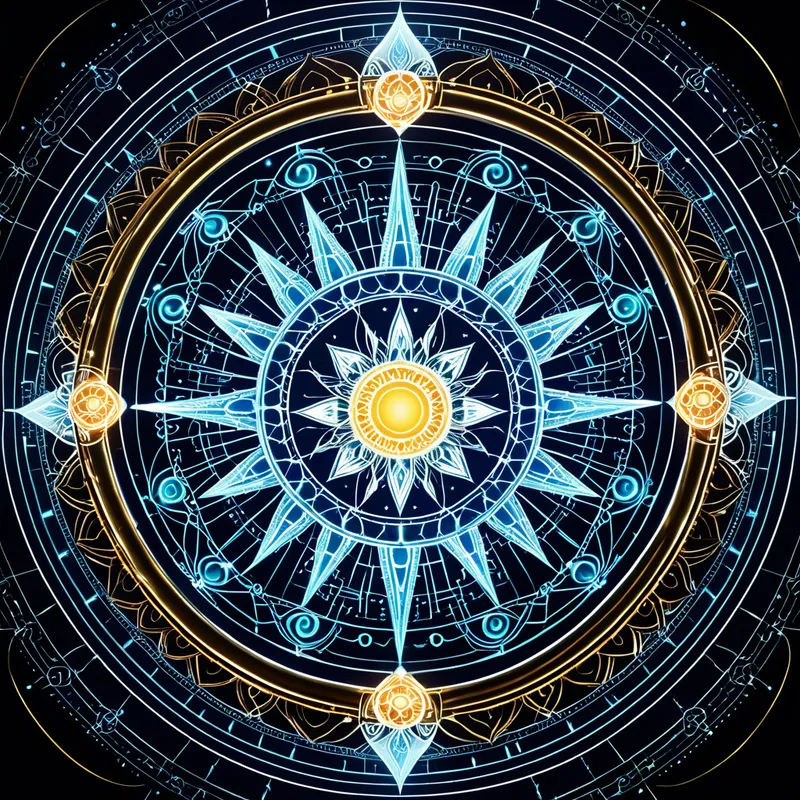
The seven rays are the archetypal faculties of this cosmic mind. They are not just sages; they are the spectrum of human potential: the ray of law and structure (Angiras), of desire and relational magic (Atri), of foundational wisdom and patience (Bhrigu), of illumination and mental clarity (Gautama), of generative power and expansion (Kashyapa), of deep contemplation and ancestral memory (Vasishtha), and the central ray of pure, penetrating insight (Marichi). Together, they constitute a complete psychic system.
The "scorching" of the worlds by Surya’s untempered light is a critical psychological truth. The unmediated light of the Self, of absolute truth, is unbearable to the unprepared ego. It incinerates complexity, nuance, and the necessary shadows that give life depth. Vishvakarma’s act of faceting is the act of culture, of psyche, of individuation—creating filters (persona, cognitive functions, artistic mediums) through which the blinding totality of the Self can be safely translated into usable knowledge, beauty, and ethical action.
The Dreamer's Resonance
When this myth stirs in the modern unconscious, it often manifests not as a clear narrative, but as a somatic or imagistic pattern. To dream of a blinding light from which one must shield their eyes speaks to an encounter with a truth or a facet of the Self that the ego is not yet ready to integrate. There is awe, but also terror.
Dreams of prisms, crystals, or stained-glass windows fracturing a single light source directly mirror Vishvakarma’s work. The dreamer is in the process of "faceting"—differentiating a overwhelming emotional truth, a traumatic memory, or a potent creative impulse into manageable, comprehensible components. A dream where one’s shadow splits into several colored versions, as in the image prompt, indicates a state of psychic fragmentation, where dissociated aspects of the personality (the rays) have broken away from the central source of consciousness.
Conversely, dreaming of successfully focusing scattered beams of light into a single point signals a movement toward synthesis. The somatic experience can be one of intense heat or a feeling of being "lit up" from within—a sign of psychic energy (libido) being mobilized and directed by a central, solar purpose.

Alchemical Translation
The journey of Surya’s Rays models the alchemical opus of individuation: from the massa confusa of undifferentiated consciousness to the ordered, radiant lapis philosophorum.
The goal is not to stare directly at the sun, but to learn to see by its light. Individuation is the crafting of the inner prism.
We begin in a state where the light of the Self is obscured or manifests as chaotic, scorching impulses—raw anger, undirected passion, paralyzing enlightenment. This is the untempered Surya. The first stage of the work (nigredo) is acknowledging this scorching, the ways our undigested totality burns ourselves and others.
The seven rays represent the stage of separatio and multiplicatio. Here, we must differentiate the mass of our psyche. Which "ray" or faculty have we over-identified with? Are we only the ray of stern law (Angiras), neglecting the ray of compassionate desire (Atri)? Have we lost our central ray of insight (Marichi) in the noise of the others? Psychological work—therapy, art, meditation—is the process of identifying and honoring each distinct beam of our potential.
Vishvakarma’s faceting is the stage of coagulatio—giving solid, beautiful form to this differentiated light. This is where we craft our unique expression: our work, our relationships, our art, our ethical stance. We become the charioteer (Aruna) of our own harnessed energies (the seven horses), guiding them across the sky of our life in a disciplined, daily rhythm.
Finally, the myth promises not a dissolution of the rays, but their harmonious operation under the aegis of the central sun. The integrated individual does not become a featureless blaze. They become a spectrum. They can apply the precise quality of light needed—the warmth of Kashyapa for nurturing, the sharp clarity of Gautama for analysis, the deep coolness of Vasishtha for reflection. They ride their own chariot, a beacon of ordered, benevolent power, illuminating their world not with a blinding glare, but with the wise, multifaceted radiance of a consciousness that has learned to hold the sun within.
Associated Symbols
Explore related symbols from the CaleaDream lexicon: