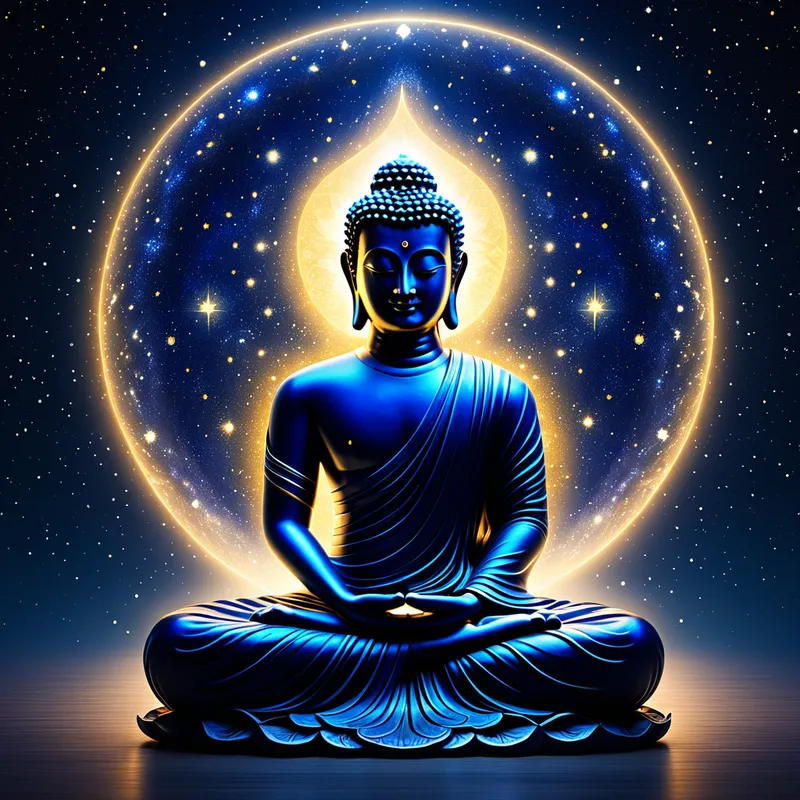
Sunyata Myth Meaning & Symbolism
The myth of Sunyata reveals the luminous void from which all reality arises, a sacred emptiness that is the source and substance of all things.
The Tale of Sunyata
Listen, and let the world around you soften at the edges. Let the solid ground beneath your feet become a question. This is not a story of something, but of the ground from which all somethings arise.
In a time before time was measured, the Tathagata sat beneath the Bodhi tree. The armies of Mara had fallen silent, their illusions of fear and desire scattered like dust. But the greatest battle was just beginning—a battle not against form, but for the truth behind it.
The night was deep, a velvet bowl holding the last stars. The air itself seemed to hold its breath. The Tathagata turned his attention inward, past the river of thoughts, beyond the mountain of sensations, diving into the very nature of perception. He saw the world as it was taught: a tapestry of separate things—the tree, the river, the self, the other. Each thread seemed strong, distinct. But he followed a single thread, the thread of "tree." He saw it was not a thing, but a coming-together. It was earth, water, sunlight, and time. It was the seed that was not a tree, and the decay that would return it to non-tree. Where, in this flowing, was the permanent, independent "tree-ness"? He searched and found only relationships, only causes and conditions dancing in a ceaseless, dependent chain.
A profound quiet, vaster than any silence he had known, opened within him. This was not a blank nothingness, not a nihilistic void. It was a luminous, pregnant absence. It was like the empty space in a vessel that makes it useful, like the silence between musical notes that shapes the melody. He saw that every single phenomenon—the feeling of his breath, the memory of his palace, the concept of enlightenment itself—shared this same nature. They were all empty of a separate, enduring self. This emptiness was not their negation, but their very reality. It was their liberation.
In that moment, the Three Poisons dissolved not because he fought them, but because he saw their essential insubstantiality. The knot of self, pulled so tight for so many lifetimes, simply loosened and fell away. What remained was not a new, better self, but the clear, open sky of Sunyata. And from that sky, compassion rained down naturally, effortlessly, for he saw all beings trapped in the same dream of solidity, yearning for a freedom that was already their true face.
The dawn that broke was not like any other. The light did not fall upon the world; it seemed to emanate from within all things. The Tathagata did not move, yet the entire universe turned within that luminous, empty cup.

Cultural Origins & Context
The mythic realization of Sunyata is the heartwood of the Prajnaparamita literature, which began to emerge in India around the 1st century BCE. This was not a folk tale told around fires, but a radical philosophical and contemplative insight transmitted from teacher to disciple in monastic universities like Nalanda. Its primary "storytellers" were the sutras themselves—texts like the Heart Sutra and the Diamond Sutra—which use potent, paradoxical poetry to point the mind beyond concepts.
Its societal function was revolutionary. While early Buddhist teachings focused on the self’s suffering, the doctrine of Sunyata applied that same analysis of insubstantiality to everything. It dismantled not just the personal ego, but any possible object of clinging, including doctrinal concepts themselves. This created a profound intellectual and spiritual framework that allowed <abbr title="The "Great Vehicle" branch of Buddhism">Mahayana Buddhism to develop its vast pantheon of bodhisattvas and its elaborate philosophies, all while repeatedly reminding practitioners that these, too, were "empty," skillful means rather than ultimate truths. It was the ultimate safeguard against dogmatism, a myth that deconstructed myth-making itself.
Symbolic Architecture
Sunyata is the ultimate symbol of groundlessness, the death of the illusion of separation. It represents the psychological truth that our sense of a solid, continuous, and independent self is a constructed narrative, a compilation of memories, sensations, and thoughts with no central commander.
Sunyata is not the absence of things, but the presence of their true, interdependent nature. It is the space that allows relationship to exist.
The Bodhi tree symbolizes the axis of this realization—the point where the relative world of form and the absolute ground of emptiness meet. The defeat of Mara represents the initial quieting of gross projections and desires, but Sunyata is the dissolution of the very projector. The dawn that follows is not an acquisition of light, but the recognition that the light of awareness was never obscured, only misidentified.
Psychologically, Sunyata symbolizes the void one encounters when deconstructing the persona—the adapted mask of the ego. It is the terrifying yet necessary encounter with the non-self, the prerequisite for contacting the deeper, transpersonal layers of the psyche, what Jung might call the collective unconscious or the Self. It is the "creative void" from which genuine renewal and individuation can spring.
The Dreamer's Resonance
When this mythic pattern stirs in the modern dreamer, it often manifests as dreams of dissolution or profound transformation of the personal environment. One may dream of their childhood home crumbling into sand, of their own face becoming indistinct in a mirror, or of familiar city streets suddenly opening into boundless, empty landscapes. These are not nightmares of annihilation, but somatic portrayals of the psyche's readiness to let go of outworn structures of identity.
The psychological process is one of de-integration. The conscious ego, which typically works to maintain a coherent and bounded sense of self, is temporarily allowing a deeper process to unwind that cohesion. The body in the dream may feel weightless, anxious, or eerily calm. This resonance occurs at life thresholds—after a great loss, at the end of a major career chapter, or during deep therapy—when the psyche intuits that the old container of "who I am" is too small for the life that wants to be lived. The dream is presenting the alchemical nigredo, the darkening, not as an end, but as the fertile ground for a new, more authentic integration.

Alchemical Translation
The myth of Sunyata models the pinnacle of psychic transmutation: the stage where the individual ego consciously aligns with and surrenders to the larger, transpersonal Self. The alchemical journey often begins with the prima materia of suffering or crisis (Mara's assault). Through the work of introspection (meditation under the tree), one analyzes and breaks down the components of their identity (the analysis of phenomena).
The alchemical gold is not found by adding something to the soul, but by subtracting the illusion that there was ever anything separate to be perfected.
The encounter with Sunyata is the experience of the solutio—the dissolving of all solidified elements back into the original fluid state. This is not a regression, but a return to source. For the modern individual, this translates to the courageous work of shadow integration and relinquishing identification with achievements, roles, and even cherished self-concepts like "the healed one" or "the spiritual seeker."
The triumph is not a new, more spiritual ego, but a capacity to hold identity lightly—to participate fully in life's forms while knowing their essential emptiness. This is the birth of authentic compassion, as one sees the same struggle for solidity in others. The individual becomes like the Tathagata at dawn: a clear, open space through which the world can manifest, love can flow, and life can play its infinite, ephemeral game, no longer mistaken for a prison of separate things. The individuated Self is not a bigger ego, but the conscious embodiment of that very emptiness, fully engaged with the world.
Associated Symbols
Explore related symbols from the CaleaDream lexicon: