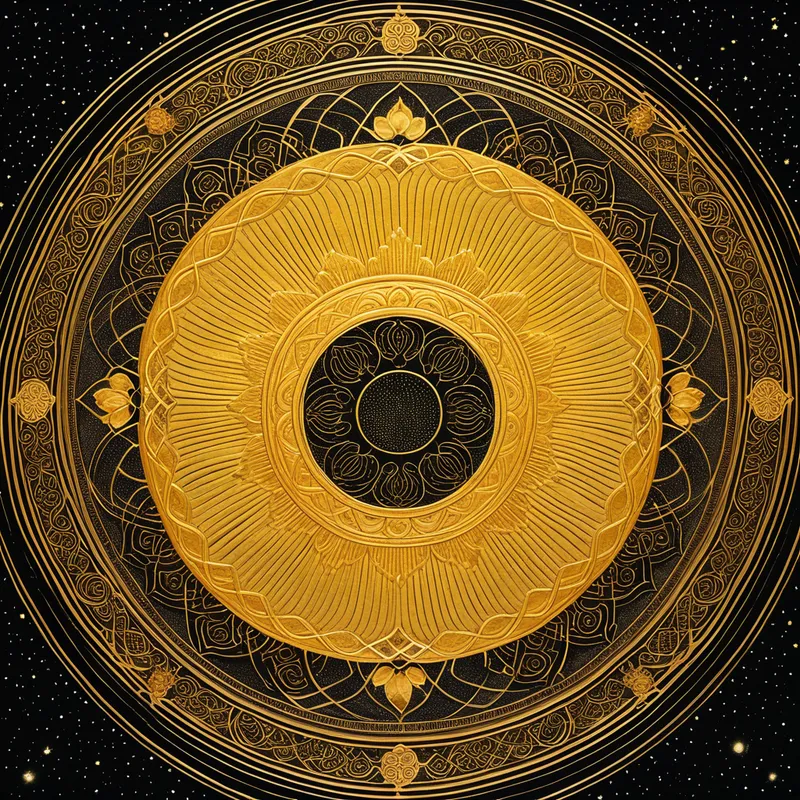
Sunyata / Wu Myth Meaning & Symbolism
The myth of the ultimate reality that is not a thing, but the pregnant, luminous emptiness from which all form and consciousness arise and return.
The Tale of Sunyata / Wu
Listen. There is a story that is not a story, for it has no beginning. It speaks of a truth that is not a truth, for it cannot be held. It is the whisper in the silence before the first word was ever spoken.
In the age when sages walked the earth and kings sought the Dao, there was a seeker named Vimala. Her mind was a cage of brilliant birds—thoughts of past and future, names and forms, desires and fears. They chattered endlessly, and in their noise, she felt a profound loneliness, a thirst for a home she could not name. She left her village and climbed the high, mist-wrapped mountains, seeking the hermits who were said to know the nature of reality.
She found an old master sitting by a waterfall that made no sound. “Master,” she implored, her voice trembling with earnest need. “Tell me of the ultimate reality. Describe the Dharma to me. Give me something to hold.”
The master said nothing. He simply pointed to the sky. Vimala looked up and saw a cloud, white and full, drifting. “It is like that cloud,” she thought, “beautiful and transient.” But as she watched, the cloud thinned, stretched, and vanished into the clear, blue expanse. There was no trace. The sky did not celebrate its arrival nor mourn its departure. The sky was simply… sky.
A deep unease settled in her. “But the cloud is gone. Where did it go? What is the sky, if not empty?”
The master then led her to a still pond. “Look,” he said. In the water, she saw the perfect reflection of the mountain, the trees, her own anxious face. It was all there, vivid and real. Then the master tossed a single pebble. The image shattered into a thousand dancing fragments of light and color before slowly, slowly settling back into perfect, mirror-like stillness. The mountain was still the mountain. Her face was still her face. But the pond was unchanged in its depth.
Years passed. Vimala sat in meditation until her bones knew the stone and her breath became the wind. One night, in the deepest watch, the chattering of her mind-birds ceased. Not through force, but through a final, gentle exhaustion. In that cessation, there was no “her” left to observe the silence. The cage itself dissolved. There was no inside, no outside. No seeker, no found thing. No full, no empty.
It was a luminous, pregnant absence. A vibrant nothingness that was not dead, but supremely alive—the silent source of all sound, the invisible canvas of all sight. It was the Sunyata of the Buddhadharma, the Wu of the Daodejing. In that non-state, the waterfall roared with a silence that filled the universe. The mountain was no longer an object “out there,” but a temporary dance of the same formless essence. She had not found an answer. She had dissolved into the question itself.
And when the morning birds sang, their song arose from that silence, and returned to it, and was made of it. Vimala smiled, a smile that belonged to no one. The story ends here, which is to say, it never truly began.
Cultural Origins & Context
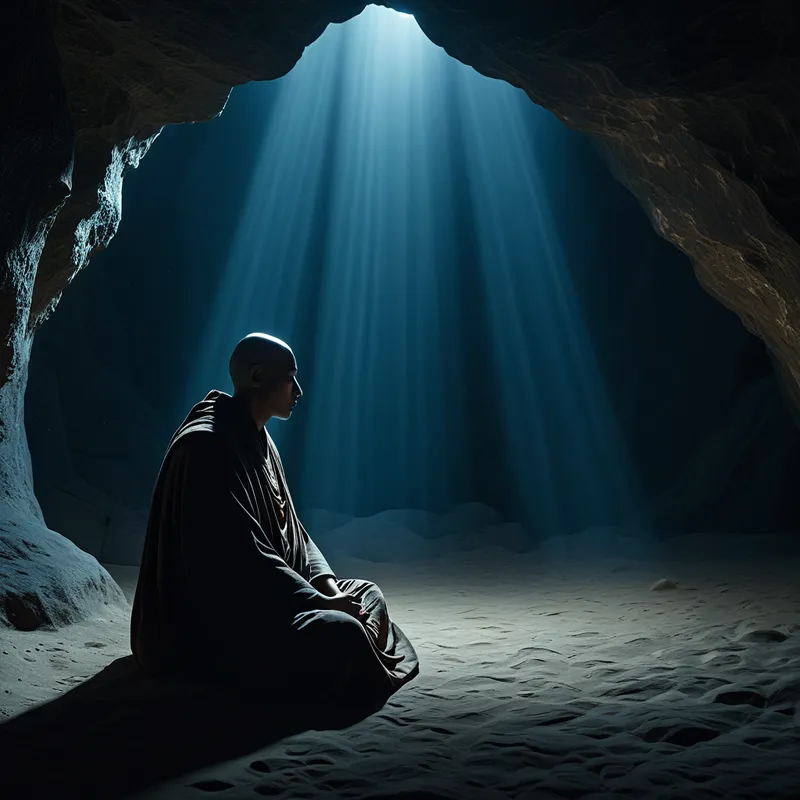
This is not a myth with a single author or a linear plot, but the foundational atmosphere of two great wisdom streams that converged in China. The concept of Sunyata is the heart of the Prajnaparamita literature, crystallized in texts like the Heart Sutra, which famously declares “form is emptiness, emptiness is form.” It was taught not as a philosophical idea, but as a direct meditative insight to deconstruct the inherent solidity of perceived reality.
Simultaneously, in the native Daoist tradition, Wu was the nameless origin of the Dao. The Daodejing opens with it: “The Dao that can be spoken is not the eternal Dao.” It described the fertile void of the uncarved block, the hollow of the pot that makes it useful, the space within the wheel hub that allows it to turn.
When Buddhism traveled the Silk Road to China, Sunyata found a profound resonance with Wu. This fusion, particularly in schools like Chan, created a unique cultural and psychological container. The myth was passed down not in epic poems, but in koans, in landscape paintings where vast emptiness dominated the scroll, in the architectural space of temples, and in the direct, wordless transmission between master and disciple. Its societal function was radical liberation: to free the individual from the suffering born of clinging to fixed identities and rigid perceptions of a solid world.
Symbolic Architecture
The myth’s symbols are not objects, but relationships and negations. The cloud vanishing into the sky symbolizes all conditioned phenomena—thoughts, emotions, the self itself—arising from and returning to the unconditioned ground. The sky is not passive; it is the allowing, the space that makes manifestation possible.
The pond and the reflection is the core paradox. The world of form (the reflection) is utterly real in its appearance, yet has no independent, permanent substance apart from the nature of the water (emptiness). The pebble’s ripple is pratityasamutpada, the interdependent arising of all things. The stillness that remains is the suchness of Sunyata.
The ultimate symbol is the dissolved cage. The seeker does not transcend the world; the illusion of a separate seeker unmakes itself, revealing that one was never confined to begin with. This is the psychological representation of the death of the ego—not as a violent annihilation, but as the realization of a fundamental misperception.
The entire narrative arc moves from thirst (the suffering of separation), through unease (the shattering of comfortable beliefs), into exhaustion (the surrender of the ego’s project), culminating in luminous absence (the true nature of mind). It maps the journey from psychological contraction to boundless, aware space.

The Dreamer's Resonance
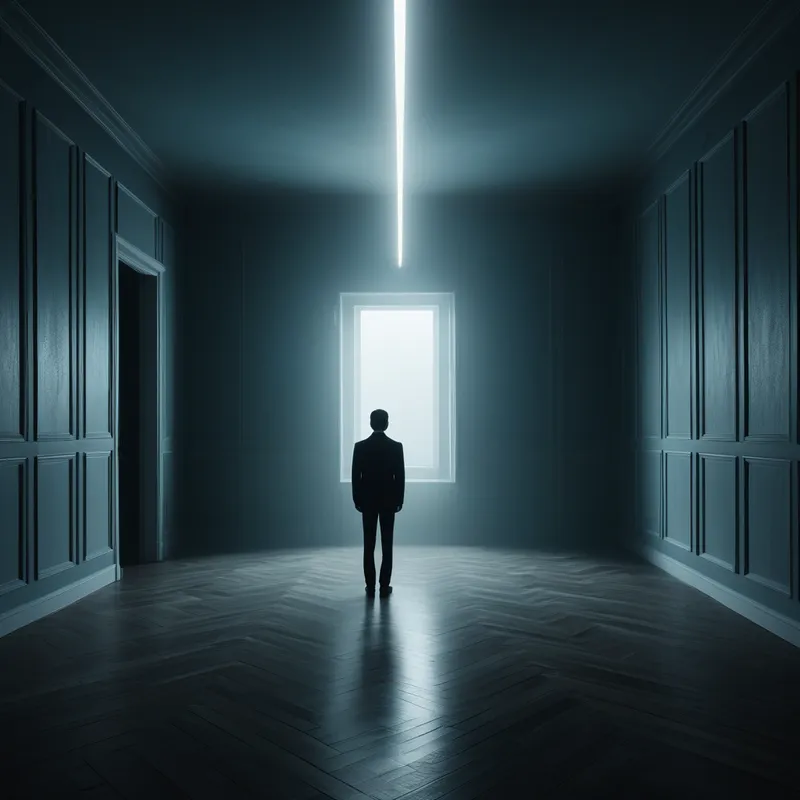
When this myth stirs in the modern unconscious, it often manifests in dreams of profound spatial and structural transformation. To dream of a familiar room where the walls become transparent, dissolve, or reveal infinite depth is to feel the psyche’s rigid boundaries—our identities, beliefs, and self-narratives—becoming permeable. There is often awe, but also a tinge of existential terror: “If these walls go, what am I?”
Dreams of watching a cherished object, a photograph, or even one’s own body gently fade into mist or light point to the psyche processing the insubstantial nature of what we hold as solid and permanent. This is not a nightmare of loss, but often a serene, if unsettling, unraveling.
Conversely, dreams of a vast, silent, dark space that is deeply peaceful and inviting, or of being a point of awareness floating in a void that feels like home, signal a somatic integration of this emptiness. The body-mind is learning to rest in the ground of being, prior to story. The dreamer is not going through a process of acquiring something, but of relinquishing the habitual stance of being a solid someone facing a solid world. It is the dreamwork of deconstruction.
Alchemical Translation
For the modern individual pursuing individuation, the myth of Sunyata/Wu models the most radical stage of psychic transmutation: the alchemy of dissolution. Our psychological development often begins with building a strong ego (the cage). The alchemical journey then involves confronting the Shadow and integrating anima/animus (meeting the master, hearing the paradoxical teachings). But the ultimate stage is the coniunctio with the Self, which is not a bigger, better ego, but a state where the ego-complex is seen through.
This is the alchemical solve: not just solving a problem, but dissolving the very solvent. The lead of our grasping, anxious, story-bound identity is not turned into gold; it is revealed to have been gold all along, once the illusion of its separateness is burned away in the fire of insight.
The practical translation is in the cultivation of psychic space. When gripped by a powerful emotion—rage, grief, desire—the practice is not to identify with it (“I am angry”) nor to repress it (“I shouldn’t feel this”). It is to become the sky to the cloud, the pond to the reflection: to allow the feeling its full, temporary manifestation while resting in the aware, empty space that witnesses it. This space is not indifference; it is the profound intimacy that allows all things to be as they are.
The triumph in the myth is the end of the search. The individual is not perfected, but perfectly ordinary, because everything—the joy, the sorrow, the washing of bowls—is seen as the miraculous play of the formless Dao, the luminous display of Sunyata. The transmutation is complete when one lives from the hollow of the pot, useful and empty, turning freely because one is nothing in particular, and thus, potentially everything.
Associated Symbols
Explore related symbols from the CaleaDream lexicon: