Suleiman and the Wind Myth Meaning & Symbolism
A king commands the wind, only to learn that true sovereignty lies not in dominion, but in listening to the wisdom of the invisible world.
The Tale of Suleiman and the Wind
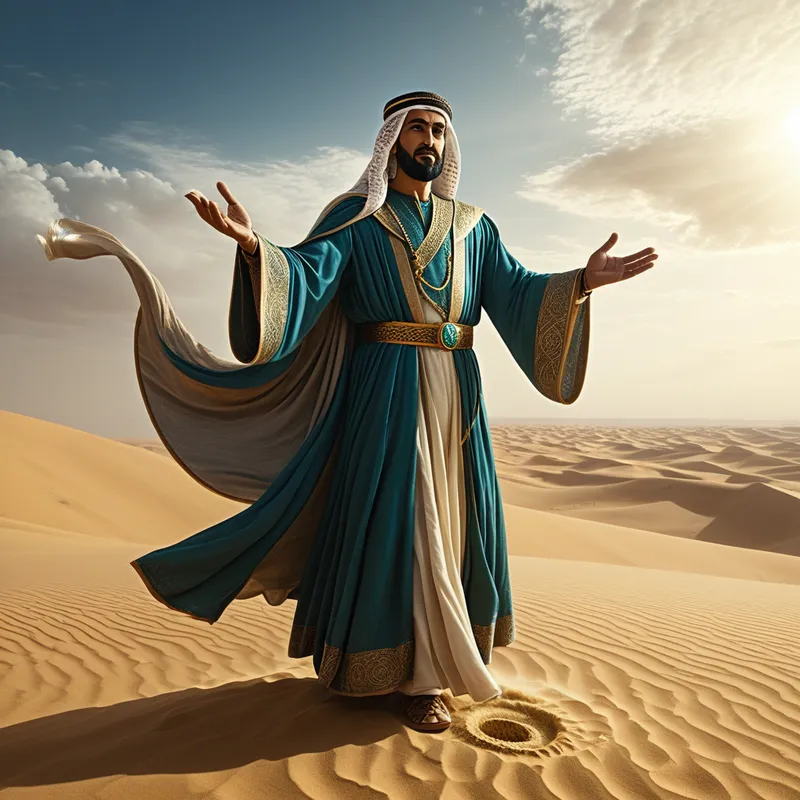
Hear now a tale from the time when the world was younger, and the veil between the seen and the unseen was thin as a spider’s silk. In an age of mighty kings, there reigned Suleiman ibn Dawood, upon whom be peace. His throne was carved from cedar and inlaid with pearls from the deep. His ring, a band of iron and brass, bore the Ism al-A’zam, and with it he commanded the tongues of beasts, the obedience of the jinn, and the very forces of nature.
Yet, one force remained elusive, a whisper at the edge of his vast dominion: the Wind.
It was not that the Wind disobeyed. When Suleiman raised his ring and spoke, great gales would lift his magnificent flying carpet, carrying his court across continents between dawn and dusk. Breezes would cool his palace in the blistering heat. But Suleiman sensed a reserve in this servant, a depth of being that his commands merely skimmed, like a stone across a boundless ocean. The Wind obeyed, but did it listen? Did it consent?
A restlessness grew in the king’s heart, a ruler’s itch for a sovereignty not just of action, but of essence. He summoned his vizier, Asif ibn Barkhiya, and declared, “I would have audience with the Wind itself. Not its service, but its presence. I would look upon the face of this invisible one.”
Asif, his face grave, warned of the pride in such a demand. “The Wind is a messenger of the Divine, a being of pure Ruh. To command its form is to command a secret of creation.” But Suleiman’s will was fixed. He ascended to the highest terrace of his palace, where the air was thin and the stars seemed close enough to pluck. He raised the ring, not in a shout of command, but with a focused intensity of will that vibrated through the very atoms of the air.
“By the permission of the Most High, I bid you: appear.”
The world held its breath. Then, a sigh arose from the four corners of the earth. It grew from a sigh to a hum, from a hum to a roar. The sand of the desert below began to spiral, not in chaos, but with terrifying intelligence. The clouds tore themselves apart and re-knit. And there, before the king, the air itself coalesced. It did not form a human face, but something vaster and more ancient—a swirling, intelligent vortex of dust and light, with eyes like calm centers within the storm. This was the Wind, not as a force, but as a Being.
A voice spoke, not in ears, but in the marrow of bones and the roots of mountains. “You have called, O Suleiman. And I have come. Not by your command, but by the ancient covenant that binds all creation. What would you have of me?”
Suleiman, his royal composure shaken by the raw presence before him, found his question had changed. The desire to impose his form upon it evaporated. Instead, a deeper curiosity, the root of his wisdom, surfaced. “I would know… what is it that you desire?”
A profound silence emanated from the swirling entity. It was a silence filled with the music of planetary orbits and the rustle of leaves on every tree. “I desire what I have always desired,” the Wind responded. “To be heard. Not commanded. To carry seeds to barren land, whispers between lovers, the scent of rain to the parched earth, and the prayers of the humble to the heavens. My purpose is connection, not conveyance. You command my body, but have you ever heard my soul?”
In that moment, Suleiman’s kingship transformed. He lowered his ring. He closed his eyes, and for the first time, he simply listened. He heard in the Wind’s presence the grief of eroded mountains, the joy of sails finding purchase, the eternal story told from dune to forest. He did not command it to depart. He thanked it, and the great Being dissolved back into the world, not as a servant dismissed, but as a sovereign acknowledged.
From that day, the Wind did not merely serve Suleiman; it collaborated with him. His journeys became swifter, his wisdom deeper, for he had learned that the greatest power does not silence the world, but listens to its countless, whispering voices.
Cultural Origins & Context
This narrative is woven from threads found in the Qur’an, classical Hadith, and the rich tapestry of Qisas al-Anbiya (Stories of the Prophets). It is not a single, canonical tale but a thematic constellation that coalesced around the figure of Prophet Suleiman (Solomon), a paragon of divinely granted wisdom and authority.
Told by storytellers (al-hakawati) in market squares and by scholars in contemplative circles, the story functioned on multiple levels. On the surface, it affirmed Suleiman’s unique status as a prophet-king. On a societal level, it served as a profound lesson for rulers: that true authority is stewardship, not tyranny; it requires listening to the needs and essence of what one governs—be it a kingdom, a family, or one’s own soul. The myth acted as a check against the intoxication of absolute power, embedding the idea that even the greatest sovereign answers to a higher order and must engage in respectful dialogue with the forces of the world, not merely exploit them.
Symbolic Architecture
At its core, the myth is an alchemical [drama](/symbols/drama “Symbol: Drama signifies narratives, emotional expression, and the exploration of human experiences.”/) of the Ruler [Archetype](/symbols/archetype “Symbol: A universal, primordial pattern or prototype in the collective unconscious that shapes human experience, behavior, and creative expression.”/) encountering its own [shadow](/symbols/shadow “Symbol: The ‘shadow’ embodies the unconscious, repressed aspects of the self and often represents fears or hidden emotions.”/) and potential. Suleiman represents the conscious will, [structure](/symbols/structure “Symbol: Structure in dreams often symbolizes stability, organization, and the framework of one’s life, reflecting how one perceives their environment and personal life.”/), and order—the Logos. The Wind represents the unconscious, the animating [spirit](/symbols/spirit “Symbol: Spirit symbolizes the essence of life, vitality, and the spiritual journey of the individual.”/), the invisible connective [tissue](/symbols/tissue “Symbol: Represents emotional release, vulnerability, and the delicate nature of feelings or physical fragility.”/) of [life](/symbols/life “Symbol: The symbol of ‘Life’ represents a journey of growth, interconnectedness, and existential meaning, encompassing both the joys and challenges that define human experience.”/)—the Eros.
The ultimate test of power is not what it can command, but what it is willing to hear.
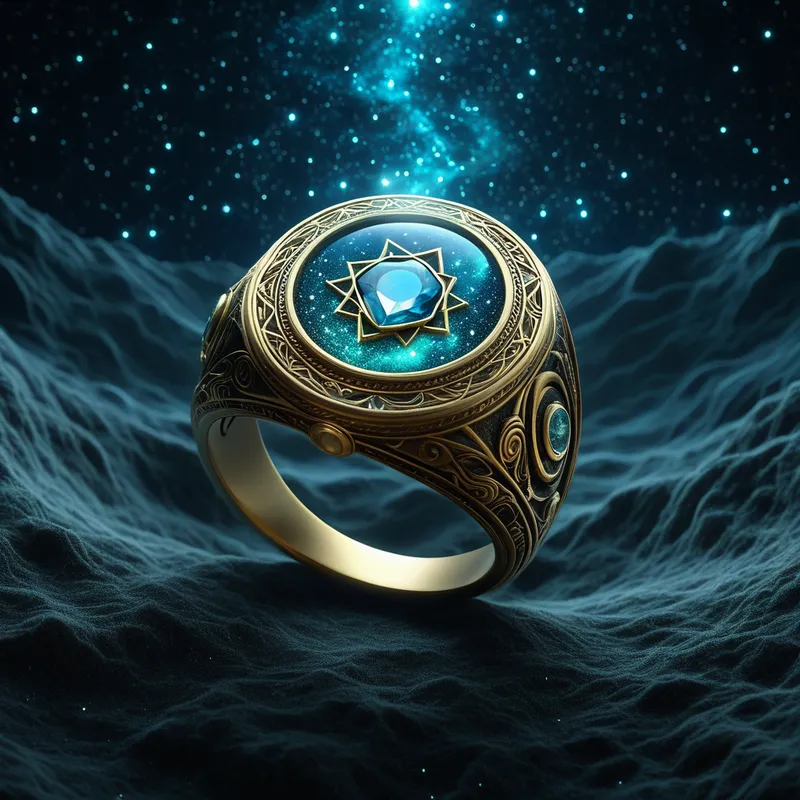
Suleiman’s ring, the Khatam Suleiman, is the [symbol](/symbols/symbol “Symbol: A symbol can represent an idea, concept, or belief, serving as a powerful tool for communication and understanding.”/) of directed [consciousness](/symbols/consciousness “Symbol: Consciousness represents the state of awareness and perception, encompassing thoughts, feelings, and experiences.”/) and magical will. It can compel [action](/symbols/action “Symbol: Action in dreams represents the drive for agency, motivation, and the ability to take control of situations in waking life.”/), but initially, it cannot foster [relationship](/symbols/relationship “Symbol: A representation of connections we have with others in our lives, often reflecting our emotional state.”/). The Wind’s refusal to fully reveal itself except on its own terms symbolizes the autonomy of the unconscious; it cannot be forced to yield its secrets through brute command, only invited through respectful inquiry. The [king](/symbols/king “Symbol: A symbol of ultimate authority, leadership, and societal order, often representing the dreamer’s inner power or external control figures.”/)’s pivotal shift from demanding an “[audience](/symbols/audience “Symbol: An audience in a dream often symbolizes the need for validation, recognition, or the desire to perform.”/)” to asking “what do you desire?” marks the [moment](/symbols/moment “Symbol: The symbol of a ‘moment’ embodies the significance of transient experiences that encapsulate emotional depth or pivotal transformations in life.”/) the ego stops projecting its will onto the world and begins to engage in a genuine [dialogue](/symbols/dialogue “Symbol: Conversation or exchange between characters, representing communication, relationships, and narrative flow in games and leisure activities.”/) with the Other.
The Dreamer’s Resonance
When this myth stirs in the modern psyche, it often manifests in dreams of immense but frustrating power. You may dream of having a remote control that only partially works, of shouting orders that are misinterpreted, or of driving a magnificent vehicle that refuses to go where you steer it. These are somatic expressions of the Tyrant’s frustration.
The psyche is signaling that a part of the self—perhaps your intellect, your willpower, your managerial persona—has become over-extended and is trying to govern aspects of life (emotions, creativity, relationships, the body) that do not respond to command. The “Wind” in your dream might be a rushing feeling you can’t contain, a voice in the dream you can’t make speak, or a chaotic yet beautiful landscape you cannot map. The dream invites a somatic shift: from clenching to releasing, from shouting to listening, from directing to feeling the direction of an inner current.
Alchemical Translation
The journey of Suleiman models the individuation process for anyone who identifies strongly with the role of the capable one, the leader, the one in control. The first stage is the inflation of the King/Queen Complex: “I have the ring, therefore I command my inner and outer world.” This leads to a subtle alienation, a loneliness at the peak of one’s power.
The crisis is the confrontation with the autonomous spirit (the Wind), which represents all that has been excluded for the sake of control: wild intuition, raw emotion, organic timing, and the soul’s own mysterious purposes. The alchemical mortificatio is Suleiman’s humbling before the vortex—the death of the tyrant’s illusion.
Individuation is not the ego’s conquest of the self, but its graceful abdication from totalitarian rule, making space for a council of inner voices.
The transformation (transmutatio) is the shift from a monarchy of the ego to a sovereignty of the Self. The ring is not discarded; its power is redeemed. It becomes a tool not for command, but for covenant. The conscious will (Suleiman) and the animating spirit (the Wind) enter into partnership. In the individual, this translates to a life where discipline serves intuition, where plans are flexible enough to accommodate inspiration, and where one’s authority in the world flows from a deep, listening communion with one’s own inner wilderness and the unseen currents of life.
Associated Symbols
Explore related symbols from the CaleaDream lexicon:
- Wind — The central symbol of the invisible, animating spirit, the messenger between realms, and the autonomous force of the unconscious that cannot be controlled, only communed with.
- Crown — Represents the archetype of the Ruler, the burden and authority of conscious ego, and the potential for that authority to become either tyrannical or wise and receptive.
- Ring — Symbolizes the seal of identity, willpower, and conscious command; the tool that mediates between the human and the unseen, capable of both compulsion and covenant.
- Whispering in the Wind — Embodies the myth’s core lesson: that truth and guidance often come not as clear commands, but as subtle hints, intuitions, and messages that require deep listening to perceive.
- Journey — Reflects Suleiman’s inner voyage from a state of imperial control to one of collaborative sovereignty, a necessary pilgrimage for the powerful soul.
- Sky — Represents the boundless realm of spirit, possibility, and the divine order to which even the greatest king must ultimately listen and submit.
- Order — Signifies the initial, rigid structure of the ego’s kingdom, which must be softened and made permeable by the chaotic wisdom of the spirit to achieve a higher, more dynamic harmony.
- Spirit — The essential nature of the Wind; the breath of life (Ruh), the connecting principle that seeks expression and relationship beyond mere function.
- Whirlwind — The manifest form of the Wind’s intelligence; a symbol of chaotic power that nonetheless has a calm, purposeful center, representing the transformative vortex of encounter with the sacred.
- Window — Represents the threshold of perception; Suleiman’s need to “see” the Wind symbolizes the ego’s desire to render the unconscious visible and manageable, a desire that transforms into simply being present at the window of listening.