Story Stones Myth Meaning & Symbolism
A myth of stones imbued with ancestral memory, teaching that true stories are not told but remembered from the bones of the earth itself.
The Tale of Story Stones
In the time before time, when the world was soft and the sky was close enough to touch, the People knew all things. The language of the wolf was their gossip, the path of the salmon their map, and the turning of the seasons was written in their blood. They lived within the story of the world, and the world lived within them. There was no separation, and so there was no need to tell a story. To know was simply to be.
But a great forgetting began to creep in, as fog creeps into a valley. It started with a whisper of fear, a question of "what if?" What if the buffalo did not return? What if the river changed its course? What if our children do not know the way? This fear was a cold wind that blew between the People, separating them from the knowing. They began to speak of things instead of living them. Their words became like dry leaves, scattering in the wind, carrying less and less of the true meaning.
The Grandmothers and Grandfathers saw this. Their hearts grew heavy, for they felt the warmth of the great story cooling. They gathered in a sacred circle as the first hard snows dusted the mountains. They prayed to Wakan Tanka, to the spirits of the earth and sky. "Our children are losing the way," they said. "Our words are becoming empty echoes. How do we hold the truth when the memory of the world is fading from our minds?"
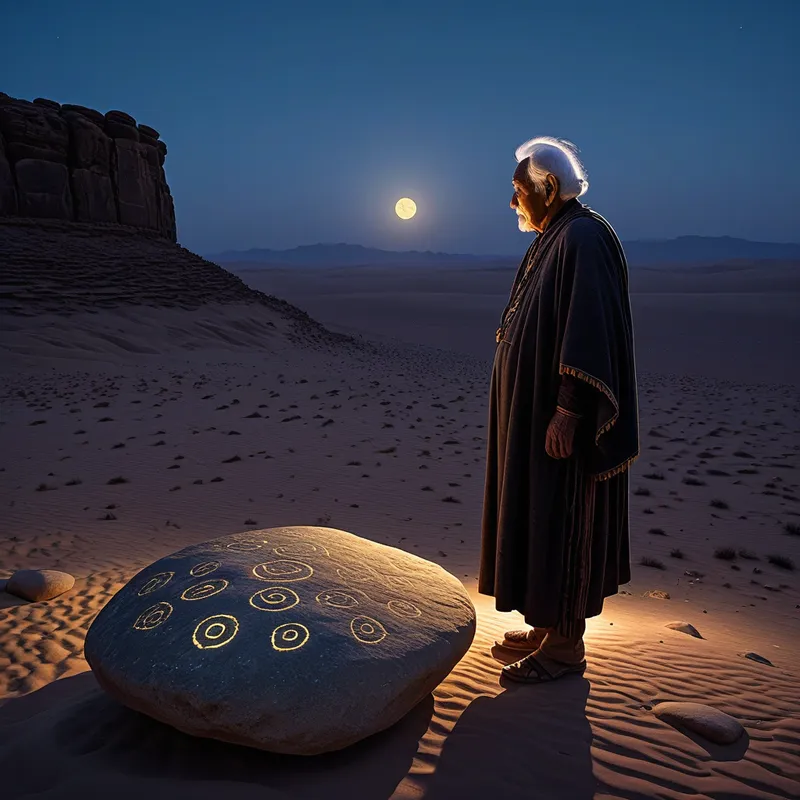
The land itself heard their sorrow. The earth beneath them trembled, not with violence, but with a deep, resonant hum, like the lowest note of a giant drum. From the circle's center, the soil parted. Not with a crack, but with a gentle sigh. And there, rising slowly, were stones. Not jagged or rough, but smooth, river-worn stones, each the size of a heart or a fist. They were dark like obsidian, yet when the starlight touched them, they seemed to hold a faint, milky light within, like a captured moonbeam.
A voice spoke, not from the air, but from the very bones of the earth. It was the voice of Unci Maka. "You have asked how to hold the truth. You have tried to hold it in your breath, which is fleeting. You have tried to hold it in your words, which are carried away. Now, you must learn to hold it in your silence, which is eternal."
"These are the Story Stones. They are the first listeners. They have heard the footfall of the first buffalo, the song of the first river, the laughter of the first child. Their patience is the patience of the mountain. Their memory is the memory of the deep earth. Speak no more about the stories. Bring your children here. Let them place their hands upon the stone. Let their skin touch what has been touched by time itself. The story is not in the telling. It is in the remembering. The stone will not speak with a tongue. It will awaken the story that sleeps in the blood."
And so it was. The People ceased their frantic telling. They brought their children to the circle of stones. A child would sit, quiet their breath, and lay a small hand upon the cool, smooth surface. They would close their eyes. And then—not in their ears, but in their very bones—they would know. They would feel the thunder of the herd, smell the pine after rain, see the face of an ancestor they had never met, yet recognized completely. The stone was a key that unlocked the memory sleeping within them. The story was not given; it was remembered. And the great forgetting was healed, not by more words, but by a deeper, older silence.

Cultural Origins & Context
The motif of stones as vessels of memory and communication is a profound thread woven through many Indigenous traditions across the North American continent. While no single, monolithic "Story Stones" myth exists verbatim, the core concept is a powerful synthesis of widespread animistic beliefs and oral history practices. For countless Nations, from the Lakota to the Coastal Salish, the land is not inert. It is a living, speaking relative.
Stories were not mere entertainment; they were the database of survival, law, ethics, and identity. Transmission was sacred. Elders were the librarians of this living knowledge. The "Story Stones" concept poetically encapsulates the method of this transmission: it is participatory, somatic, and deeply relational. The learner doesn't passively receive data; they actively engage in an act of resonant remembrance with an elder (the stone, the land, the human teacher). This myth likely arose not as a literal tale of talking rocks, but as a metaphorical teaching story used by elders to explain how true learning occurs. It instructs the listener to move beyond the surface of words and connect to the embodied, ancestral wisdom that pre-exists language. The stone represents the elder, the tradition, the land itself—all constant, patient presences waiting for the seeker to become still enough to listen with their whole being.
Symbolic Architecture
At its heart, the myth of the Story Stones is an allegory for the nature of true knowledge and the architecture of the soul. The stone is the ultimate symbol of the Self—the enduring, central core of the individual that exists outside of time and personal history.
The stone does not create the story; it contains the conditions for its remembrance. It is the silent, enduring vessel that makes the ephemeral eternal.
The "great forgetting" symbolizes the ego's emergence—the conscious mind's separation from the unconscious, collective well of knowing. Fear, doubt, and linear thinking ("what if?") create this rift. The frantic storytelling of the People represents the ego's attempt to reconstruct wholeness through intellect and language alone, which always fails, producing only "dry leaves."
The stones rising from the earth signify a return to the primordial source. They are not brought from elsewhere; they emerge from Unci Maka herself, representing wisdom that is innate, grounded, and archetypal. Their smooth, river-worn texture speaks to wisdom shaped by the flow of time and experience. The act of touching the stone is the critical symbolic gesture. It represents the ego's humble submission to and connection with the greater Self. It is a somatic, non-verbal dialogue. The memory that awakens "in the blood" is the knowledge stored in the collective unconscious—the ancestral, instinctual, and spiritual heritage that every human carries within.
The Dreamer's Resonance
When this myth pattern stirs in the modern dreamscape, it often manifests as dreams of finding stones, tablets, crystals, or ancient books. The dreamer may be in a familiar place—a backyard, an office—and discover a perfectly smooth, heavy stone that feels profoundly significant. They may feel compelled to touch it, and upon doing so, experience a flood of emotion, imagery, or a sense of "knowing" that transcends logic.
Psychologically, this dream signals a critical phase where intellectual understanding is failing the dreamer. They are "forgetting" their own deeper truth, lost in the "dry leaves" of societal narratives, personal anxieties, or sterile rationality. The dream stone is the psyche's compensatory symbol, emerging from the unconscious to offer a more profound mode of knowing. The somatic act of touching it in the dream points to a need for embodied practice—to move out of the head and into the body, into feeling, into nature. It is the unconscious insisting, "Your current way of seeking answers is insufficient. Be still. Connect to what is older and more patient within you." The dream often brings a deep, melancholic longing for roots, for legacy, for a truth that feels ancestral and real, cutting through the noise of contemporary life.

Alchemical Translation
The alchemical process modeled here is the opus contra naturam—the work against one's current, fragmented nature—aiming for the lapis philosophorum, the philosopher's stone, which is none other than the realized Self. The myth provides a flawless map for this psychic transmutation.
First, the Nigredo (blackening): The "great forgetting." This is the necessary despair, the confusion, the sense of alienation from meaning. The ego realizes its knowledge is incomplete, its stories hollow. This dark night is not a failure but the fertile ground for the work.
Second, the Albedo (whitening): The prayer of the elders and the rising of the stones. This is the turning toward the source, the humble petition for help from the deeper psyche (the Self/land). The stones, glowing with inner light, represent the first glimpses of the Self, the "white stone" of new identity mentioned in Revelation, rising from the black earth of confusion.
The transmutation occurs not in the speaking, but in the touching; not in the assertion of the ego, but in its receptive communion with the Self.
The core alchemical operation is the conjunction. This is the sacred, silent touch of the hand upon the stone—the ego making conscious, willing contact with the Self. This is the hieros gamos, the sacred marriage of conscious and unconscious. It is a non-verbal, profoundly intimate act.
The final result is the Rubedo (reddening) or illumination: The story awakening "in the blood." This is the integration. The knowledge is no longer intellectual; it is cellular, passionate, and alive. The individual is remade. They remember their place in the greater story. The stone (Self) has transferred its quality of enduring, grounded wisdom to the individual. They become, in a sense, a living Story Stone—a vessel of timeless truth in the flow of time, capable of facilitating remembrance in others not by lecturing, but by the quality of their grounded, silent presence. The myth teaches that individuation is not about becoming a unique speaker of new stories, but about becoming a conscious rememberer of the eternal one.
Associated Symbols
Explore related symbols from the CaleaDream lexicon: