Srikandi Myth Meaning & Symbolism
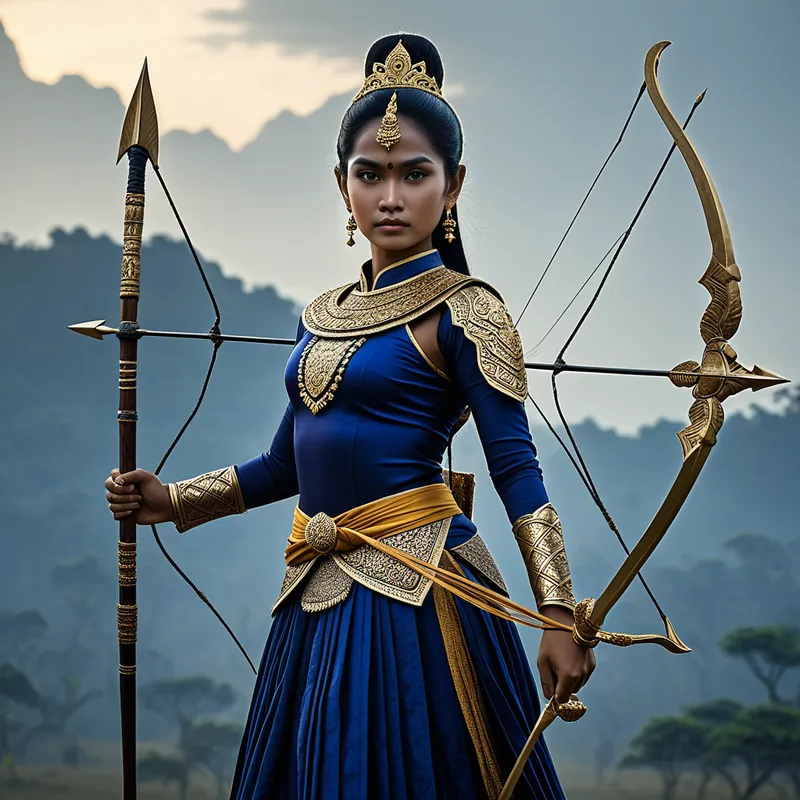
The myth of Srikandi, a peerless archer who transcends gender to become a legendary warrior, embodying the integration of skill, identity, and destiny.
The Tale of Srikandi
Listen, and let the gamelan’s ghostly echo carry you to a time when the world was woven from epic poetry. The air over the land of Astina is thick with the scent of impending thunder. The great war, the Bharatayuddha, gathers like a storm, and on its field, heroes are not born but forged in the crucible of impossible choice.
Among them stands a figure who commands silence before awe. She is Srikandi. Daughter of a king, yet not defined by his throne. In the courts, they whispered of her beauty, but in the training grounds, they fell silent before her skill. For Srikandi did not wield the fan or the needle; her soul spoke the language of the bow. The curve of yew and bamboo was an extension of her will, the feathered arrow a thought given flight. Her teacher was the greatest of all—Arjuna, the peerless archer of the Pandavas. From him, she learned not just to hit a target, but to understand the wind’s secret, the distance’s truth, and the stillness at the heart of action.
But destiny is a relentless hunter. The armies clashed on the field of Kurukshetra, a cacophony of clashing steel and dying cries. From the opposing ranks emerged a terror named Bisma, an elder sworn to a vow of celibacy, a warrior who would not raise his weapon against a woman. He was a fortress that could not be stormed, a tide that broke every charge. The Pandava forces faltered, their courage bleeding into the dust.
In that moment of despair, all eyes turned to Arjuna. But it was Srikandi who stepped forward. The air itself seemed to part for her. She did not speak of replacing her teacher; she spoke of completing a pattern. She took her place on Arjuna’s chariot, a silent pact passing between student and master. As Bisma advanced, invincible, Srikandi drew her bow. Her arrows did not merely fly; they sang a song of piercing truth. They found the gaps in the old warrior’s defense, not through brute force, but through flawless perception. Confronted by a warrior who was a woman, Bisma, bound by his own sacred vow, lowered his weapon. In that sacred hesitation, Srikandi’s final arrow found its mark. The unassailable fell, not to greater strength, but to a transcendent principle. The legend was sealed not in a princess’s chamber, but in the eye of the hurricane, where skill, identity, and destiny became one.

Cultural Origins & Context
The myth of Srikandi is a brilliant facet of the vast Mahabharata tradition as it took root and flourished in the Indonesian archipelago, particularly in Java and Bali. This is not a mere import but a profound adaptation. The epic was absorbed into the local wayang tradition, where dalangs became the custodians of these stories, performing them through long nights. Srikandi’s character evolved within this context. She is a quintessential Javanese refinement of the epic’s archetypes, embodying local values of refined strength (halus) and potent capability (kesaktian).
Her story was not merely entertainment; it was societal instruction. In a culture with complex, often complementary gender roles, Srikandi presented a model of excellence that transcended simple binaries. She was a loyal wife to Arjuna, yet her primary mythic function was as his equal in the warrior’s art. She served as a narrative bridge, demonstrating that ultimate capability (ilmu) is a quality of consciousness and discipline, not merely of physical form. Through wayang performances and later literary works like the Kakawin, her legend reinforced the idea that destiny is claimed by those who master their craft and honor their unique position within the cosmic order.
Symbolic Architecture
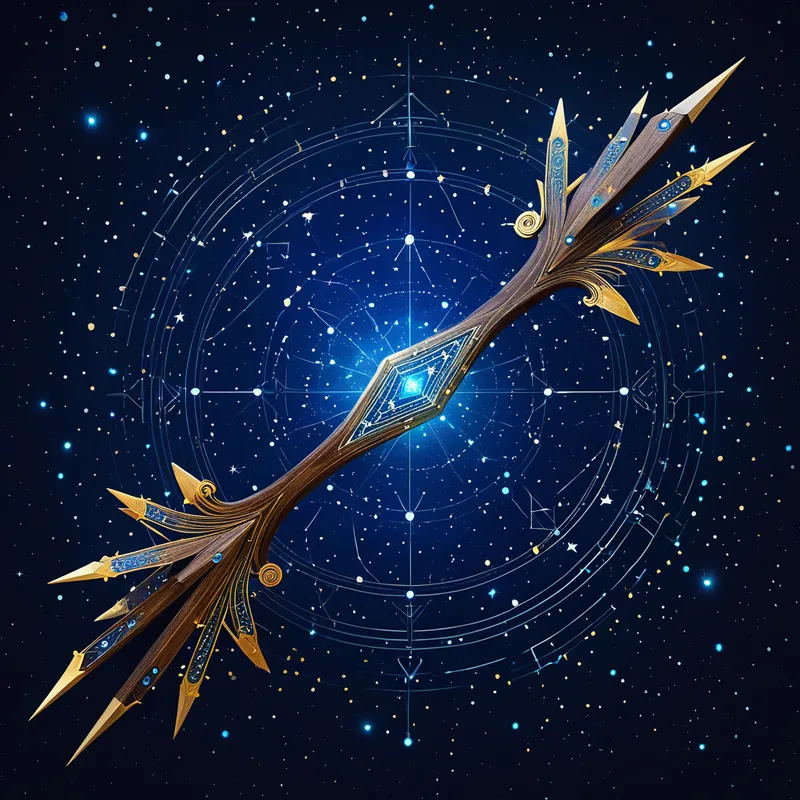
Srikandi’s myth is a profound [allegory](/symbols/allegory “Symbol: A narrative device where characters, events, or settings represent abstract ideas or moral qualities, conveying deeper meanings through symbolic storytelling.”/) for the realization of authentic selfhood through disciplined skill. She represents the archetypal principle that true power is not assumed through [title](/symbols/title “Symbol: A title represents identity, accomplishment, and societal roles, often indicating a hierarchy or level of respect.”/) or birthright, but earned through unwavering dedication to a craft. Her bow is not just a tool of war; it is the focused [instrument](/symbols/instrument “Symbol: An instrument symbolizes creativity, communication, and the means by which one expresses oneself or influences the world.”/) of the individuated will. The [arrow](/symbols/arrow “Symbol: An arrow often symbolizes direction, purpose, and the pursuit of goals, representing both the journey and the destination.”/)’s [flight](/symbols/flight “Symbol: Flight symbolizes freedom, escape, and the pursuit of one’s aspirations, reflecting a desire to transcend limitations.”/) symbolizes [intention](/symbols/intention “Symbol: Intention represents the clarity of purpose and direction in one’s life and can symbolize motivation and commitment within a dream context.”/) made manifest, traveling from the inner world of potential to the outer world of effect with unerring [accuracy](/symbols/accuracy “Symbol: A measure of correctness, precision, or truthfulness in thought, action, or representation.”/).
The greatest battle is not against the external giant, but for the right to stand in your own unique space and let your singular skill speak.
Her pivotal [role](/symbols/role “Symbol: The concept of ‘role’ in dreams often reflects one’s identity or how individuals perceive their place within various social structures.”/) against Bisma is deeply symbolic. Bisma represents an old order, a [system](/symbols/system “Symbol: A system represents structure, organization, and interrelated components functioning together, often reflecting personal or social order.”/) of rules and vows that has become rigid and inviolable. His vow not to fight women is a form of absolute, categorical thinking. Srikandi, by embodying a transcendent [identity](/symbols/identity “Symbol: Identity represents the sense of self, encompassing personal beliefs, cultural background, and social roles.”/)—neither fitting neatly into the category of “man” nor being limited to the category of “woman” in the context of war—becomes the living [paradox](/symbols/paradox “Symbol: A contradictory yet true concept that challenges logic and perception, often representing unresolved tensions or profound truths.”/) that dissolves the old rule. She does not break his vow; she reveals its limitation. Her victory is alchemical: she transmutes the perceived limitation of her identity into the very [weapon](/symbols/weapon “Symbol: A weapon in dreams often symbolizes power, aggression, and the need for protection or defense.”/) that dismantles the [obstacle](/symbols/obstacle “Symbol: Obstacles in dreams often represent challenges or hindrances in waking life that intercept personal progress and growth. They can symbolize fears, doubts, or external pressures.”/).
The Dreamer’s Resonance
When the archetype of Srikandi stirs in the modern unconscious, it often manifests in dreams of potent, focused action amidst confusion. One might dream of holding a tool or instrument—a pen, a scalpel, a musical bow—with supernatural steadiness while chaos reigns around them. There may be dreams of standing before a gatekeeper or an immovable authority figure, not with aggression, but with a calm, unshakable demonstration of skill that compels recognition and passage.
Somatically, this process can feel like a gathering of scattered energies into a single, potent point in the body—often in the chest or hands. Psychologically, it is the process of moving from a diffuse sense of “who I am supposed to be” to a crystallized knowledge of “what I can do.” The dreamer is integrating disparate parts of their identity—perhaps the nurturer and the competitor, the artist and the technician—forging them into a unified capability. The enemy in the dream is rarely another person, but more often an internalized “Bisma”: a rigid belief, a vow of limitation (“I can’t because I am X”), or an inherited system that says your particular combination of traits has no place on this battlefield.

Alchemical Translation
The individuation journey modeled by Srikandi is one of skill as the path to soul. It counters the notion that we must first “find ourselves” and then act. Instead, it proposes that we forge ourselves through committed action toward mastery. The first stage is Apprenticeship: finding your Arjuna—the craft, discipline, or knowledge that calls to you and demands your utmost focus. This is a period of humility, practice, and internalization.
The second, critical stage is the Assumption of Position. This is the moment of existential choice, where you must step onto your own “chariot” and declare, through action, your readiness to face the central challenge of your life. It requires accepting your complex identity as your strength, not an apology.
The arrow that finds its mark is the self that has stopped arguing with its own reflection and has instead learned the language of its target.
The final stage is the Transmutation of Limitation. Here, the very thing you or your culture perceived as a weakness—your gender, your background, your unconventional perspective—is revealed as the precise quality needed to resolve a stuck system. You do not fight the old order on its terms; you change the terms of engagement by fully embodying your unique synthesis. The “Bisma” within—the inner critic, the patriarchal voice, the rule of shame—falls not to rebellion, but to the undeniable truth of your competent being. The victory is not one of destruction, but of revelation, freeing energy for the next necessary battle on the path of destiny.
Associated Symbols
Explore related symbols from the CaleaDream lexicon:
- Warrior — The archetype of disciplined courage and skilled action that Srikandi perfectly embodies, showing that the warrior’s path is one of mastery, not mere aggression.
- Bow — The symbol of focused intention, latent power drawn back and released with precision, representing Srikandi’s primary skill and her channeled will.
- Arrow — The manifestation of will and skill in flight, symbolizing the direct, truthful action that pierces through illusion and rigid defense.
- Teacher — Represents Arjuna as the guide and master who provides the technique and discipline necessary for the latent self to become potent.
- Destiny — The overarching fate of the Bharata war, the field upon which Srikandi must claim her role, moving from potential to enacted purpose.
- Shadow — The unintegrated aspects of identity and capability that Srikandi’s journey brings into the light, particularly around gender and power.
- Mask — The societal expectations of princess and woman that Srikandi transcends, not by removing a mask, but by integrating it into a larger, truer face.
- Ritual — The disciplined, daily practice of archery that forges Srikandi’s skill, turning repetitive action into sacred competence.
- Honor — The code that binds Bisma and which Srikandi navigates not by breaking, but by fulfilling at a higher, more complete level of understanding.
- Light — The clarity of perception and purpose that Srikandi possesses, allowing her to see the true target amidst the chaos of battle and expectation.