Songtsen Gampo Myth Meaning & Symbolism
The mythic tale of Tibet's first Buddhist king who tamed the land through sacred marriage and built the Jokhang Temple, transforming a kingdom through wisdom and compassion.
The Tale of Songtsen Gampo
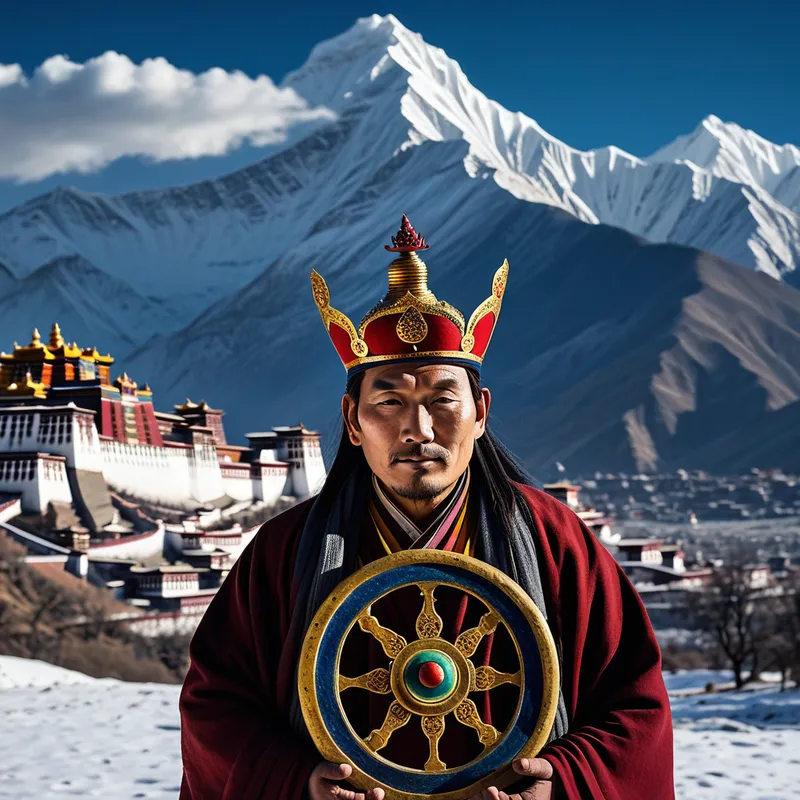
Listen. In the high, wild roof of the world, where the wind carves stories into stone and the sky presses close enough to touch, a kingdom was born in tumult. It was not a gentle birth. The land itself, Bod, was a raw, untamed creature—a supine demoness of rock and river, her limbs splayed across the valleys, her restless spirit churning the elements. Storms were her breath, earthquakes her shifting dreams. Upon this volatile earth walked a man of iron and vision: Songtsen Gampo. He was a king forged in the old ways, a unifier whose arm was strong and whose will was a glacier, slow, immense, and irresistible.
Yet, for all his power, the kingdom would not settle. Temples built by day crumbled by night. Plagues stalked the people. The demoness of the land tossed in her sleep. The king, in his wisdom, sought counsel beyond the mountains. He looked to the civilized horizons and saw a greater order—not of the sword, but of the spirit. He sent his minister, the cunning and faithful Thönmi Sambhota, to the south, to the source of sacred scripts. And he sent proposals of marriage to the courts of Nepal and the mighty Middle Kingdom.
From Nepal came Princess Bhrikuti, a daughter of the Licchavi kings. Her dowry was not merely gold, but a sacred, serene presence—a statue of the Buddha Akshobhya, carved from sandalwood, and the knowledge of crafts and rites. From the east, across impossible passes, came Princess Wencheng of the Tang. Her journey was an epic of its own, a caravan of silk and scripture, bearing another profound treasure: a life-sized statue of the Buddha Shakyamuni, the Jowo Rinpoche.
But the land resisted these foreign vessels of peace. The cart carrying the Jowo sank into the mud of the Lhasa valley and would not move. Princess Wencheng, versed in the arts of feng shui, surveyed the wild terrain. She saw what others could not: the body of the demoness, her heart a lake, her vital points marked by hills and rivers. To build a temple upon her heart would pin her, finally calm her furious energy.
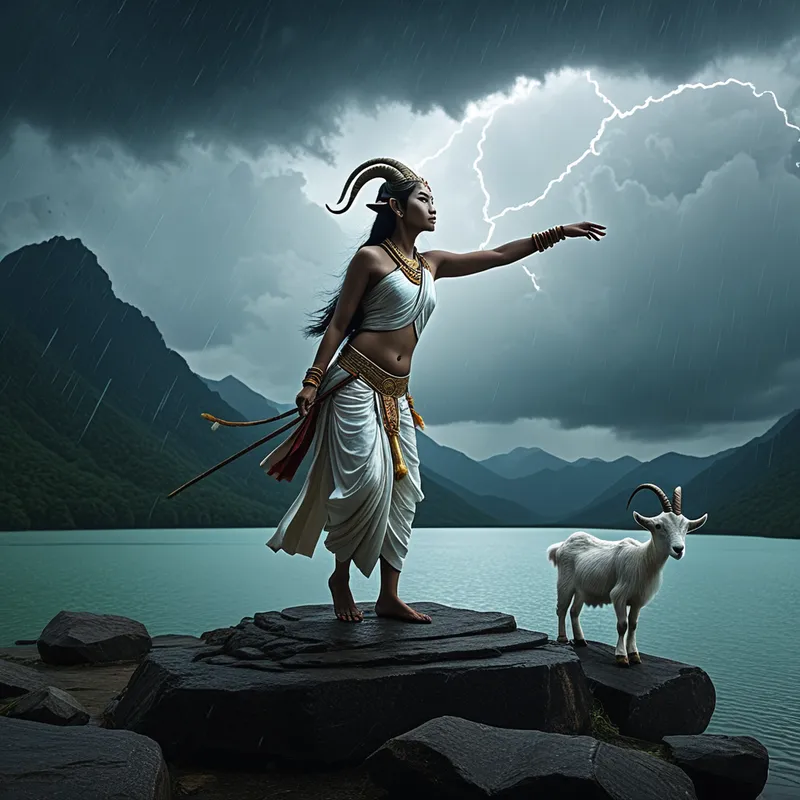
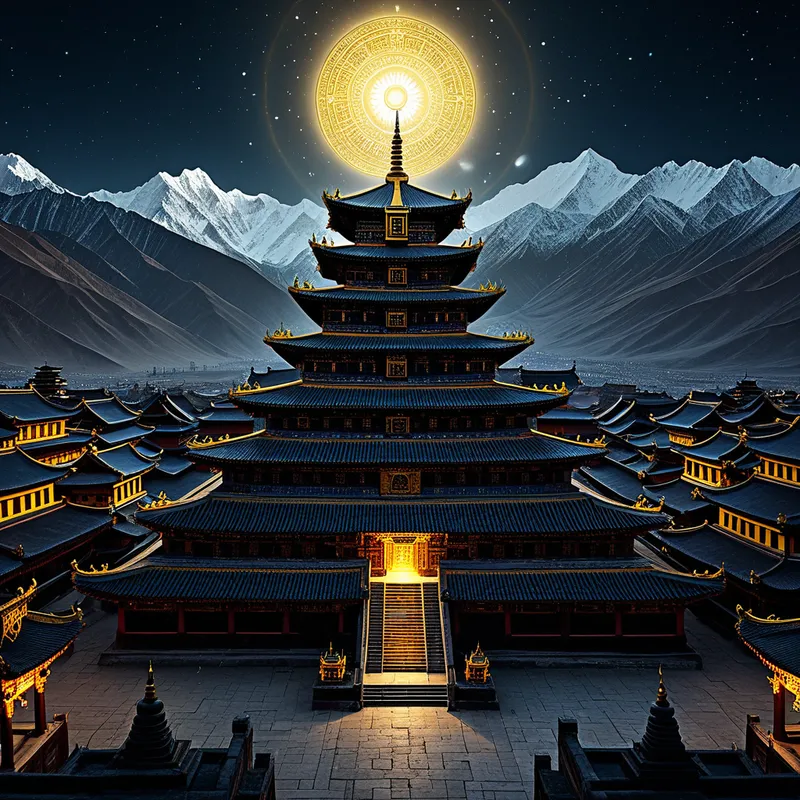
The king acted. He commanded the lake to be filled. For years, thousands of white goats carried earth and stone upon their backs. And then, a miracle: a white dakini, taking the form of a goat, struck the ground with her hoof, and the waters receded, revealing the firm foundation. Upon that sacred site rose the Jokhang, the "House of the Lord." The Jowo Rinpoche was installed within, and around it, a city of light and prayer began to pulse—Lhasa. The king, transformed from a warrior into a dharmaraja, had not conquered the land with force, but had married it, had wedded its wild spirit with the boundless compassion of the Avalokiteshvara, of whom he was now seen as an incarnation. The demoness was subdued, not slain, becoming the protected earth of a spiritual kingdom.
Cultural Origins & Context
The myth of Songtsen Gampo sits at the precise and potent crossroads of Tibetan history and sacred identity. Historically, he was a formidable 7th-century emperor who unified the Tibetan Plateau and established its first centralized empire. The myth, however, emerges from the later Buddhist historiographical tradition, particularly from texts like the Ba' Bzhed and the Bka' chems ka khol ma, which retroactively sanctified his political achievements.
Told by lamas and chroniclers, this narrative performs a crucial cultural function: it provides a divine charter for Tibet's Buddhist civilization. It translates military expansion and diplomatic marriage—historical facts—into a cosmological drama of taming and transformation. The story answers the profound question: "How did Buddhism, a foreign teaching, become the soul of Tibet?" The answer is not mere conversion, but a sacred marriage. The king becomes a nirmanakaya, the land becomes a buddhafield, and political alliance becomes spiritual destiny. This myth is the foundational story of Tibetan national and religious identity, establishing Lhasa as a sacred center and the king as the prototype of the ideal ruler: the chakravartin who wields power in service of wisdom.
Symbolic Architecture
At its core, this myth is an elaborate blueprint for the civilizing process, not as suppression, but as integration. The wild, feminine land—the demoness—symbolizes the untamed, chaotic, and potent raw material of nature, instinct, and the unconscious itself. She is the unintegrated shadow of the kingdom, its volatile potential.
The true ruler does not conquer the wild; he enters into a sacred marriage with it, transforming chaos into the ground of a new order.
Songtsen Gampo represents the organizing principle of consciousness—the ego or the Self in its formative, heroic stage. His two foreign brides are not merely princesses but emissaries of differentiated wisdom (Prajnaparamita) and skillful means (Upaya). Bhrikuti brings the arts of culture (form), and Wencheng brings the science of placement and alignment (relationship). The Jokhang Temple, built on the demoness's heart, is the ultimate symbol of the sacred center, the axis mundi. It is the stabilized heart of the psyche, the place where the divine (the Jowo statue) can reside permanently, bringing order to the entire system. The filling of the lake with the help of white goats signifies the alchemical work of using humble, persistent effort (the goats) to transmute the emotional, watery depths (the unconscious) into solid, buildable ground (conscious structure).
The Dreamer's Resonance
When this mythic pattern stirs in the modern dreamer, it often signals a profound process of inner foundation-building. One may dream of chaotic, overwhelming landscapes—a roiling sea where one tries to build a house, or a swamp that swallows every path. This is the somatic feeling of the "demoness-land," the unruly emotional or instinctual substrate of one's life that resists order.
Conversely, one might dream of receiving a precious, foreign object—a gem, a book, a child—that feels profoundly sacred but impossibly heavy to carry. This is the "Jowo" energy, a new spiritual or psychological content demanding integration. The dream ego, like Songtsen Gampo's ministers, may feel baffled and powerless. The resolution in the dream may come through an unexpected alliance (a marriage, a partnership) or the discovery of a precise, correct "location" within oneself for this new content. The dream is orchestrating a sacred marriage between one's wild, native nature and a transformative, civilizing influence from beyond one's current borders. It is the psyche preparing to build its own inner Jokhang.

Alchemical Translation
For the individual, the myth of Songtsen Gampo models the journey from a personality ruled by monolithic, often aggressive, will (the warrior-king) to one governed by a synthesized, compassionate consciousness (the dharmaraja). The alchemical process is one of containment and placement.
First, one must acknowledge the "demoness"—the raw, untamed, and often disruptive energies of one's own nature: rage, passion, primal fear. The old kingly mode seeks to vanquish them. The alchemical mode, revealed by the myth, is to map them. Like Princess Wencheng surveying the land, we must observe where our energy congests (the lake), where it runs wild (the limbs), and where its vital heart lies.
Individuation is the construction of a temple upon the very site of one's deepest turmoil.
The "foreign brides" are those aspects of wisdom we must court and welcome from beyond our familiar identity—perhaps the receptive, nurturing quality a driven person ignores, or the disciplined structure a chaotic soul avoids. Their dowry is the "sacred statue," the core image of the Self that feels otherworldly yet is meant to be the central inhabitant of our psyche. The labor of the "white goats" is the daily, often tedious, work of mindfulness and practice that fills in our emotional swamps with the solid ground of conscious attention. Finally, we erect our inner temple—a stable structure of values, practice, and identity—not by rejecting our wild foundation, but by building directly upon it, thereby transforming its chaotic power into the grounded energy of a sacred life.
Associated Symbols
Explore related symbols from the CaleaDream lexicon:
- Mountain — The immutable, lofty aspiration of the king and the spiritual civilization he founded, representing the challenge and stability of the highest self.
- Temple — The Jokhang itself, symbolizing the constructed sacred center within the psyche, where the divine image is housed and the chaotic world is ordered.
- Marriage — The sacred union between the wild, native land (the unconscious) and civilized, foreign wisdom (consciousness), which creates a new, fertile whole.
- Earth — The demoness as the raw, feminine material of existence, the foundational substance that must be engaged with and transformed, not escaped.
- Journey — The epic travels of the ministers for script and the princesses with their statues, representing the long, perilous quest for the elements needed for inner transformation.
- Heart — The lake upon which the temple is built, symbolizing the emotional and spiritual center that must be stabilized and made firm.
- Order — The ultimate gift of the myth, the transformation of a chaotic landscape into a harmonious mandala of spiritual and social life.
- Buddhist Stupa — A architectural echo of the temple, representing the enlightened mind and the stable axis around which reality is organized.
- Bridge — The diplomatic and marital alliances that connected Tibet to Nepal and China, symbolizing the connection of disparate parts of the self or world.
- Crown — The symbol of Songtsen Gampo's sovereignty, which is transformed from a sign of temporal power to that of a chakravartin's spiritual duty.
- Goddess — Manifest in the two princesses as emanations of Tara, representing the active, compassionate feminine wisdom that guides the civilizing process.
- Light — The wisdom of Buddhism that illuminates the "Land of Snows," dispelling the darkness of ignorance and pacifying the chaotic energies of the land.