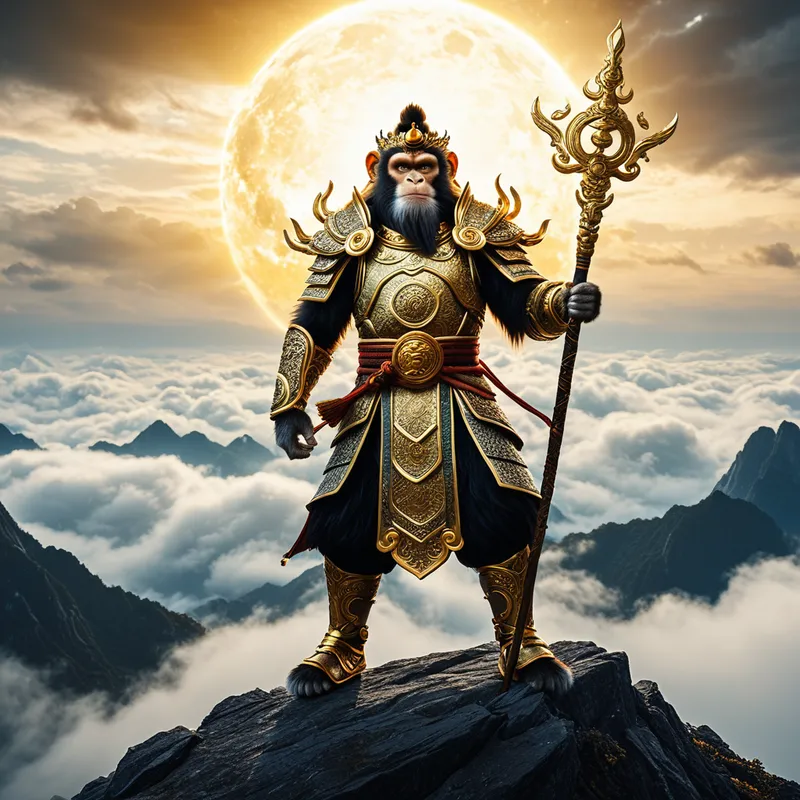
Son Goku Myth Meaning & Symbolism
The celestial monkey king's epic journey from divine trickster to enlightened guardian, a myth of boundless potential seeking discipline and purpose.
The Tale of Son Goku
Listen, and hear the tale of the stone that dreamed.
From a stone egg, kissed by the wind and washed by the sea, he was born. Not with a cry, but with a beam of light that shot to the heavens and troubled the court of Jade Emperor himself. He was Sun Wukong, the Monkey King, and the world was his playground. He learned the arts of transformation and cloud-somersaulting from an immortal sage, stole a weapon fit for a god—the Ruyi Jingu Bang—from the Dragon King’s treasury, and with a stroke of his brush, erased his name and the names of his kind from the ledgers of death.
The heavens trembled. They offered him a title, “Keeper of the Heavenly Stables,” a hollow honor meant to tame him. When he discovered the deceit, his wrath was a storm. He devoured the Peaches of Immortality, drank the elixirs of the gods, and fought his way through ten thousand celestial soldiers. No weapon could pierce him; no fire could burn him. He was chaos incarnate, a scream of pure, unbounded potential against the ordered silence of the cosmos.
Finally, the Buddha himself intervened. “Leap from my palm,” he said, “and the heavens are yours.” The Monkey King somersaulted across the world, marking a mountain with his scent, believing he had reached the edge of creation. He returned in triumph, only to find he had never left the Buddha’s hand. The five elemental peaks of a mountain range crashed upon him, sealing him in stone and earth for five centuries.
His punishment was not imprisonment, but waiting. The rustle of seasons, the slow growth of moss—these were his teachers. Then came the sound of footsteps, and a holy monk’s hand brushing the earth from his face. This was Tripitaka, bound for the Western Paradise to fetch sacred scriptures. To atone, the Monkey King would be his protector. A golden fillet was placed upon his brow, a circlet that tightened with a sutra, bringing pain to tame his wild mind.
Their journey was a path of trials. Demons of greed and illusion rose from the land, each a reflection of the turmoil within. The Monkey King fought them with fury and cunning, but his greatest battle was with his own nature—the impulsive rage, the arrogant heart. He learned duty, not as a chain, but as a compass. He learned compassion, not as weakness, but as the true source of his strength. After countless trials, they reached their destination. The scriptures were obtained, and the stone that dreamed was finally polished clean. The Buddha named him Douzhanshengfo. The trickster was now a guardian. The rebel had found his true kingdom.
Cultural Origins & Context
The myth of Son Goku is not originally Japanese, but a profound cultural import that took deep root. It originates from the 16th-century Chinese novel Journey to the West by Wu Cheng’en, a seminal work of Ming dynasty literature that blended Taoist folklore, Buddhist allegory, and popular adventure. The myth entered Japan as Saiyuki, translated and adapted over centuries through woodblock prints, rakugo storytelling, and eventually, modern media.
Its societal function was multifaceted. On one level, it was a thrilling adventure story of demons and magic. On a deeper level, it served as a vehicle for spiritual instruction, illustrating the Buddhist path of overcoming the “monkey mind”—the restless, ego-driven consciousness—to achieve enlightenment. The monk Tripitaka represented the pure, but fragile, intention for wisdom, while Sun Wukong embodied the raw power and cunning necessary to protect that intention on its perilous journey through the world of desire and illusion. In Japan, the story resonated with existing themes of loyalty, mastery, and the transformation of wild spirits (yokai) into protective forces, finding a permanent home in the cultural imagination.
Symbolic Architecture
At its core, the myth is a grand allegory for the individuation process—the integration of the wild, unconscious self with the conscious, moral self.
The unbound potential of the Self is chaos; the disciplined application of that potential is divinity.
Sun Wukong is the archetypal Shadow and the Trickster made manifest. His birth from stone signifies a consciousness emerging from the prima materia, the raw stuff of the psyche, devoid of social conditioning. His rebellious rampage through heaven is the ego’s inflation, the untamed id believing itself to be the center of the universe. The magical staff is a profound symbol: a weapon, a tool, and the axis of his world. It represents the will—infinitely adaptable (able to shrink or grow) but fundamentally solid and unwavering at its core.
The imprisonment under the mountain is not merely punishment, but a necessary containment. It is the psyche’s own defense forcing a period of incubation, where unchecked energy is compressed into potential. The golden fillet, tightened by the headache sutra, is the binding principle of consciousness and conscience. It is the painful but essential constraint that directs raw power toward a meaningful purpose, transforming blind impulse into focused action.
The Dreamer's Resonance
When this myth stirs in modern dreams, it often signals a profound confrontation with one’s own untapped or unruly power. To dream of a monkey causing chaotic, clever mischief may reflect a feeling that one’s innate talents or desires are being stifled by societal or internal “heavenly” rules, leading to rebellious frustration.
Dreaming of being trapped under a great weight, yet remaining conscious and aware, points to a somatic experience of potential in forced latency. The dreamer may feel their energy, creativity, or true nature is suppressed by circumstances (a job, a relationship, an illness), creating a potent, pressurized readiness. The appearance of a magical, size-changing tool—a staff, a key, a pen—suggests the dreamer is on the cusp of discovering or acknowledging their own unique instrument of will, their means of impacting the world.
Most telling are dreams of a journey with an unlikely, irritable companion or protector. This indicates the psyche is organizing for a difficult but necessary pilgrimage toward a goal (individuation, healing, creation), where the dreamer’s own “monkey mind”—their anxiety, arrogance, or impulsivity—must be harnessed as a protective force rather than rejected as an enemy.
Alchemical Translation
The myth of Son Goku is a perfect map for the alchemical opus of the soul. It begins with the Nigredo, the blackening: the chaotic, undifferentiated birth from stone and the ensuing destructive inflation. The rampage in heaven is the necessary, fiery stage of Calcinatio, burning away naive identification with the ego.
The mountain tomb is the Albedo, the whitening—a silent, lunar purification where the fiery spirit is cooled by the weight of reality and consequence, washed in the waters of isolation until it becomes reflective.
The journey with Tripitaka is the central work of Citrinitas, the yellowing, where the refined spirit learns to operate in the world. Each demon is a projection or a complex to be integrated. The pig demon, Zhu Bajie, is the appetite; the stoic sand demon is the weight of depression or obligation. Sun Wukong must engage them all, not merely destroy them. The golden fillet is the philosopher’s stone in its formative stage—the binding agent that allows for the Coniunctio, the sacred marriage. Here, the conscious will (the monk’s sutra) and the unconscious power (the monkey’s strength) are painfully, inseparably joined.
The final attainment of Buddhahood is the Rubedo, the reddening, the culmination. The stone monkey is fully transmuted. The rebellious energy that sought to overthrow heaven becomes the enlightened awareness that sustains the cosmic order. For the modern individual, this translates to the moment when one’s deepest wounds, fiercest passions, and most “unacceptable” traits are no longer sources of shame or chaos, but the integrated, disciplined foundations of a unique and compassionate character. The quest ends not with the destruction of the monkey, but with his coronation.
Associated Symbols
Explore related symbols from the CaleaDream lexicon: