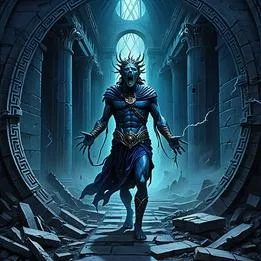
Chronos Dream Meaning
Ancient Greek personification of time as a destructive, all-devouring force, representing inevitable change, decay, and the cyclical nature of existence.
Common Appearances & Contexts
| Context | Emotion | Interpretation |
|---|---|---|
| Chronos devouring | Terror | Fear of being consumed. |
| Chronos with scythe | Resignation | Accepting inevitable endings. |
| Chronos as clock | Anxiety | Pressure of deadlines. |
| Chronos sleeping | Relief | Temporary reprieve from time. |
| Chronos aging | Melancholy | Personal mortality awareness. |
| Chronos as father | Fear | Authoritarian parental figure. |
| Chronos in nature | Awe | Natural cycles observed. |
| Chronos destroying | Despair | Loss of what was. |
| Chronos creating | Hope | New beginnings possible. |
| Chronos imprisoned | Triumph | Mastery over time. |
| Chronos as infant | Confusion | Time's origin mystery. |
| Chronos vanishing | Liberation | Freedom from constraints. |
Interpretive Themes
Cultural Lenses
Jungian Perspective
View Context →Archetype of the destructive father/time, representing the collective unconscious's awareness of mortality and the need to integrate shadow aspects of temporality for individuation.
Freudian Perspective
View Context →Symbol of the superego's punishing aspect and castration anxiety, with devouring representing oral fixation and fear of paternal authority consuming one's potential.
Gestalt Perspective
View Context →Projection of the dreamer's relationship with time management, deadlines, and aging, where Chronos represents unfinished business with temporal aspects of existence.
Cognitive Perspective
View Context →Mental schema for processing temporal concepts, anxiety about future events, and cognitive awareness of life's finite nature, manifesting as mythological imagery.
Evolutionary Perspective
View Context →Adaptive representation of time-awareness crucial for survival, with devouring imagery reflecting ancestral fears of resource scarcity and generational competition.
European Perspective
View Context →Greek Titan father of Zeus, often conflated with Roman Saturn in Renaissance art, representing agricultural cycles, melancholy, and the 'Saturnine' temperament in medieval astrology.
Middle Eastern Perspective
View Context →Parallels with Zurvan in Zoroastrianism as infinite time, and Islamic concepts of divine decree (qadar), where time is both destructive and a manifestation of Allah's will.
East Asian Perspective
View Context →Resonates with Buddhist impermanence (anicca) and Daoist cyclical time, though less personified; modern interpretations blend with Western imagery in globalized contexts.
South Asian Perspective
View Context →Similar to Kala in Hinduism, both as time and death, with Kali as destructive mother counterpart; in yoga, time's mastery leads to liberation (moksha).
African Perspective
View Context →Many traditions view time as cyclical and communal rather than linear; Chronos might represent colonial imposition of Western time concepts disrupting traditional rhythms.
Modern Western Perspective
View Context →Metaphor for anxiety about productivity, aging in youth-obsessed culture, and climate change as time running out; appears in media as villain or warning symbol.
Global/Universal Perspective
View Context →Cross-cultural recognition of time as both creative and destructive force, with Chronos representing humanity's universal struggle to comprehend and cope with temporal existence.
Interpret Your Full Dream
Beyond this symbol, every dream carries a unique story. Share your dream for a personalized AI-powered interpretation.