Shiva's Dance Myth Meaning & Symbolism
The story of Shiva performing the Tandava, a cosmic dance that dissolves and renews the universe, embodying the eternal cycle of existence.
The Tale of Shiva's Dance
Listen. In a time before time was measured, in the deep pine forests at the foot of the world-mountain Kailash, a grave error was taking root. A conclave of sages, the Rishis of the Dāruvana, had grown drunk on their own austerity. Through fierce penance, they had amassed power like a coiled serpent, but their wisdom had curdled into arrogance. They believed their rituals commanded the cosmos itself. They looked upon the gods not with devotion, but with the cold eye of technicians seeking to control a force of nature.
Their pride manifested a monstrous creation: a great tiger, its stripes the color of burnt offerings, sent to rend the peace. Then, a slithering army of serpents, hissing with the poison of misplaced knowledge. Finally, a malignant, dwarf-like demon, Apasmāra, born from the very sludge of their spiritual ignorance. This dwarf was the most dangerous of all, for he did not attack the body, but the mind, seeking to stamp out consciousness itself.
The forest, once a place of serene tapas, became a theater of chaos. The air grew thick with the smoke of hubris and the cries of frightened creatures. The balance of the world trembled. The pleas of the truly devout reached the silent, meditative peak of Kailash, where the great ascetic, Shiva, sat immersed in the void. His consort, Parvati, watched the unfolding discord. She knew the hour had come.
Shiva opened his eyes. There was no anger in them, only a profound, terrifying clarity. He rose. He took up a small, double-headed damaru. He smeared his body with sacred ash. And then, he began to dance.
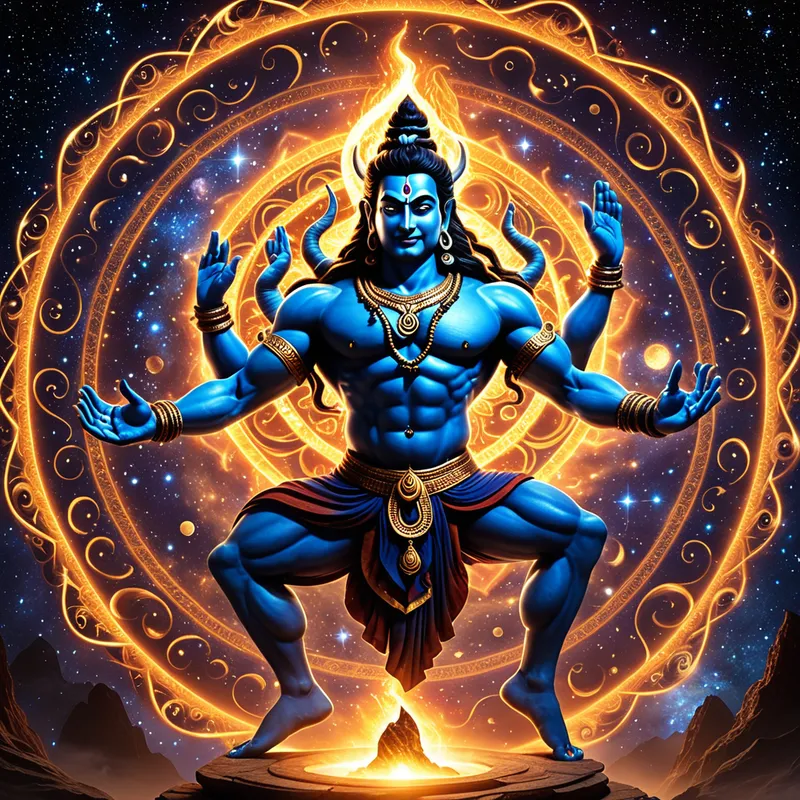
It was not a dance of celebration, nor of war. It was the Tāṇḍava. His form multiplied into a sublime, cosmic spectacle. One foot stamped down upon the squirming dwarf Apasmāra, pinning ignorance beneath his heel, not to kill it, but to hold it in check—for without the challenge of ignorance, there can be no striving for wisdom. His other foot lifted in a gesture of sublime liberation. In one hand, the damaru beat the primal rhythm of creation; in another, the flame of destruction flickered; a third hand gestured "fear not," while a fourth pointed to his raised foot, the path to salvation.
His long, matted hair, usually coiled, flew out in a wild arc, catching the Ganga river as it fell from heaven, cushioning its force for the world. Around him, a ring of fire—the Pralaya—blazed, consuming the forms of the tiger and the serpents, reducing them back to the elements from which they came. The Rishis stood frozen, their rituals meaningless before this awesome display. They saw not a god to be controlled, but the very principle of the universe in motion: sound, fire, rhythm, and grace, simultaneously dissolving their arrogance and offering a vision of a truth far greater than their own. The dance reached its crescendo, and in the silence that followed the final beat of the drum, only awe remained. The universe had been reset, not by annihilation, but by a necessary, rhythmic correction.
Cultural Origins & Context
The myth of Shiva's Nataraja is woven deeply into the fabric of Shaivism. While its philosophical underpinnings are ancient, its most iconic visual and narrative formulation flourished in the medieval period, particularly in Southern India under the patronage of the Chola dynasty (9th-13th centuries CE). The Chola bronzes of Nataraja are not merely art; they are theological treatises in metal, capturing the dynamic equilibrium of the cosmos in a single, perfect form.
The story is primarily preserved in the Purāṇas</ab- br>, such as the Koyil Purānam and the Ānanda Tāṇḍava of the Kūrma Purāṇa. It was passed down through temple storytellers, dancers of the sacred Bharatanatyam tradition (which traces its origins to Shiva's dance), and philosophical schools. Its societal function was multifaceted: it was a cautionary tale against the perils of spiritual pride, a theodicy explaining the necessity of destruction, and a metaphysical model illustrating the non-dual nature of reality, where creation and destruction are two phases of one continuous, divine energy.
Symbolic Architecture
The dance of Shiva is a complete symbolic system, a map of reality itself. Every element is a profound allegory.
The cosmos is not a created thing, but a continuous verb—a dancing. We are not in the universe; the universe is in the dance.
The ring of fire (Prabhāmaṇḍala) represents the cycle of birth, death, and rebirth, the consumed fuel of time and form. The dwarf Apasmāra under Shiva's foot is the essential obstacle: ignorance, forgetfulness, and the crushing weight of the ego. He is not obliterated because he is necessary; our struggle against him defines the human journey. The damaru in his right hand beats the rhythm of Aum, the pulse of emergence. The flame in his left hand is the agent of dissolution, burning away the old to make space for the new.
The two-sided expression of his face—serene on the right, fierce on the left—embodies the union of opposites: mercy and justice, eternity and time. The flying hair signifies the release of boundless energy, while the Ganga within it shows the channeling of that transcendent, potentially overwhelming power into a life-giving, conscious flow for the world.
Psychologically, Shiva represents the Self in its totality, the central archetype of order that emerges from the chaos of the psyche. The dance is the process of psychic life itself: the constant formation of complexes (creation), their necessary breakdown when they become rigid or tyrannical (destruction), and the fleeting moments of perfect balance (the pose of Nataraja) where consciousness holds the whole turbulent process in awareness.
The Dreamer's Resonance
When this myth stirs in the modern unconscious, it rarely appears as a literal deity. Instead, one may dream of being in a building that is simultaneously under construction and demolition; of a relentless, rhythmic sound that makes old structures collapse and new shapes coalesce from the debris; or of a powerful, androgynous figure dancing in the center of a personal storm.
Somatically, this can correlate with periods of intense upheaval—the end of a career, the dissolution of a long-held identity, a creative breakthrough that requires the "death" of a previous project. The psyche is performing its own Tāṇḍava. The feeling is often one of terrifying exhilaration: things are falling apart, but there is an undeniable, rhythmic rightness to the collapse. The dwarf Apasmāra may manifest as a recurring, petty thought pattern, a stubborn addiction, or a deep-seated insecurity that the dream-ego finally pins down, not to eliminate, but to acknowledge as the necessary friction against which one defines oneself.
Alchemical Translation
The alchemical journey of individuation mirrors Shiva's dance perfectly. The initial stage, nigredo, is the dark forest of the Dāruvana—the chaos of the unexamined life, the inflation of the ego (the Rishis' pride), and the emergence of shadow beasts from the unconscious. This crisis demands the intervention of a transpersonal principle.
Individuation is not about becoming perfect, but about becoming whole. It requires the dance—the willingness to hold the tension between constructing a self and deconstructing its illusions.
Shiva's dance is the solutio and coagulatio processes happening simultaneously. The flame of consciousness (solutio) dissolves rigid identifications ("I am my job," "I am my trauma"). The drumbeat of the damaru (coagulatio) is the new rhythm of the more authentic Self beginning to pulse, organizing psychic energy into novel, more fluid patterns. Pinning Apasmāra is the crucial act of conscious relationship with the shadow. We do not eradicate our flaws or ignorance; we "dance" with them, using their resistance to develop strength, humility, and nuance.
The ultimate goal is not a static state of perfection, but the achievement of that dynamic, dancing balance—the unio oppositorum—represented by Nataraja's pose. The individuated person can contain their own creative and destructive impulses, can hold serenity amidst chaos, and can channel raw, unconscious energy (the flying hair/Ganga) into conscious, life-affirming expression. They understand that to live fully is to participate willingly in the cosmic dance, to be both the dancer and, ultimately, the dance itself.
Associated Symbols
Explore related symbols from the CaleaDream lexicon: