Shepherd's Crook Myth Meaning & Symbolism
A symbol of divine guidance and sacrificial love, the crook pulls the lost from the abyss, embodying the archetypal journey from isolation to belonging.
The Tale of the Shepherd's Crook
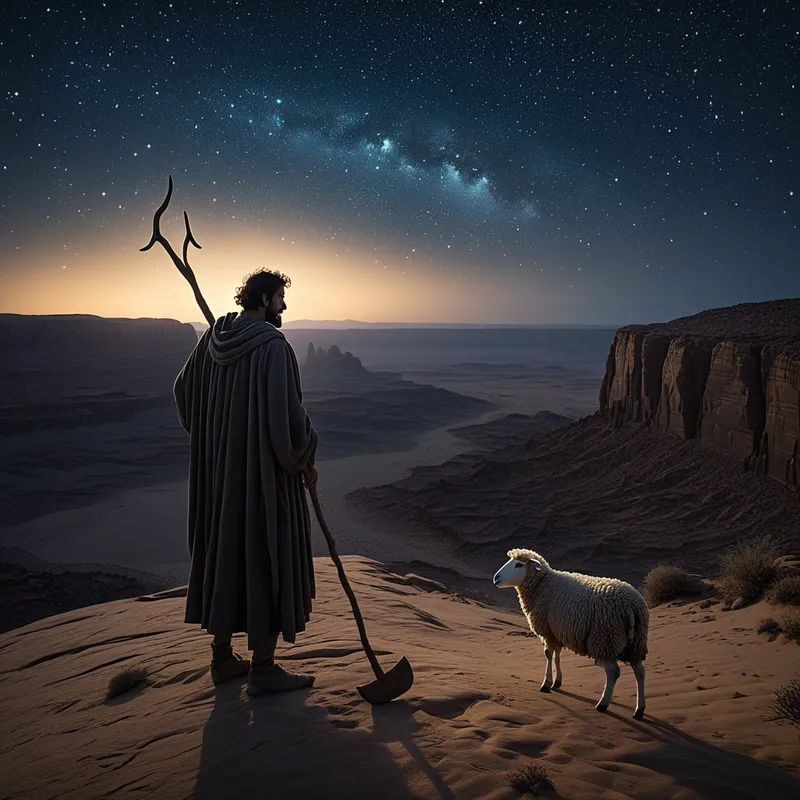
Listen. Before the world was paved, when the wind spoke in the voices of dust and stone, there was a land of high, lonely places and deep, shadowed valleys. The sun was a hammer by day, the cold a knife by night. And in this land walked the Shepherd.
His was not a kingdom of walls, but of horizons. His crown was the wide sky, his scepter a simple staff of gnarled wood, worn smooth at the grip by a lifetime of vigil. But this was no ordinary staff. At its head, it curved—a patient, knowing hook, carved by his own hand from the branch of a stubborn, living tree.
He knew his hundred. He knew the bold one who led, the foolish one who strayed, the weak one who lagged behind. He knew them by the sound of their step on the gravel, by the particular timbre of their cry. And one evening, as the bruised purple of twilight settled into the black velvet of night, the cry was missing. One voice was absent from the chorus. The hundred were ninety-nine.
Without a word, the Shepherd turned his back on the safety of the fold. He took up his crook and walked into the gathering dark. The path was not a path. It was a descent into the teeth of the wilderness—over scree that shifted like a liar’s promise, through thickets that clutched with bony fingers. He heard the distant howl of the wolves, the whisper of the abyss from unseen cliffs.
He found it, at last, not by sight, but by a faint, terrified trembling in the air. The lamb was wedged in a crack of rock, a fissure so deep the moonlight could not find the bottom. It was beyond bleating, frozen in a silence of pure despair. To reach down with a hand was to risk falling in after it. The gap was too wide, the darkness too complete.
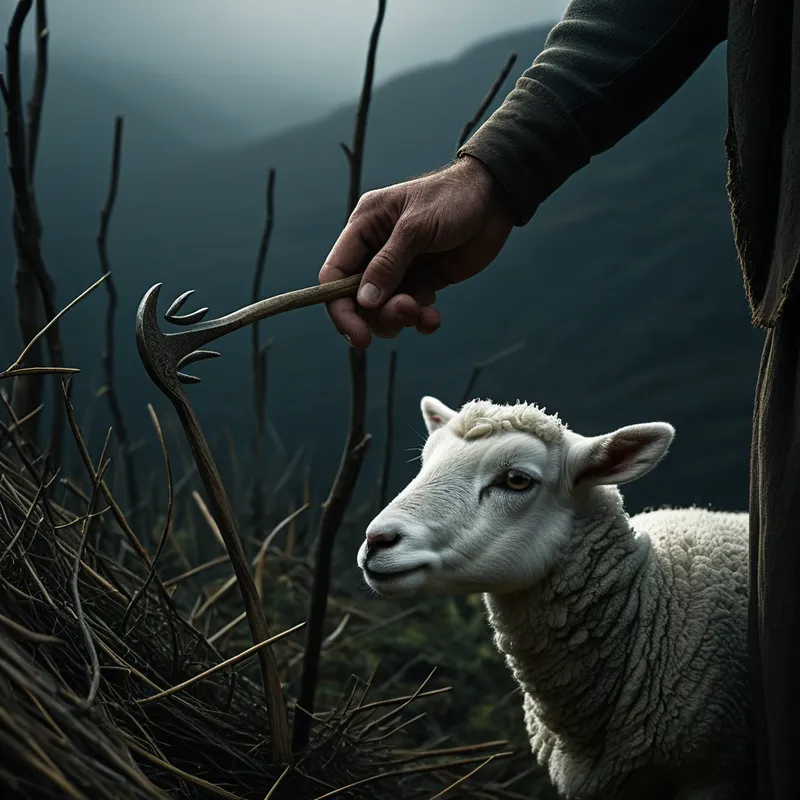
So the Shepherd knelt. He did not shout. He did not reach blindly. He lowered the curved head of his crook, that humble, intentional hook, into the darkness. He did not prod or poke. He presented the curve—an open question, an invitation to be held. A space was made. And when he felt the faintest pressure, the slightest acceptance of that wooden embrace, he pulled. Not with the jerking force of a hunter, but with the slow, inevitable surety of a tide. He drew the lost one up from the crack in the world, caked in the mud of its own fear, and placed it upon his shoulders, where the weight was not a burden, but a belonging. And the walk back, under the now-brilliant stars, was made not to the sound of one set of footsteps, but two: the steady tread of the Shepherd, and the beating of a heart returned to its rhythm.
Cultural Origins & Context
This is not a myth of Mount Olympus or the frozen North, but a parable from the heart of the Biblical tradition, attributed to Jesus of Nazareth. It was an oral story, told to crowds of peasants, fishermen, and outcasts—people intimately familiar with the literal stakes of herding in a harsh landscape. Its power lies in its radical re-framing of divine authority. In an age where gods were often depicted as distant, capricious, or demanding blood sacrifice, this story presented the sacred as a figure who leaves security to enter peril, whose power is expressed not in thunderbolts but in a careful, retrieving hook.
It was a subversive comfort. It functioned socially to validate the worth of the single, the lost, the marginal against the logic of the secure majority (the ninety-nine). It was passed down not as formal theology initially, but as a living image, a story that painted a picture of a God whose primary mode is seeking, and whose strength is perfected in the act of restoration.
Symbolic Architecture
The myth’s power is not in its plot, but in the symbolic architecture of its central artifact and action. The Shepherd's Crook is a perfect union of opposites. The long, straight staff represents authority, stability, and the upright path—the Law, one might say. But the curved hook is something else entirely. It is grace. It is the adaptable, reaching, non-linear intervention into the unique chaos of a single soul’s predicament.
The straight staff judges the direction; the curved hook saves the one who has fallen from the path.
Psychologically, the Shepherd embodies the Self in its role as the unifying center of the personality. The ninety-nine sheep represent the aspects of ourselves that are relatively conscious, ordered, and "in the fold"—our functional identities. The one lost sheep is the shadow, the valuable yet terrified part that has become trapped in a complex, a fissure of trauma, shame, or forgotten potential. The journey into the wilderness is the necessary descent into the unconscious. The Shepherd does not destroy the fissure (the wound); he operates within its confines with a precise tool.
The Dreamer's Resonance
When this myth stirs in the modern soul, it often surfaces in dreams not as a biblical scene, but through its core patterns. You may dream of being lost in a labyrinthine building (the modern wilderness), hearing a distant, reassuring sound you cannot locate. You may dream of a tool—a cane, a rope, an extending arm—that can reach you where you are stuck. You may be the one reaching with a tool into a dark hole, trying to retrieve something precious and frightened.
Somatically, this process feels like a deep, often anxious longing paired with a nascent trust. It is the feeling of being "stuck" in a life pattern, a relationship, or a depression—the psychological fissure. The dream resonance indicates the psyche is initiating a retrieval mission. The anxiety is the fear of the wilderness; the flicker of trust is the recognition of the crook’s curve, the sense that something within you is not punishing you for being lost, but is architecting a way to pull you out. It is the body-mind preparing for reassimilation, often felt as a tightness in the chest (the trapped lamb) beginning to loosen.

Alchemical Translation
The alchemical process mirrored here is solve et coagula: dissolve and coagulate. First, the solve: the secure, coagulated identity of the "flock" of ninety-nine must be temporarily dissolved. The Shepherd (the integrating Self) turns away from collective security and enters the solitary, dissolving chaos of the wilds to find the lost, primal matter (the prima materia of the soul).
The retrieval is the great work. The crook is the alchemical vessel and the philosopher's stone combined. It does not deny the fissure (the nigredo, the blackening); it works within its specific geometry. The gentle, firm pull is the coagula—the re-integration. The lost, base element (the shadow-self) is not destroyed, but transmuted through the act of being carried. Its weight becomes part of the Shepherd’s strength; its experience of the abyss becomes wisdom.
Individuation is not becoming perfect, but becoming whole; it is the Self, with the crook of consciousness, going again and again into the interior wilds to bring back the lost voices that complete the chorus.
For the modern individual, this myth models the psychic shift from a spirituality or self-help of condemnation ("why are you lost?") to one of retrieval ("how can you be reached?"). It teaches that our deepest authority—our inner Shepherd—is defined not by its distance from our brokenness, but by its proficient, loving skill in reaching into it. We are invited to carve our own crook: the unique, adaptable tool of awareness, compassion, and patience that can reach into our own specific darkness and perform the ultimate alchemy—turning a burden on the shoulders into a belonging in the heart.
Associated Symbols
Explore related symbols from the CaleaDream lexicon: