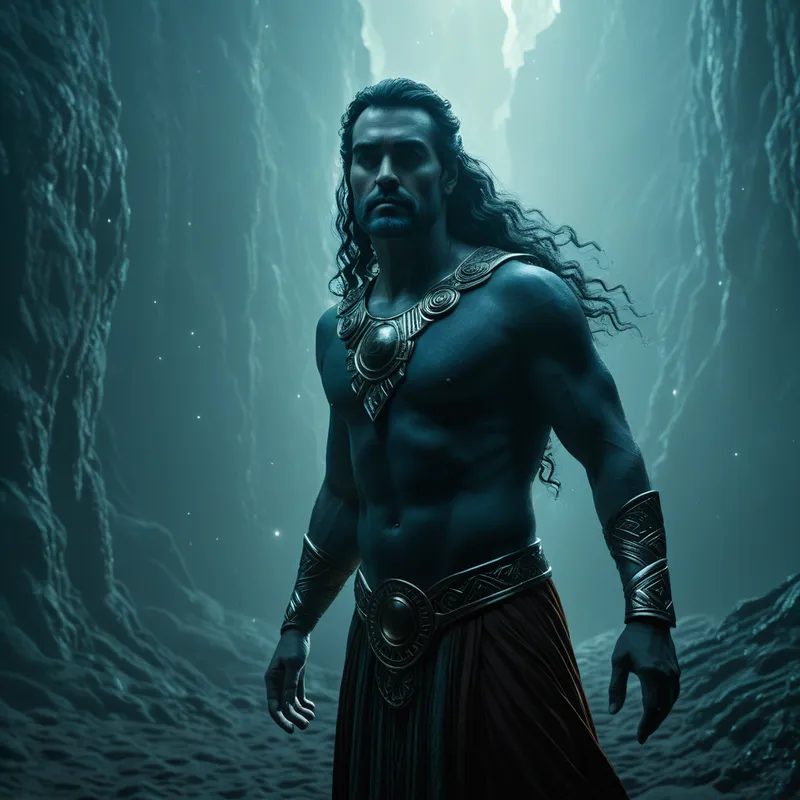
Shango of the Akan
Shango is the formidable Akan god of thunder, lightning, and justice, embodying both royal authority and the raw, untamed power of storms.
The Tale of Shango of the Akan
[The world](/myths/the-world “Myth from Tarot culture.”/) was heavy with injustice, the air thick with the silence of the oppressed. From the royal stool of the Oman, a king ruled not with wisdom, but with a capricious and cruel hand. His name was [Shango](/myths/shango “Myth from African Diaspora culture.”/), and his will was law. Yet, within his chest beat not only the heart of a ruler but the gathering storm. His famed temper was not mere human anger; it was the precursor to a divine awakening. The tale whispers that in a fit of royal rage, Shango sought to prove his supreme power by invoking a dangerous magic—the secrets of lightning. He caused bolts to strike his own palace, seeking to cow his people and rivals with a display of terrifying force. But the power he courted was not to be commanded by mortal pride. The flames he summoned turned upon him, consuming his home and, in the eyes of his subjects, his very life. In shame and despair, it is said he hanged himself upon an Onyina tree.
Yet, from the ashes of the king and the sacred wood of the tree, a new presence was born. Shango did not descend into [the earth](/myths/the-earth “Myth from Hindu culture.”/); he ascended into [the sky](/myths/the-sky “Myth from Persian culture.”/). His mortal failure was alchemized into divine office. The man became the god. Now, when the heavens darken and the first deep rumble echoes over the plains, it is the footfall of Shango. He rides the storm clouds, his voice the crack of thunder, his will made manifest in the searing, branching lightning. He is no longer the flawed king, but the embodiment of cosmic [justice](/myths/justice “Myth from Tarot culture.”/)—Katanko. His lightning is his swift, unerring judgment, striking down liars, oath-breakers, and the wicked. The rain he brings is not merely [water](/myths/water “Myth from Chinese culture.”/); it is the cleansing flood that follows divine verdict, washing away corruption to allow for new growth. He is the ultimate sovereign, whose authority is written in fire across [the sky](/myths/the-sky “Myth from Persian culture.”/) and whose law is fundamental as the storm itself.
Cultural Origins & Context
Shango’s veneration is most prominently associated with the Yoruba people, where he is a central Orisha. However, his presence and influence permeate West Africa, including among the Akan peoples (such as the Ashanti and Fante). For the Akan, Shango (or variations like Songo) is integrated into a complex spiritual landscape where deities often represent natural forces and moral principles. He is not an isolated figure but part of a dynamic [pantheon](/myths/pantheon “Myth from Roman culture.”/) interacting with other divine entities and the ancestral world.
His Akan iteration sits at [the crossroads](/myths/the-crossroads “Myth from Celtic culture.”/) of nature, monarchy, and morality. Historically, Akan societies were organized around powerful kingdoms with sacred kingship. The king’s power (tumi) was seen as divinely sanctioned but also held accountable to the welfare of the people and the ancestors. Shango’s mythos perfectly encapsulates this tension: he is both the archetype of the powerful ruler and the terrifying consequence of power abused. He legitimizes royal authority while simultaneously being the divine check upon it. His domain—thunder, lightning, and justice—exists beyond human institutions, making him the ultimate arbiter in matters of truth and falsehood. To invoke Shango is to appeal to a force that bypasses all earthly corruption, a concept deeply resonant in cultures with intricate legal and social systems.
Symbolic Architecture
Shango’s essence is a profound duality, a [synthesis](/symbols/synthesis “Symbol: The process of combining separate elements into a unified whole, representing integration, resolution, and the completion of a personal journey.”/) of destructive and generative forces. He is the terrifying flash that splits the [tree](/symbols/tree “Symbol: In dreams, the tree often symbolizes growth, stability, and the interconnectedness of life.”/) and the [life](/symbols/life “Symbol: The symbol of ‘Life’ represents a journey of growth, interconnectedness, and existential meaning, encompassing both the joys and challenges that define human experience.”/)-giving rain that follows. This makes him a [symbol](/symbols/symbol “Symbol: A symbol can represent an idea, concept, or belief, serving as a powerful tool for communication and understanding.”/) of necessary [rupture](/symbols/rupture “Symbol: A sudden break or tear in continuity, often representing abrupt change, separation, or the shattering of established patterns.”/), the catastrophic [event](/symbols/event “Symbol: An event within dreams often signifies significant life changes, transitions, or emotional milestones.”/) that clears the ground for new [life](/symbols/life “Symbol: The symbol of ‘Life’ represents a journey of growth, interconnectedness, and existential meaning, encompassing both the joys and challenges that define human experience.”/). His justice is not the slow grind of [human](/symbols/human “Symbol: The symbol of a human represents individuality, complexity of emotions, and social relationships.”/) courts; it is instantaneous, dramatic, and final.
He represents the psyche’s confrontation with its own potent, often repressed, rage—not as a flaw to be eliminated, but as a raw, divine energy that, when integrated, becomes the faculty of fierce discrimination and the courage to enact necessary boundaries.
His symbols—the double-headed axe, the thunderstone (edun ara), the colors red and white—speak to this union of opposites. The axe is a tool of both execution and cultivation. The thunderstone is a [weapon](/symbols/weapon “Symbol: A weapon in dreams often symbolizes power, aggression, and the need for protection or defense.”/) from the sky that becomes a sacred [altar](/symbols/altar “Symbol: An altar represents a sacred space for rituals, offering, and connection to the divine, embodying spirituality and devotion.”/) [piece](/symbols/piece “Symbol: A ‘piece’ in dreams often symbolizes a fragment of the self or a situation that requires integration, reflection, or understanding.”/) on [earth](/symbols/earth “Symbol: The symbol of Earth often represents grounding, stability, and the physical realm, embodying a connection to nature and the innate support it provides.”/). Red is the heat of fire and [blood](/symbols/blood “Symbol: Blood often symbolizes life force, vitality, and deep emotional connections, but it can also evoke themes of sacrifice, trauma, and mortality.”/); white is the purity of [truth](/symbols/truth “Symbol: Truth represents authenticity, honesty, and the quest for knowledge beyond mere appearances.”/) and the cleansing rain. Shango is the [moment](/symbols/moment “Symbol: The symbol of a ‘moment’ embodies the significance of transient experiences that encapsulate emotional depth or pivotal transformations in life.”/) of [crisis](/symbols/crisis “Symbol: A crisis symbolizes turmoil, urgent challenges, and the need for immediate resolution or change.”/) that forces [truth](/symbols/truth “Symbol: Truth represents authenticity, honesty, and the quest for knowledge beyond mere appearances.”/) to the surface, a divine violence against falsehood.
The Dreamer’s Resonance
To encounter Shango in the inner landscape is to be summoned to a reckoning. He appears when the soul’s atmosphere becomes heavy with unresolved injustice, repressed fury, or the need for sovereign assertion. He is the archetypal energy that erupts in dreams of storms, lightning strikes, or confronting powerful, kingly figures. This is not a call to uncontrolled anger, but a call to own one’s power—the power to judge, to set limits, to speak truth with conviction.
Psychologically, Shango represents the integration of the [Persona](/myths/persona “Myth from Greek culture.”/) of the responsible ruler with the Shadow of destructive rage. The individual who fails to integrate this energy may either become tyrannical (identifying with the king’s unchecked power) or pathologically passive (projecting all authority and anger outward). Shango’s full integration allows one to hold authority with humility, to express righteous anger without cruelty, and to wield personal power as an instrument of justice rather than domination. He is the [thunderclap](/myths/thunderclap “Myth from Various culture.”/) of a long-silenced voice finally speaking its truth.
Alchemical Translation
The myth of Shango’s transformation is a complete alchemical recipe for the soul. The [Nigredo](/myths/nigredo “Myth from Alchemical culture.”/), the blackening, is his despair and suicidal shame—the total dissolution of his mortal identity. The [Albedo](/myths/albedo “Myth from Alchemical culture.”/), the whitening, is his ascent into the sky, his purification into a celestial principle. The [Rubedo](/myths/rubedo “Myth from Alchemical culture.”/), the reddening, is his manifestation as the fiery lightning, the perfected, active divine force.
His process teaches that true, enduring power is not seized, but forged in the crucible of catastrophic failure and ego death. The lightning is not controlled; one must become the lightning—allowing the raw, chaotic force of one’s deepest nature to be channeled through the conductive rod of a purpose greater than oneself: justice.
In personal transformation, the “Shango moment” is often a crisis that feels like a lightning strike: sudden, devastating, and illuminating. It destroys an old, false structure of [the self](/myths/the-self “Myth from Jungian culture.”/) (the corrupt kingdom) to reveal a more authentic, potent, and principled core. The task is not to avoid the storm, but to learn to speak its language and understand its verdicts, allowing its fierce energy to cleanse and redefine one’s moral and psychic landscape.
Associated Symbols
Explore related symbols from the CaleaDream lexicon:
- Lightning — The instantaneous, penetrating flash of divine judgment and revelatory truth, cutting through obscurity and falsehood.
- Thunder — The formidable voice of divine authority and the rumbling approach of inevitable consequence or awakening power.
- Crown — The burden and authority of sovereignty, representing both legitimate rule and the isolation and accountability of ultimate power.
- Justice — The principle of cosmic moral balance, enacted not through slow deliberation but through direct, transformative retribution and restoration.
- Fire — The purifying and destructive force that consumes the old and corrupt, creating the necessary ashes from which new order can arise.
- Stone of Power — The concentrated, earthly embodiment of a celestial force, a [talisman](/myths/talisman “Myth from Global culture.”/) of authority that connects the wielder to primordial strength.
- Rage — The raw, untamed psychic energy that, when consciously integrated, becomes the fuel for righteous action and the enforcement of boundaries.
- Sky — The domain of the supreme and the transcendent, the source of weather as divine mood and the arena where cosmic dramas unfold.
- Tree — The living axis between earth and sky, a witness to sacrifice and transformation, and a conduit for spiritual ascent.
- Ritual — The structured invocation of divine force, a ceremonial container for channeling immense powers like storm and justice into the community.
- Rebirth — The essential promise following divine destruction, the emergence of a new, higher state of being from the ashes of the old self.
- Power Dynamics — The ever-shifting landscape of force, authority, and resistance, made visible and subject to correction by the intervening divine arbiter.