Seven Chakras Myth Meaning & Symbolism
A sacred narrative of the serpent's ascent through seven luminous wheels, awakening the dormant divine within the human form.
The Tale of Seven Chakras
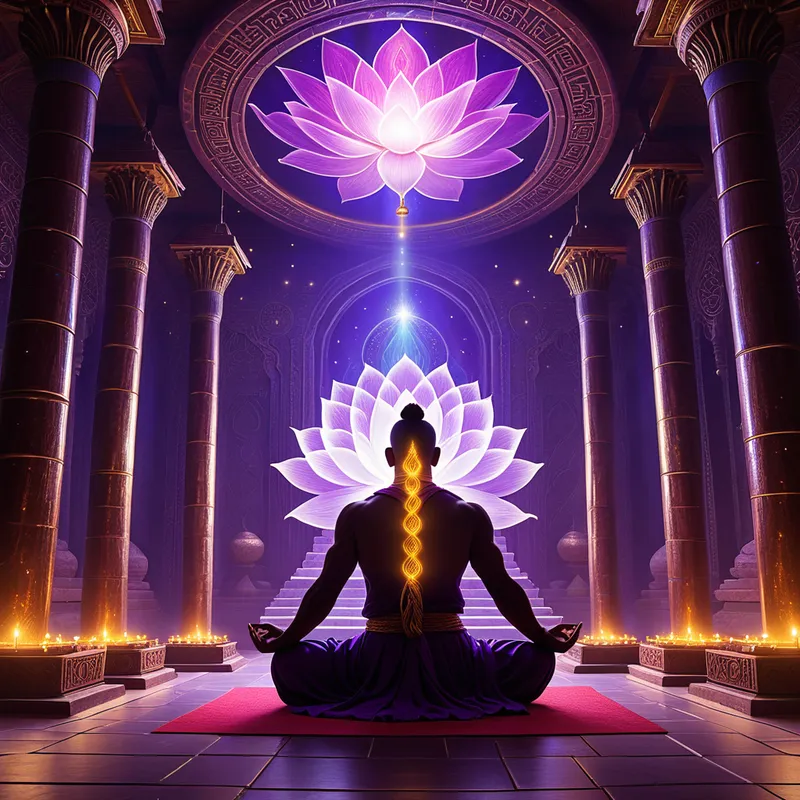
Listen. In the deep silence before the first word, there was a sleeping power. It lay coiled at the foundation of the world, at the very root of the human form, a serpent of potential slumbering in the red earth of the flesh. Its name was Kundalini.
She slept in the dark, in the cave of the pelvis, wrapped three and a half times around a black lingam of void. The world above her was a cacophony—a marketplace of desire, a battlefield of fear, a river of fleeting pleasure and pain. The human, a vessel of clay and breath, wandered this surface world, unaware of the dormant sun within their own marrow.
But sometimes, in the deep hour when the breath grows long and the mind grows still, a call would sound. Not from outside, but from the crown of the head, from a thousand-petaled lotus of pure starlight waiting, inverted, at the summit of the skull. A silent vibration, a note from the source of all notes. It would descend, a cascade of nectar, seeking its counterpart in the mud.
And the serpent would stir.
Her first movement was not a slither, but a warming. The cold, dense earth at the base began to glow with a coppery heat, a Muladhara awakening. Stability was found. The seeker felt rooted, a tree now, not scattered leaves. Emboldened, the fiery energy rose. It met a swirling vortex of water and orange flame—Svadhisthana. Here, the raw power became fluid, creative, a river of emotion and generative force.
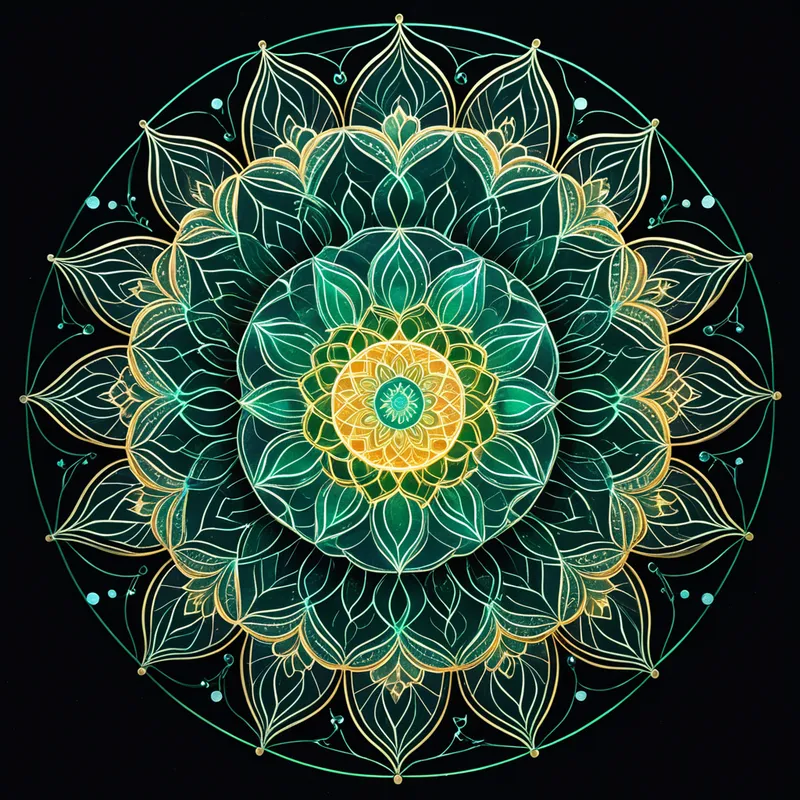
The ascent continued, a pilgrimage up the inner mountain. At the solar plexus, a blazing sun of yellow gemstone spun—Manipura. Here, the serpent-energy forged a will. "I am," it declared, separating its light from the shadows of the world. But will alone is a harsh master. So the energy softened, flowing into a chamber of jade-green light in the center of the chest—Anahata. The hard sun became a compassionate heart. The "I am" became "Thou art." The seeker felt the universe breathe in their own chest.
Cleansed by love, the energy refined itself further. In the hollow of the throat, a sphere of sapphire blue hummed—Vishuddha. The heart's feeling found its voice, its authentic expression. Lies fell away like dead skin. Truth resonated, clear as a bell.
Then, between the brows, a doorway opened. A lotus of indigo light, with two petals—Ajna. The inner eye saw. It witnessed the play of consciousness itself, the dance of thought and form. The seeker was no longer the actor, but the audience of their own mind.
Finally, the serpent, now a stream of liquid gold, reached the crown of the head. It touched the waiting lotus, the Sahasrara. The thousand petals unfurled, drinking in the light. In that moment, the boundary dissolved. The root touched the crown. The earth met the sky. The serpent was the path, the pilgrim, and the destination. The sleeping power was now the awakened presence. The human form was no longer a cave, but a temple flooded with dawn.
Cultural Origins & Context
The mytho-poetic system of the seven chakras is not the property of a single culture, but a profound synthesis that emerged primarily within the Tantric traditions of India, weaving together threads from the ancient Vedas, the esoteric practices of Tantra, and the systematic philosophy of Yoga. Its earliest textual mentions appear in the later Upanishads (c. 7th-8th century BCE onward), such as the Yoga Kundalini Upanishad, but its full symbolic architecture was mapped in medieval Tantric and Hatha Yoga manuscripts.
This was not a myth told around a fire to the many, but a secret map (yantra) whispered from guru to disciple. Its transmission was oral, experiential, and initiatory. The societal function was not to explain the cosmos, but to provide a precise, psycho-physiological blueprint for liberation (moksha). It served as an interior cartography for ascetics and yogis, a guide to transmute the raw materials of human existence—survival, desire, power, emotion—into the refined gold of enlightened consciousness. It grounded the lofty goal of union with the divine in the very real, tangible landscape of the human body.
Symbolic Architecture
The myth is a masterclass in symbolic architecture, presenting the human being as a microcosm of the universe. The spine becomes the axis mundi, the central pillar linking the underworld (instinct) with the heavens (spirit). The seven chakras are not mere energy centers, but distinct stages of alchemical transformation.
The journey from the root to the crown is the soul's odyssey from identification with matter to identification with pure consciousness.
Each chakra is a complete world with its own element, deity, sound (bija mantra), and psychological domain. Muladhara symbolizes our foundational right to be here and have our needs met. Svadhisthana governs our right to feel and create. Manipura asserts our right to act. The heart chakra, Anahata, is the crucial pivot—the transition from "me" to "we," from personal power to transpersonal love. The upper chakras then refine this connected awareness into truthful expression (Vishuddha), intuitive wisdom (Ajna), and ultimate unity (Sahasrara).
The serpent, Kundalini, is the potent, often repressed, life force itself—our untapped psychic potential and creative libido. Its ascent represents the awakening and integration of this primal energy into the totality of our being.
The Dreamer's Resonance
When this mythic pattern stirs in the modern dreamscape, it signals a profound process of psycho-somatic reorganization. Dreams of climbing ladders, spiraling staircases, or elevators moving through distinct floors often mirror the chakra ascent. A dream of a blocked or flooded basement (Muladhara issues) may coincide with life instability or financial fear. Vivid, turbulent dreams of oceans or forbidden sensual encounters may point to activations or disturbances in the Svadhisthana realm.
To dream of a blocked chakra is to feel, somatically, where your story has become stuck, where your life energy has congealed into a narrative of limitation.
A dream of a blinding, oppressive sun in the stomach area could reflect a Manipura struggle with powerlessness or uncontrolled anger. Conversely, dreams of healing green light, heart expansion, or repairing broken objects symbolize the heart chakra's integrative work. Dreams of speaking truths that shatter walls, or of a piercing blue light, engage Vishuddha. Visions of a third eye opening, or of seeing the world from a detached, panoramic view, are pure Ajna consciousness. The dreamer is not just having a dream; their unconscious is performing non-physical surgery on the subtle body, attempting to clear the passages for a more holistic flow of being.
Alchemical Translation
For the modern individual, the myth of the seven chakras is a timeless model of Jungian individuation—the process of becoming the integrated, whole Self. It provides a stage-by-stage map for psychic transmutation.
The initial stages are about containment. One must first establish a secure base (Muladhara) in reality, then learn to navigate the fluid world of emotion and relationship (Svadhisthana) without drowning, and finally forge a coherent ego (Manipura) capable of acting in the world. This is the development of a healthy personality.
The alchemical miracle occurs at the heart. Here, the ego's will must be sacrificed—not destroyed, but dissolved in the solvent of compassion. The hard, yellow gem of personal power is recast into the soft, green light of interconnectedness. This is the crucial transmutation.
Individuation is not a tower of solitude, but a wheel of relation. The heart is the hub where the separate self spins out into the world and the world spins back into the self.
The upper chakras then represent the refinement of this connected consciousness. One finds their authentic voice (Vishuddha), gains insight beyond the personal (Ajna), and ultimately experiences the Self not as a separate entity, but as a focal point of universal awareness (Sahasrara). The serpent's journey is the soul's journey from unconscious identification with the parts to conscious identification with the whole. It teaches that enlightenment is not an escape from humanity, but its ultimate fulfillment—a return to the root, now seen as divine, with the crown fully integrated into every step upon the earth.
Associated Symbols
Explore related symbols from the CaleaDream lexicon: