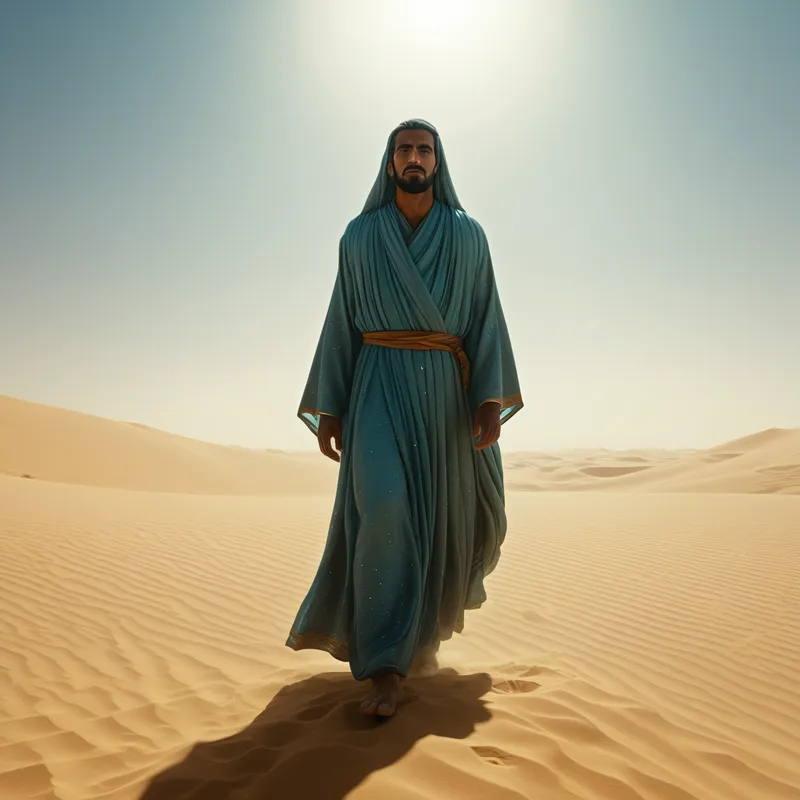
Sarāb Myth Meaning & Symbolism
A myth of a shimmering desert spirit, Sarāb, who lures the thirsty with visions of water, embodying the soul's treacherous encounter with its own deepest longings.
The Tale of Sarāb
Listen, and let the wind carry you to the Empty Quarter, where the sun is a tyrant and the sand a sea of glass. Here, in the time before time, when the world was a parchment scrawled by djinn, there walked a spirit born not of earth or water, but of the space between. Her name was Sarāb.
She was the sigh of the scorched stone, the shimmer above the salt flat. She did not walk, but wavered. She did not speak, but sang with the light. Her form was a promise—a pool of cool, deep water, ringed with date palms whose fronds whispered of shade. She was beauty woven from hunger, hope spun from despair.
And so, the travelers came. The merchant, his camels laden with silks, his heart laden with greed, would see her pools where none existed and drive his caravan into a labyrinth of dunes until all was lost. The poet, seeking solitude and inspiration, would follow her glimmering lakes to the heart of nothingness, finding only verses of dust. The lost soul, fleeing a tribe or a fate, would run towards her palms, arms outstretched, only to embrace the burning air.
But the tale speaks of one who was different. A youth named Hāmid, cast out from his clan for a crime of passion. For forty days and nights, he wandered, his waterskin long empty, his lips cracked like the land. On the forty-first day, as death perched on his shoulder, he saw her. Sarāb bloomed before him, more real than reality. A lake so blue it hurt, so clear he could see the pebbles at its bottom.
His body screamed to run. But Hāmid, in his extremity, felt a strange clarity. He saw how the palms did not quite sway in rhythm with the wind he felt. He saw how the water’s edge trembled not with waves, but with the pulse of the heat itself. He fell to his knees, not in supplication to the vision, but in exhaustion before the truth.
“I see you,” he whispered, his voice a rasp. “I see the beauty of my own thirst. If you are to be my end, let me meet you knowing your name.”
A silence fell, deeper than the desert’s. The shimmering form coalesced, and for a moment, the spirit of the mirage looked not like water, but like a woman of tragic, luminous eyes. “All who see me see their own deepest need,” her voice echoed, not in the air, but in his mind. “The merchant sees wealth. The poet sees fame. The fugitive sees escape. You, who are empty of all but the will to know… what do you see?”
“I see,” Hāmid gasped, “the shape of my longing. And it is beautiful.”
At those words, the vision of the lake did not vanish. It transformed. The water dissolved into a cool, merciful shadow on the sand. The palm trees became the outlines of low, hardy shrubs he had not noticed—the arfaj. Following their line, his blistered hand brushed against a stone, and beneath it, he felt not sand, but damp earth. He dug with his last strength, and there, welling up from a hidden fissure, was a seep of bitter, life-giving water. He drank, and the spirit of Sarāb faded into the daylight, not as a deception dispelled, but as a guide departed.
Cultural Origins & Context
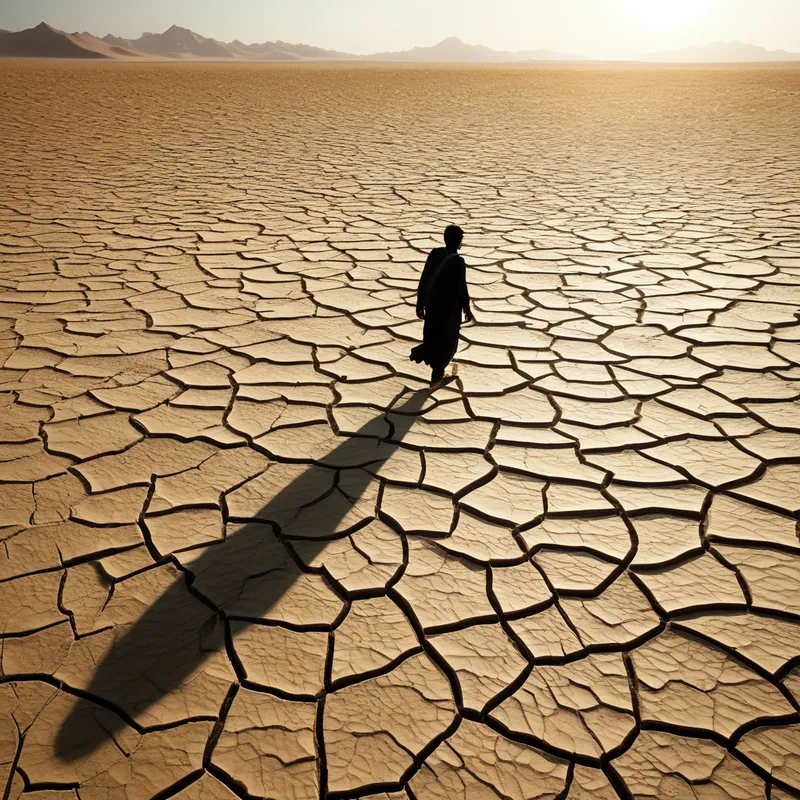
The myth of Sarāb is not a single story from a single tome, but a collective breath born from the very ecology of the Arabian Peninsula. It emerged from the oral traditions of Bedouin tribes, a necessary wisdom-technology for survival. Around night fires, elders would not merely describe a mirage as a physical phenomenon; they would personify it, giving it agency and intent. This served a critical societal function: to instill a profound, bodily respect for the desert’s tricks, and to teach discernment—the ability to question the evidence of one’s own desperate senses.
It is a pre-Islamic myth, belonging to the time of Jāhiliyyah, yet its essence was so powerful it was absorbed into later Islamic discourse. The Qur’an itself uses “sarāb” as the ultimate metaphor for the futility of disbelievers’ pursuits: “But the disbelievers’ deeds are like a mirage in a desert. The thirsty one thinks it is water until he comes upon it and finds it is nothing…” (Qur’an 24:39). This transition from a survival folktale to a theological metaphor shows how the symbol evolved from a warning about physical death to a warning about spiritual bankruptcy.
Symbolic Architecture
At its core, Sarāb is the archetypal symbol of the projective illusion. She represents not an external deception, but the mind’s terrifying and beautiful capacity to paint its deepest needs onto the blank canvas of reality.
Sarāb is the externalized shape of internal lack. She shows you not what is, but what you most desperately believe must be.
Psychologically, she is the embodiment of the anima in its most elusive, tantalizing form—or the animus as an unreachable savior. She is the promised land of the addict, the perfect love of the romantic, the guaranteed success of the ambitious. She is the siren song of the complex, the compulsive idea that this time, fulfillment lies just over that dune. The myth makes it clear: the danger is not in the longing, but in the failure to recognize that the vision is a mirror.
Hāmid’s triumph is not in conquering or dispelling Sarāb, but in seeing through her to himself. He does not reject the vision; he re-owns the longing that created it. This is the pivotal shift from being a victim of projection to becoming a student of one’s own soul.

The Dreamer's Resonance
When this myth stirs in the modern psyche, it often manifests in dreams of futile pursuit. You are running towards a train that always leaves the platform as you arrive. You are calling out to a loved one who turns a corner and vanishes. You are trying to read a crucial message, but the words blur and swim. The somatic feeling upon waking is one of hollow exhaustion, a tightness in the chest—the physiological signature of craving meeting emptiness.
This dream-state is not nonsense; it is a profound initiation. The dreaming culture.") mind is staging an encounter with your personal Sarāb. It is asking: What is the “water” you are chasing that remains perpetually out of reach? What life-saving solution have you projected onto a job, a relationship, a status, that those things can never truly provide? The anxiety in the dream is the friction between the ego’s plan for salvation and the soul’s knowledge of its true source.
Alchemical Translation
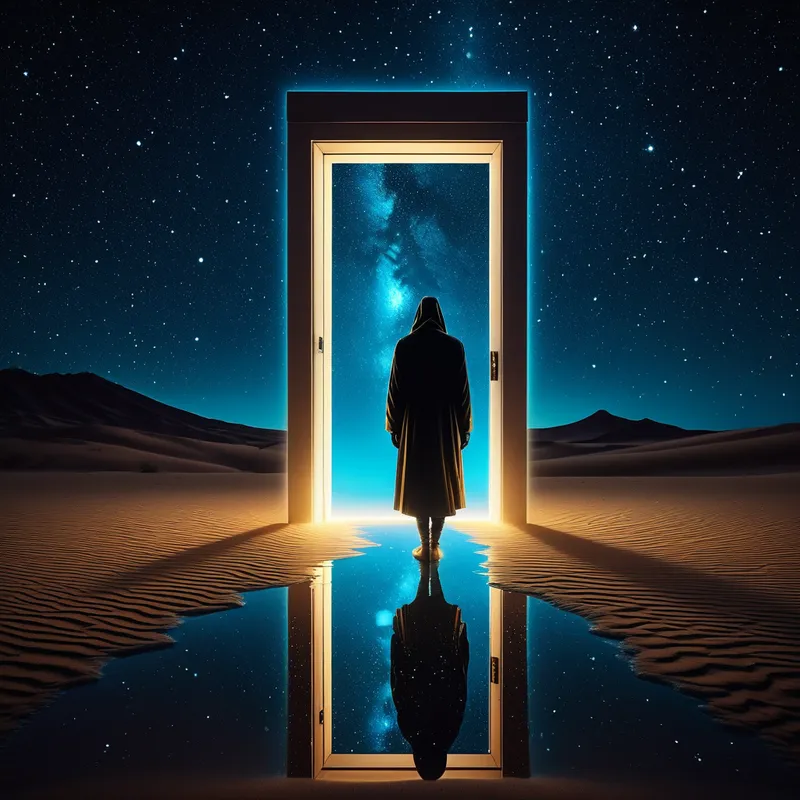
The journey with Sarāb models the alchemical stage of nigredo—the desert of the soul, the utter parching of old identities and certainties. In this scorched place, the psyche, in its agony, conjures its savior. The individuation process requires that we, like Hāmid, must have the courage to follow this shimmering vision to its apparent end, not to attain it, but to discover what it really points to.
The mirage does not lie about the existence of water; it lies about its location. It is a distorted reflection of a real, but hidden, source.
The “water” that Hāmid finds is not the grand, sparkling lake of his vision. It is a bitter seep, hidden under a stone. This is the alchemical gold: the authentic, often underwhelming, but real sustenance of the Self. It is the discovery that what we truly need is not the grandiose fulfillment of our projected fantasy, but the humble, concrete act of self-knowledge—digging in the damp earth of our own present reality.
The myth teaches that transcendence is not reached by grasping at illusions, even beautiful ones, but by the humble, gritty work of re-collection. We must reclaim the energy and hope we have projected onto the mirage and invest it instead in the patient, unglamorous search for the hidden arfaj—the resilient, authentic signs of life within our own landscape. In doing so, the spirit of Sarāb transforms from a deceiver into the most severe and necessary of guides, the one who leads us, by showing us everything we are not, to the stark truth of what we are.
Associated Symbols
Explore related symbols from the CaleaDream lexicon: