Samsin Halmoni Myth Meaning & Symbolism
The myth of the triple goddess of childbirth, weaving the fate of each life from the threads of destiny, sacrifice, and primal nourishment.
The Tale of Samsin Halmoni
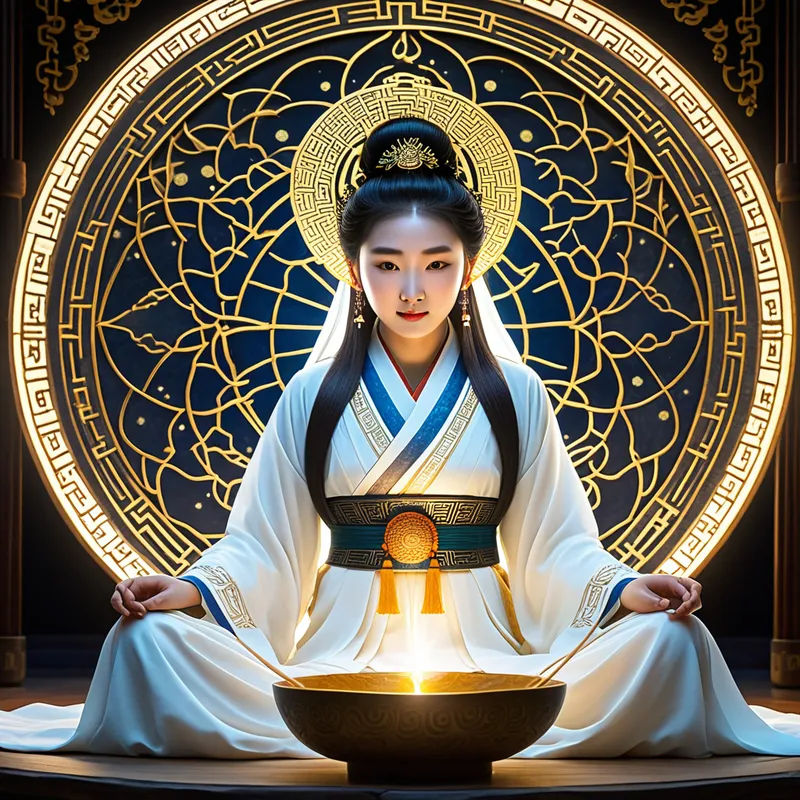
Listen, child, to the story that hums in the blood before the first breath is drawn. In the time before time, when the sky was a bowl of dark honey and the earth a sleeping beast, there existed a presence in the between-place. She was not one, but three, and yet she was a singular heartbeat in the silence. She was Samsin Halmoni.
Her chamber was not of stone or wood, but woven from the first sigh and the last whisper, a pavilion suspended where destiny dips its brush into the well of souls. Here, she sat with her three faces turned to the three winds of life. One face gazed into the Past, her eyes pools of memory deep as ancient wells. One face beheld the Present, her expression as calm as a moonlit pond. One face peered into the Future, her brow etched with the patterns of what was yet to be woven.
Her work was the Great Weaving. From a spindle of starlight, she drew the myeongjan, the thread of a soul’s destiny. But a thread alone is bare; it must be clothed in substance, given weight and warmth. And so, from her own essence, she made a sacrifice. Not with a cry, but with a profound, silent offering. From the breath of her first face, she spun the thread. From the vitality of her second, she gave it length. And from the very substance of her third, she paid the price for its earthly form—a drop of her own sacred blood, a measure of her own divine gi.
This offering fell not onto the earth, but into it, becoming the first seed. From this seed sprouted not a tree of wood, but the Tree of Life, its roots drinking from the underworld, its branches cradling the stars. And from this tree came the first sustenance: not mere grain, but sacred rice, each pearl a condensed fragment of her life-force, her compassion made edible.
When a soul is ready to journey from the spirit world into the world of flesh, it is Samsin Halmoni who prepares its passage. She measures the thread, cuts it to its appointed length, and imbues it with her triple gift: the memory of the before, the vitality for the now, and the secret destiny for the after. She places the thread in the womb of the mother, and for nine moons, she is the unseen guardian, the weaver in the shadows, ensuring the fragile vessel is nourished by her primordial sacrifice. Her presence is felt in the craving for the red bean rice, in the cool peace that follows a mother’s sip of seaweed soup—these are the earthly echoes of her divine, nourishing blood and her sustaining breath.
Cultural Origins & Context
The veneration of Samsin Halmoni is deeply rooted in the shamanic substrate of Korean culture, a tradition where the boundary between the divine and the domestic is porous. She is not a distant Olympian figure but a household deity, her shrine often a simple paper or cloth placed in the inner room, the anbang. Her myth was not preserved in formal epics but in the oral traditions passed down by mothers, grandmothers, and Mudang.
Her societal function was, and in some respects remains, profoundly practical and psychological. In a world of high infant and maternal mortality, she personified the terrifying, miraculous, and bloody process of childbirth. By giving her a face—three faces—and a story of compassionate sacrifice, the culture provided a framework to manage the profound anxiety surrounding birth. Rituals like offering bowls of rice and clean water, or hanging red pepper and charcoal to ward off evil spirits near the mother’s room, were acts of communion with Samsin. They were a way of saying, “We remember your sacrifice. Please continue your guardianship.” She transformed a biological event into a sacred, mythically-sanctioned passage, presided over by a benevolent, if stern, grandmotherly authority.
Symbolic Architecture
At its core, the myth of Samsin Halmoni is a symbolic map of the act of creation itself, where creation is always preceded by a necessary diminishment of the creator.
To give life is to consent to a sacred hemorrhage. The creator must become less, so that the creation may become.
The triple form is the primary symbol. She is the Triple Goddess—Maiden, Mother, Crone—compressed into a single moment of cosmic midwifery. She represents the three phases of time (Past, Present, Future) that converge to create a new point in the continuum. Psychologically, she embodies the three essential faculties needed to bring anything new into being: memory (the source material), present-moment action (the labor), and foresight (the purpose or destiny).
The thread and the sacrificial drop are the twin poles of the myth. The thread is order, destiny, the linear path of an individual life. The blood is chaos, vitality, the raw, unformed substance of life itself. The myth tells us that a destined life (myeong) cannot manifest without an infusion of this primal, sacrificial energy. The sacred rice is the alchemical result: the chaotic life-force transformed into structured, nourishing sustenance. It symbolizes how divine love becomes practical, daily care.
The Dreamer’s Resonance
When the pattern of Samsin Halmoni stirs in the modern psyche, it often surfaces in dreams of profound, creative anxiety or nurturing crisis. One might dream of trying to weave a tapestry, but the threads are made of liquid or light, impossible to control. Another might dream of a nurturing grandmother figure who is suddenly revealed to have a bleeding wound, yet she smiles peacefully. Or perhaps a dream of a room with three identical doors, behind each a different version of one’s own life.
These dreams signal a somatic and psychological process of gestation—but not necessarily of a child. We are gestating a new project, a new identity, a new phase of life. The anxiety is the recognition of the impending “sacrifice”: the time, energy, old identity, or comfort that must be “bled” to feed this new creation. The dream may also point to a search for inner nourishment, a feeling that one’s creative or vital energies are depleted, and a deep need to connect with the inner, primordial Great Mother who can replenish from an infinite source.
Alchemical Translation
The individuation process modeled by Samsin Halmoni is the alchemy of responsible creation. It moves us from being passive children of fate to conscious co-creators of our destiny.
The first step is recognizing the Three Faces Within—integrating our past (our personal and ancestral history), our present capacity, and our future potential into a unified purpose. This is the “weaving” of a coherent Self.
The core alchemical operation is the Willing Sacrifice. To bring something new and soulful into the world, we cannot simply rearrange old parts. We must offer something precious from our own substance—our time, our vulnerability, our certainty. This is the “drop of blood” that transforms fate (myeong) from a theoretical script into a lived, embodied reality.
The ultimate creation is not the object made, but the Self remade through the act of giving itself away to the creation.
Finally, the myth teaches Sustained Nourishment. Samsin does not just birth and abandon. She guards the gestation and provides the sacred rice. Psychically, this translates to the ongoing, often mundane, work of self-care and commitment that sustains a new venture or a new aspect of personality after the initial burst of creation. It is the daily “rice” of discipline, kindness, and attention that allows the newly born fragment of soul to grow strong.
We are all, in a sense, Samsin Halmoni. We hold the spindle of our potential. We pay for its realization with our life’s energy. And we are tasked with nourishing what we have brought forth, with a grandmother’s fierce, silent, and enduring love.
Associated Symbols
Explore related symbols from the CaleaDream lexicon:
- Thread — The luminous strand of destiny, or myeongjan, that Samsin Halmoni measures and weaves, representing the linear path and potential of an individual life.
- Blood — The sacred, sacrificial offering from Samsin’s own essence, symbolizing the raw life-force, vitality, and personal cost required to animate a destined form.
- Mother — The archetypal embodiment of Samsin Halmoni as the primal source of all nourishment, protection, and the sacred space of gestation.
- Bowl — The vessel holding the sacred rice, representing the container of transformation where divine sacrifice becomes sustainable earthly nourishment.
- Destiny — The pre-woven pattern of a life, which Samsin Halmoni both honors and imbues with the free will of her sacrificial vitality.
- Sacrifice — The central, silent act of giving a part of oneself to empower another’s existence, which is the foundational engine of creation in the myth.
- Tree — The Tree of Life that sprouts from Samsin’s sacrificial offering, connecting the underworld, earth, and heavens, and providing the substance (rice) of life.
- Rice — The alchemical product of Samsin’s sacrifice, symbolizing sustenance, fertility, and the transformation of divine energy into practical, life-giving form.
- Cave — Symbolic of the womb, the inner chamber, and the sacred, protected space where gestation and the mysterious work of creation occur under Samsin’s watch.
- Three — The fundamental number of the goddess, representing the phases of time, the aspects of the feminine, and the unified process of creation-persistence-destiny.
- Goddess — The divine feminine principle in its triple, nurturing, and fate-weaving aspect, presiding over the most profound of human transitions.
- Nourishment — The ultimate gift and function of Samsin Halmoni, representing the ongoing flow of care and sustenance required to maintain all that is born.