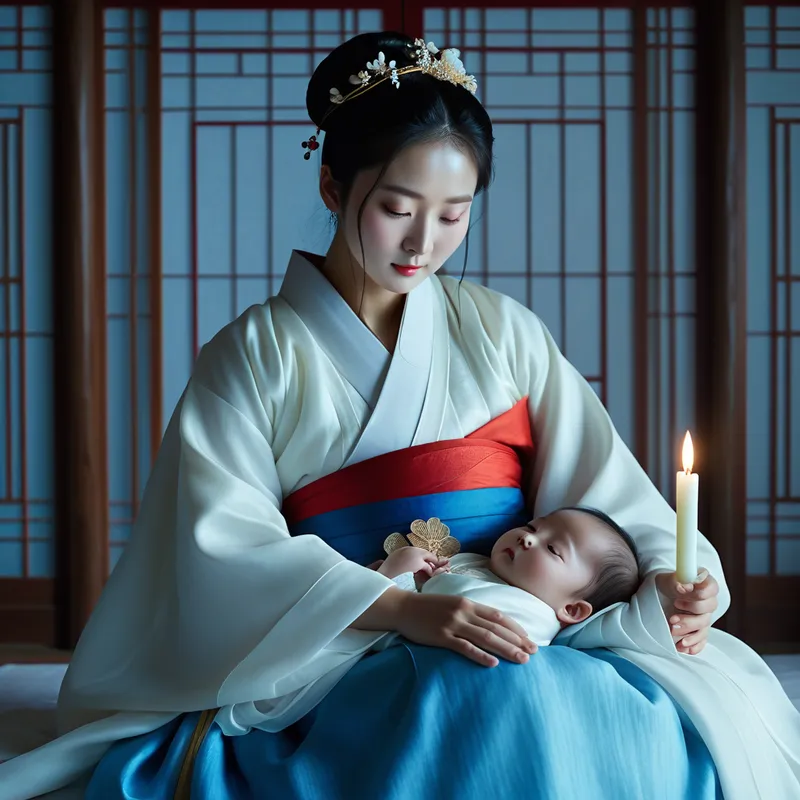
Samshin Goddess of Birth Myth Meaning & Symbolism
The myth of the Samshin Goddess reveals the sacred triad of creation, where life emerges from sacrifice and is sustained by a trinity of divine presence.
The Tale of Samshin Goddess of Birth
In the time when the world was woven from mist and mountain, when tigers spoke in proverbs and the first kings were descended from the heavens, there lived a woman. She was not a queen in a palace of jade, but a mother in a home of clay and thatch. Her name is lost to the whispering winds, but her story is etched into the very bones of the land.
She labored. Not for a day, nor for two, but for a time outside of time. The child within her was a promise so vast it strained the fabric of the mortal world. The midwives came and went, their faces etched with a growing dread. The hearth-fire guttered. The world held its breath. In her final, searing moment of agony, suspended between life and the great unknown, she did not cry out to the distant sky gods. Instead, she poured the entirety of her being—her love, her fear, her last breath—into a silent, fervent vow. Let this life continue, even if mine must be its soil.
And the world answered.
The air in the room did not stir, but it changed. It became thick with the scent of wet earth after first rain, of warm milk, and of sacred incense. The light from the single oil lamp fractured, not into darkness, but into three distinct, gentle glows: one white as moonlight on snow, one red as the life-river within, one blue as the deepest mountain spring. And from these coalescing lights, a presence formed. It was one, yet it was three. A figure of impossible grace, her form draped in robes that flowed between the three sacred colors. When she turned her head, you did not see one face, but saw them all at once—a maiden’s gentle smile, a mother’s knowing gaze, a crone’s serene acceptance.
This was Samshin Halmoni. She approached the still mother, and with hands that were both ephemeral and solid as stone, she reached into the very threshold of death. She did not pull; she guided. And from the silent mother, a child drew its first breath—a cry that was both lament and triumph. The mother’s spirit, like a final, loving exhalation, wove itself into the newborn’s soul, and then into the very walls of the home, into the land itself.
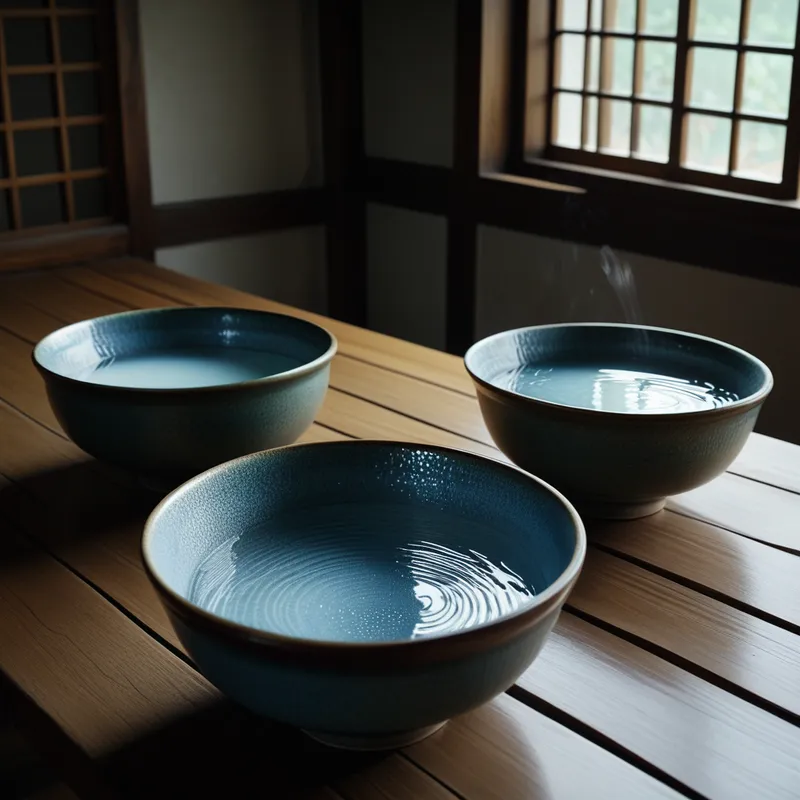
The Samshin Halmoni lifted the child, her threefold gaze holding the infant in a circle of absolute protection. “You are born of sacrifice,” her voice echoed, a chorus of three. “And by sacrifice, you shall be guarded. I am the first cry, the sustaining milk, and the guiding hand. For three days, this room is a sacred grove. For twenty-one days, this child is under my watch.” She placed the child in a cradle woven from moonlight and promise, and as she faded back into the numinous glow, she left behind a command that would echo for millennia: “Honor the triad. Set out three bowls of pure water. Speak no harsh words. For where life begins, the divine dwells.”
Cultural Origins & Context
The myth of Samshin Halmoni is not a tale confined to ancient texts, but a living tradition breathed into the daily rituals of the Korean home. Her worship was domestic, intimate, and profoundly feminine. Passed down from mother to daughter, from experienced halmoni (grandmother) to new bride, the story functioned as both sacred narrative and practical survival guide. It encoded critical postpartum knowledge—the samchil-il (three-seven days) of rest, the taboos against outsiders and negative speech—within a divine framework.
Societally, the myth served to sacralize the terrifying, bloodied mystery of childbirth, transforming it from a dangerous physical ordeal into a holy event presided over by a benevolent, triune force. The Samshin-dan, a simple shelf or chest holding the three bowls of water, rice, and sometimes seaweed soup, was the altar of this faith. It acknowledged that the creation of new life was the most potent magic, requiring a sacred pact between the human and the divine, between the sacrifice of the old and the hope of the new. This myth placed the power of creation and its guardianship squarely in the feminine realm, creating a spiritual matriarchy within the physical walls of the home.
Symbolic Architecture
At its core, the myth of Samshin is a profound map of creation itself. The triad—the three goddesses in one, the three bowls, the three weeks—is its fundamental architecture. This is not a simple numeric symbol, but a representation of the processual nature of reality: beginning, middle, and end; past, present, and future; maiden, mother, crone. Life does not spring from a void, but from a dynamic, interwoven relationship.
Birth is the alchemical moment where sacrifice becomes sustenance, where an ending is irrevocably woven into a new beginning.
The mother’s ultimate sacrifice is the foundational act. It represents the necessary “death” or dissolution of a previous state—the autonomous self, the maiden—to give form to the new. Her transformation into the protective spirit of the home signifies that true caregiving often requires a form of self-annihilation and rebirth. The Samshin Halmoni herself symbolizes the externalized, deified form of this nurturing intelligence. She is the archetypal Caregiver, but one who understands that care is rooted in the acknowledgment of loss and the cyclical nature of existence. The three bowls of water are a perfect symbol: water as the source of life, presented in triplicate, reflecting the ever-watchful, plural gaze of the divine. They are an offering, but also a mirror and a container for the sacred.
The Dreamer's Resonance
When this myth stirs in the modern dreamer, it rarely appears as a literal goddess in hanbok. Instead, it manifests as the feeling of the myth. One might dream of being in a warm, dark, enclosed space—a Cave or a secluded room. There is a palpable sense of a sacred, protected process unfolding. The dreamer may be tending to something fragile and luminous—a Seed, a glowing stone, a vulnerable animal.
Often, the triad appears in disguised forms: three lights in a hallway, three identical doors to choose from, three voices speaking in unison. This can signal a psychological process of integration, where disparate parts of the self (often the critical, the nurturing, and the observing ego) are coming into alignment to “midwife” a new aspect of personality into being. The somatic sensation is frequently one of profound pressure followed by release, or of being both the one laboring and the one witnessing the labor. Such dreams surface during life transitions that involve a creative “birth”—not just of a child, but of a project, a relationship, or a new identity—that requires the “death” of an old way of being. The shadow side of this dream may involve polluted water, broken bowls, or a feeling of being watched by hostile, multiple eyes, pointing to anxieties about inadequate support or the fear of being consumed by the demands of creation or care.
Alchemical Translation
For the individual on the path of individuation, the Samshin myth models the psychic transmutation required to bring any authentic element of the Self into conscious life. The “child” to be born is the nascent, true personality—a feeling, a talent, a long-buried truth. The “mother” who must undergo the sacrifice is the old ego-structure, the comfortable identity that must expand or dissolve to make room for this new life.
The alchemical process follows the myth’s threefold path. First, the Sacrifice (The White Light): This is the conscious surrender. It is the hard, painful labor of letting go—of outdated beliefs, of protective pride, of the fear that the new will destroy the old. This is the stage of purification, represented by the white bowl of water.
The psyche’s most profound creations are always birthed in the silent chapel where the ego makes its votive offering.
Second, the Vessel (The Red Light): This is the Cup of the unconscious itself, the nourishing, bloody, emotional womb where the new form gestates. It requires protection (samchil-il), a temporary withdrawal from the harsh, rational world to allow the fragile connection between conscious intent and unconscious content to solidify. This is the red bowl, the bowl of life-blood.
Third, the Guiding Presence (The Blue Light): This is the transcendent function, the Sage or inner Caregiver that emerges from the union of the conscious sacrifice and the unconscious vessel. It is not the ego, but a numinous, guiding intelligence—Samshin herself—that knows how to safely deliver this new psychic content into the light of day. This is the blue bowl, the bowl of spirit and deep knowing. The successful integration results not just in a “newborn” aspect, but in the transformation of the entire psychic “home,” which now holds the sacred, protective spirit of the process that created it.
Associated Symbols
Explore related symbols from the CaleaDream lexicon:
- Goddess — The triune form of Samshin represents the divine feminine as a process of creation, sustenance, and wise guardianship, embodying the full cycle of care.
- Birth — The central event of the myth, symbolizing not just physical childbirth but any profound emergence of new life, consciousness, or identity from a state of potential.
- Sacrifice — The mother’s ultimate offering is the foundational act, representing the necessary dissolution of one state of being to nourish and give form to another.
- Water — Presented in three bowls, water symbolizes the source of life, purification, reflection, and the fluid, containing essence of the feminine divine.
- Mother — The human mother who transforms through sacrifice represents the archetypal source of life and the primal act of nurturing that often requires selflessness.
- Child — The newborn represents pure potential, the nascent Self, and the vulnerable new beginning that requires absolute protection and sacred space to thrive.
- Cave — The secluded birth room symbolizes the womb, a protected psychic space where profound, vulnerable transformation can occur away from the outside world.
- Cup — The three bowls are vessels that hold the sacred offering; they represent the receptive, feminine principle that contains and nurtures the process of becoming.
- Door — The threshold between life and death that the mother and child cross, representing any liminal space of passage where one identity is left behind for another.
- Spirit — The mother’s essence that becomes part of the home, and the numinous presence of Samshin, representing the non-material, guiding force in creation and care.
- Circle — The triad of goddesses, days, and bowls forms a cyclical, complete system of protection and process, symbolizing wholeness and the eternal return.
- Tree — Symbolizing lineage, growth, and the connection between roots (ancestral sacrifice) and branches (new life), mirroring the family line Samshin protects.