Salvador Dalí's 'The Persistence of Memory' Myth Meaning & Symbolism
In a sun-blasted dreamscape, time melts, memory congeals, and a solitary figure sleeps, witnessing the dissolution of certainty into a soft, eternal now.
The Tale of Salvador Dalí’s ‘The Persistence of Memory’
Listen, and let your mind’s eye soften. There is a land not on any map, a province of the soul visited only when the vigilant sun hangs high and cruel in a sky of unyielding blue. This is the Port Lligat coast, a shore of the mind where the rocks are smooth as sleeping whales and [the earth](/myths/the-earth “Myth from Hindu culture.”/) is a cracked, pale hide.
Here, in this silent theater, the great drama of certainty unravels. The sentinel of this realm is not a king or a god, but a slumbering, amorphous creature—a creature of the shore. Its eyelashes are long, its form is both fetal and decayed, and it sleeps a sleep so deep it becomes the bedrock of [the world](/myths/the-world “Myth from Tarot culture.”/). It dreams, and the world dreams with it.
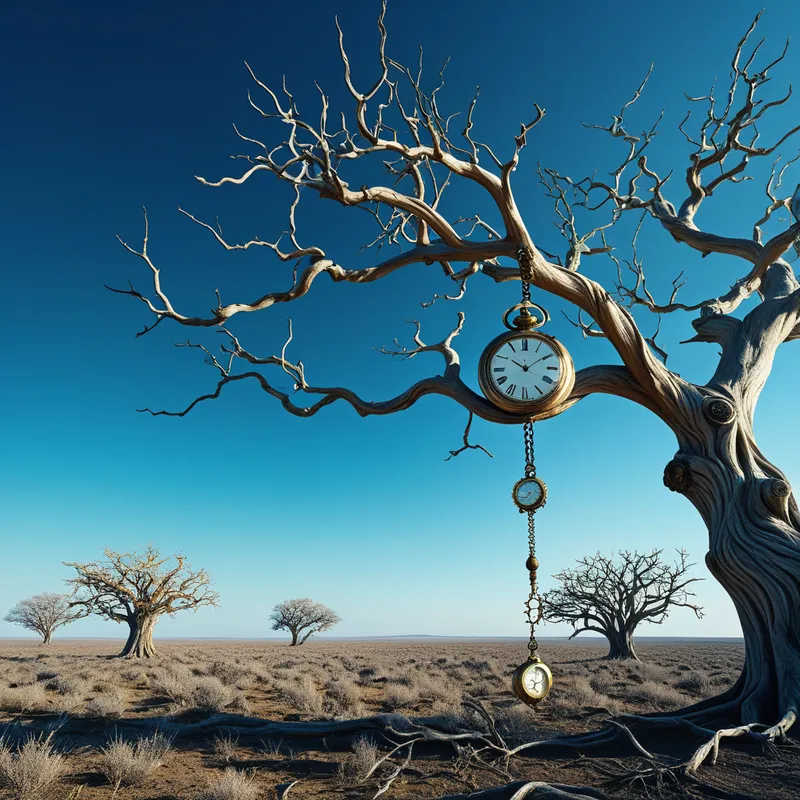
And from this dream, time bleeds. The hard, metallic ticks and tocks that govern the waking world lose their conviction. Three chronos-skins surrender to a new, languid law. One drapes itself over the dead limb of a silver-bone tree, its face bowed as if in prayer or exhaustion. Another melts over the edge of a rectangular plinth, its form becoming a viscous, golden cheese, its numbers meaningless. A third, covered in industrious ants, clings to the strange flesh of the dreaming creature itself, a parasitic idea feeding on slumber.
In the foreground, a solid box lies open, its interior black as a pupil, holding a single, untouched watch. This is the seed, the potential for measure, but here it is ignored, a relic from another age. A fly rests on the face of the molten clock on the plinth, and in the distance, reflected in a tranquil cove, the cliffs of another reality hang suspended.
The conflict is silent, total, and already won. It is the war between the hard, measured world of Chronos and the soft, eternal world of the dream. There is no rising action, only a profound, settled descent. The resolution is this: memory does not persist as a record, but as a sensation—a persistent, melancholic, beautiful feeling that outlasts the clocks meant to contain it. The myth ends not with a bang, but with a slow, endless drip.

Cultural Origins & Context
This myth was not chanted around fires but manifested in 1931, in the studio of a young Catalan painter named Salvador Dalí. It emerged from the cauldron of the Surrealist movement, a culture that rejected rationalism and sought to document the “absolute reality” of the unconscious mind. The myth was “passed down” not orally, but visually, through reproductions in art books, posters, and later, digital screens, becoming one of the most recognizable psychic artifacts of the 20th century.
Its societal function was revolutionary. In a world increasingly governed by industrial schedules and mechanistic thinking, Dalí’s painting acted as a psychic bomb. It gave form to a collective intuition: that our inner experience—of memory, anxiety, desire—operates on a logic that defies and melts the rigid structures imposed upon it. It served as a sacred icon for the religion of the irrational, a visual proof that beneath the surface of reality lay a far stranger, more fluid truth.
Symbolic Architecture
The symbols here are not mere objects but psychic organs in a [landscape](/symbols/landscape “Symbol: Landscapes in dreams are powerful symbols representing the dreamer’s emotional state, personal journey, and the broader context of life situations.”/) of the [soul](/symbols/soul “Symbol: The soul represents the essence of a person, encompassing their spirit, identity, and connection to the universe.”/).
The melting [chronos](/symbols/chronos “Symbol: Ancient Greek personification of time as a destructive, all-devouring force, representing inevitable change, decay, and the cyclical nature of existence.”/)-skins are the central [mystery](/symbols/mystery “Symbol: An enigmatic, unresolved element that invites curiosity and exploration, often representing the unknown or hidden aspects of existence.”/). They represent the collapse of objective, [linear](/symbols/linear “Symbol: Represents order, predictability, and a direct, step-by-step progression. It symbolizes a clear path from cause to effect.”/) time under the heat of subjective experience. In the unconscious, past, present, and future coexist and intermingle; a [memory](/symbols/memory “Symbol: Memory symbolizes the past, lessons learned, and the narratives we construct about our identities.”/) from [childhood](/symbols/childhood “Symbol: Dreaming of childhood often symbolizes nostalgia, innocence, and unresolved issues from one’s formative years.”/) can feel more immediate than the present [moment](/symbols/moment “Symbol: The symbol of a ‘moment’ embodies the significance of transient experiences that encapsulate emotional depth or pivotal transformations in life.”/). The watches’ softness signifies time’s plasticity in the realms of [memory](/symbols/memory “Symbol: Memory symbolizes the past, lessons learned, and the narratives we construct about our identities.”/), dream, and psychological [trauma](/symbols/trauma “Symbol: A deeply distressing or disturbing experience that overwhelms the psyche, often manifesting in dreams as unresolved emotional wounds or psychological injury.”/).
Time, in the psyche, is not a line but a pool—some memories float on the surface, others sink to the bottom, and all are subject to the same slow, inevitable dissolution.
The silver-bone [tree](/symbols/tree “Symbol: In dreams, the tree often symbolizes growth, stability, and the interconnectedness of life.”/) is [life](/symbols/life “Symbol: The symbol of ‘Life’ represents a journey of growth, interconnectedness, and existential meaning, encompassing both the joys and challenges that define human experience.”/) stripped of its temporal cycles—no seasons, no growth, no [death](/symbols/death “Symbol: Symbolizes transformation, endings, and new beginnings; often associated with fear of the unknown.”/). It is existence in a suspended state, a perfect [host](/symbols/host “Symbol: The symbol of a ‘host’ often represents nurturing, hospitality, or the willingness to offer support and guidance to others.”/) for the new, soft time. The ants, a recurring Dalínian [motif](/symbols/motif “Symbol: A recurring thematic element, pattern, or design in artistic or musical works, representing underlying ideas or emotional currents.”/), swarm the closed watch, symbolizing decay, [anxiety](/symbols/anxiety “Symbol: Anxiety in dreams reflects internal conflicts, fears of the unknown, or stress from waking life, often demonstrating the subconscious mind’s struggle for peace.”/), and the gnawing, organic processes that consume even our most precise constructs. The fly suggests ephemerality and insignificance, a brief [life](/symbols/life “Symbol: The symbol of ‘Life’ represents a journey of growth, interconnectedness, and existential meaning, encompassing both the joys and challenges that define human experience.”/) observing the [death](/symbols/death “Symbol: Symbolizes transformation, endings, and new beginnings; often associated with fear of the unknown.”/) of time itself.
The dreaming [creature](/symbols/creature “Symbol: Creatures in dreams often symbolize instincts, primal urges, and the unknown aspects of the psyche.”/) is [the Self](/myths/the-self “Myth from Jungian culture.”/) in a state of profound introspection or [regression](/symbols/regression “Symbol: A psychological or spiritual return to earlier states of being, often involving revisiting past patterns, memories, or developmental stages for insight or healing.”/). It is the [dreamer](/symbols/dreamer “Symbol: The dreamer represents the self, the conscious mind engaging with subconscious thoughts and feelings during dreaming.”/) from whose [psyche](/myths/psyche “Myth from Greek culture.”/) this entire landscape emanates. Its form, both organic and [alien](/symbols/alien “Symbol: Represents the unknown, otherness, and the exploration of new ideas or experiences.”/), represents the primal, pre-verbal state of being from which all conscious thought and measurement eventually harden.
The Dreamer’s Resonance
When this myth surfaces in modern dreams, it signals a profound somatic and psychological process: the deconstruction of personal chronology. The dreamer is not simply “seeing a weird clock.” They are undergoing an internal shift where the narratives that have structured their life—the timeline of their career, the story of a relationship, the schedule of their ambitions—are losing their solidity.
Somatically, this may feel like a loosening in the joints, a heaviness in the limbs, or a disorienting warmth—the physical echo of “melting.” Psychologically, it is the process of confronting the fluid nature of memory and identity. A dream of a melting watch often precedes or accompanies a period where long-held regrets (past) or anxieties (future) begin to lose their sharp, painful edges and blend into a more complex, manageable emotional substrate. The dream is the psyche’s way of practicing non-linear being, of allowing the hard edges of trauma or expectation to soften in the healing waters of the unconscious.
Alchemical Translation
The core struggle in this myth is the alchemical [solutio](/myths/solutio “Myth from Alchemical culture.”/)—the dissolution of a rigid, perfected form (the solid watch, the conscious ego) into its primal, chaotic matter (the molten metal, the unconscious). This is not destruction, but the necessary first step in psychic transmutation. [The ego](/myths/the-ego “Myth from Jungian culture.”/)’s tyrannical grip on a fixed identity and a linear life-story must be softened for a more authentic, fluid Self to emerge.
For the modern individual, the myth models the journey toward individuation by demonstrating the necessity of “melting time.” We are asked to enter our own Port Lligat—a state of deep reflection or therapy—and allow the measured successes and failures of our personal history to lose their absolute authority.
The triumph is not in rebuilding the clock, but in realizing you no longer need to tell time. The goal is to become the shore, not the watch.
The closed, ant-covered watch represents the hardened complex—a traumatic memory or rigid belief system—that is being actively broken down by the unconscious (the ants). The untouched watch in the box is the latent, potential for a new kind of time-consciousness, one not yet activated. The entire process is overseen by the sleeping Self, the inner Sage, who knows that wholeness is found not in ordering chaos, but in recognizing oneself within the beautiful, melancholic, persistent dream of being. The alchemical gold produced is not a new structure, but the profound, peaceful awareness of the eternal now that persists beneath all memory.
Associated Symbols
Explore related symbols from the CaleaDream lexicon: