
The Alchemy of the Impossible: When Dreams Turn Surreal
The Somatic Echo
Before the image forms, the body knows. It is a subtle vertigo, a liquid displacement in the inner ear. The ground beneath your dream-feet is both solid and not. Gravity operates on a whim. There is a pressure behind the eyes, not of pain, but of expansion—as if the very architecture of your skull is being gently pried open to admit a stranger geometry. This is the somatic signature of surrealism: the visceral sensation that the operating system of your perceived reality is undergoing a soft, profound crash. The rules of cause and effect, of object permanence, of time’s arrow, have been suspended. You are not in chaos, but in the pregnant silence between two frames of logic, feeling the old structures dissolve before the new syntax has fully arrived.
The Dreamer's Log
I stood in my childhood kitchen, but the ceiling was the night sky, pinpricked with unfamiliar constellations. My mother was there, speaking, but her words emerged as visible, three-dimensional letters that fell like heavy fruit into a sink that had become a bottomless well. I tried to catch them, but they dissolved into silver mist upon touch.
The alchemy here is the transmutation of familiar emotional language (a mother’s words) into an elusive, tangible yet ungraspable substance, revealing a deep longing to comprehend a foundational relationship that now operates on an entirely different, cosmic scale.
The False Lead
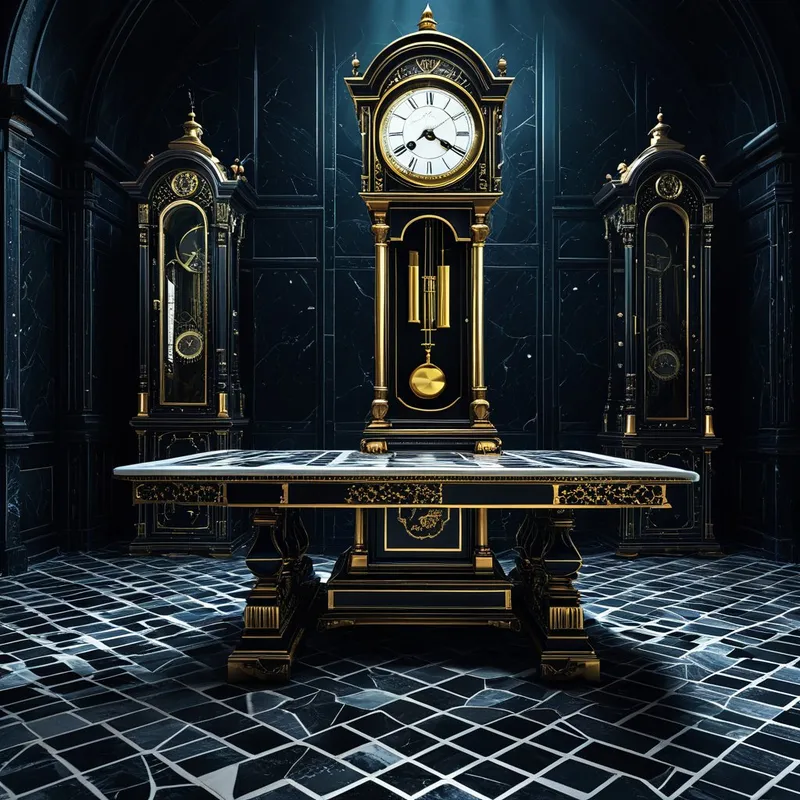
Surrealism is not mere randomness or "weird for weird’s sake." It is not the psyche’s garbage disposal, nor is it a sign of mental fragmentation. To dismiss a surreal dream as nonsensical is to mistake a profound structural shift for noise. The bizarre juxtapositions—a clock melting, a train emerging from a fireplace—are not failures of imagination, but its most precise and urgent language. This is the mind bypassing the censoring parliament of daytime logic to deliver a report from the frontier of your own becoming. It is the opposite of madness; it is a rigorous re-ordering.
Psychological Architecture
At its core, surreal dreamwork is the psyche’s declaration of independence from the tyranny of the literal. It is shadow work of the highest order, targeting not a single repressed memory or trait, but the very framework you use to organize reality itself. The conscious mind builds a habitable world upon certain agreements: walls are solid, time flows forward, identity is continuous. The surreal dream performs a controlled demolition of these agreements.
This is the individuation process in its most radical phase. You are not just integrating a forgotten part of yourself; you are witnessing the dissolution of the "self" as a fixed, centralized concept. The dream ego—your sense of "I" in the dream—is often a passive observer in these scenes, because the active agent is a deeper, impersonal intelligence restructuring the stage upon which the drama of "you" is played. It is the psyche using paradox as a solvent to break down the calcified boundaries between inner and outer, past and present, possible and impossible. The grief and terror often felt here is not for a lost object, but for a lost world—the familiar, coherent reality you thought you inhabited. The liberation offered is the sovereignty to inhabit a reality that is fluid, poetic, and far more true to the actual, mysterious nature of existence.
Mythic Resonance
We see this in the Celtic concept of the Thin Places, where the veil between the mundane world and the Otherworld wears through. In such places, logic falters; time dilates, and a day may pass as a century. The surreal dream is a personal Thin Place, a psychic locale where the membrane separating your internal mythology from your lived experience becomes permeable. Similarly, the Aboriginal Dreamtime is not a "dream" as we understand it, but a foundational, ever-present reality of creative potential that underlies and interpenetrates the visible world. To dream surrealistically is to have temporary, direct access to your own personal Dreamtime—the shaping layer of reality before it congeals into consensus form.
Symbolic Nodes
- Melting Clocks & Elastic Time: The deconstruction of linear, oppressive time.
- Floating/Flying Without Cause: The liberation from conventional laws (physics, social gravity).
- Impossible Architecture (Endless Staircases, Rooms Within Rooms): The psyche’s infinite complexity and hidden compartments.
- Anthropomorphic Objects (Talking Furniture, Watching Portraits): The latent consciousness and memory embedded in your environment and history.
- Fluid Transmutations (Person into Animal, Wall into Water): The essential fluidity of identity and emotional states.
Archetypal Resonance
The energy humming at the core of the surreal is that of The Magician Archetype. Not the shadow manipulator, but the pure Alchemist-Visionary. The Magician’s domain is the hidden substrate of reality, the underlying code that can be altered. The somatic echo of vertigo and cranial pressure is the Magician’s power stirring—the feeling of potential that exists before the spell is cast. The surreal dream is the spell: it rearranges symbols and laws with a wave of the unconscious wand. Its alchemical potential is total; it seeks not to fix a part of the self, but to change the very medium in which the self exists, offering the ultimate sovereignty: the ability to perceive, and thus participate in, the malleable nature of reality itself.
The Alchemical Process
The alchemy of surrealism is Dissolution (Solve). The intense psychological heat required is the courage to endure ontological uncertainty—to stay in the room while the walls melt. The pressure is the weight of meaninglessness that threatens to crush you when familiar narratives evaporate. The transmutation occurs not by interpreting each bizarre symbol literally, but by surrendering to the disorientation itself. You must let the old map burn. In that ashes, you do not find a new, better map. You find that the territory itself was alive, intelligent, and responsive. The grief of lost solidity is cooked into the profound sovereignty of knowing nothing is fixed, that you are in a dynamic, creative conversation with a universe that is dreamlike at its core. You move from being a tourist in a rigid world to a co-creator in a fluid one.
The Integration Protocol
Question 1: Where in my waking life do I feel the most rigid, unyielding pressure to conform to a single, "sensible" version of reality—be it in my work, my self-concept, or my relationships?
Question 2: If the central bizarre element of my surreal dream (the melting clock, the talking tree) was not a symbol of something, but a new, living law for something, what old law is it replacing?
Question 3: What felt more true—the disorienting freedom of the dream’s illogic, or the relief of waking up to "normal" rules? Where does that truth want to breathe in my daily life?
Action 1 (Somatic Anchoring): When you recall the surreal feeling, don’t reach for words. Instead, close your eyes and re-inhabit the bodily sensation of it—the vertigo, the expansion. Breathe into that space for two minutes, allowing it to be just a sensation, without a story. This grounds the experience in the body, not the confused mind.
Action 2 (Unstructured Transcription): Set a timer for 10 minutes. Write from the perspective of the most inexplicable object or scene from the dream (e.g., "I am the hallway that forks into a forest. My purpose is not to lead somewhere, but to be the moment of choice itself..."). Do not craft a story; let the entity speak its own logic.
Action 3 (Micro-Ritual of Dissolution): Take a small, rigid item that represents a "rule" you feel bound by (a stale to-do list, a formal business card). In a safe container, slowly burn a corner of it, watching the fixed form dissolve into smoke and ash. As you do, silently acknowledge one internal rule you are allowing to soften and become more fluid.
Final Validation
It is terrifying to feel the world you know soften at the edges, to watch the dependable props of reality warp and bend. This fear is not a sign of weakness, but a testament to how deeply you had invested in a coherent story. Honor that disorientation. For within that very liquefaction lies your most potent creative power: the ability to no longer just live in a world, but to subtly, profoundly, dream it awake. The surreal vision is not an error message; it is an invitation to log in as a developer, not just a user, of your own reality.