
Ruth Myth Meaning & Symbolism
A Moabite widow's unwavering loyalty leads her to a foreign land, where loss becomes the seed for a new lineage and a profound covenant of the heart.
The Tale of Ruth
The land was a mouth of dust. It had swallowed husbands, sons, and futures whole, leaving behind three widows in a house of echoes. Naomi, emptied of her men in the foreign plains of Moab, tasted only bitterness on her tongue. She turned her face toward Judah, a homeland now strange, and told her Moabite daughters-in-law to return to their own gods, their own mothers. One wept and turned back. The other, Ruth, clung.
Her voice was a vow that cut through the grief: “Where you go, I will go. Your people will be my people, and your God my God. Where you die, I will die, and there I will be buried.” It was not a plea, but a declaration. She bound her fate to a bitter woman and a foreign land.
So they walked, two shadows against the sun, arriving in Bethlehem at the barley harvest. The town buzzed with the rhythm of the sickle, a stark contrast to their poverty. Ruth, the stranger, said, “Let me go to the field and glean.” She became a figure of relentless motion among the stalks, following the reapers, gathering the forgotten sheaves left for the poor. Her hands grew raw, her back ached, but she gathered the fragments of a future.
The field belonged to Boaz, a man of substance. He saw her, asked after her, and heard the tale of her loyalty. His heart was moved. He offered her protection, water from his vessels, and a place among his workers. “May you be richly rewarded by the God of Israel,” he said, “under whose wings you have come to take refuge.”
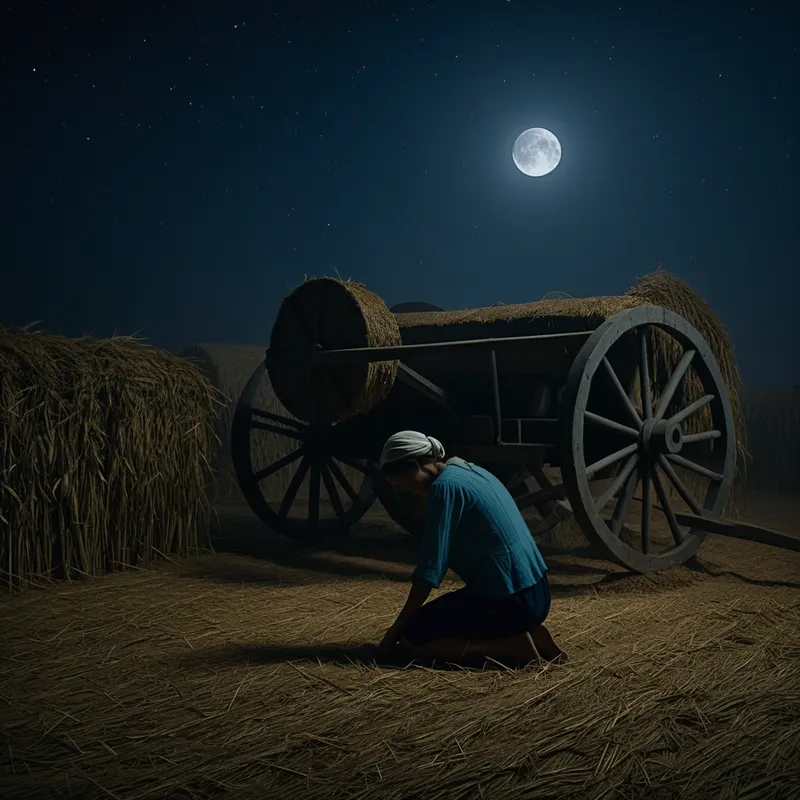
Naomi, seeing the kindness, saw a thread of hope. She knew the ancient law, the duty of the kinsman-redeemer. Under the cover of darkness, on the threshing floor where winnowed barley smelled of earth and promise, Ruth lay at the feet of Boaz. It was an act of profound risk and submission, invoking the covenant of family. Boaz awoke, and in the holy silence of midnight, he beheld her courage. “You are a woman of noble character,” he declared. He would be her redeemer.
But the thread of law had another claimant. At the city gate, before the elders, Boaz presented the choice: a nearer kinsman could redeem the land, but with it, he must take Ruth. The man, fearing for his own inheritance, refused. The sandal was passed, the deal sealed. Boaz took Ruth as his wife, and the barren widow bore a son. The women said to Naomi, “Your daughter-in-law, who loves you, is better to you than seven sons.” They placed the child in her arms, and the bitterness in her soul was sweetened. They named the boy Obed. He would be the father of Jesse, the father of David. From a field of loss, a royal lineage was gleaned.
Cultural Origins & Context
The Book of Ruth is a novella set “in the days when the judges ruled,” a time of social and moral chaos in Israelite memory. Yet its tone is not one of battle and betrayal, but of quiet, domestic fidelity. Scholars debate its date, with possibilities ranging from the early monarchy to the post-exilic period. Its placement in the Hebrew canon is telling: in the Christian Old Testament, it follows Judges; in the Hebrew Tanakh, it is part of the Ketuvim, read during the feast of Shavuot.
This positioning is key. The story functions as a counter-narrative. Against a backdrop of tribal strife and cyclical violence, it presents a vision of covenant loyalty (chesed) that transcends ethnicity and law. It was likely preserved and told to reinforce ideals of social responsibility (the gleaning laws, the role of the go'el), to grapple with the inclusion of foreigners in the community, and to provide a dignified, human-scale origin story for the Davidic monarchy. It is a folk tale elevated to sacred history, celebrating the unexpected channels through which divine providence flows.
Symbolic Architecture
At its core, Ruth is a myth of the Outsider Who Belongs. Ruth herself symbolizes the soul in transition—stripped of its former identity (daughter, wife in Moab), voluntarily entering a state of poverty and foreignness to cling to a deeper, if unknown, truth.
The most profound loyalty is not to a place, but to a connection. It is the choice to make someone else’s destiny your own, thereby forging a new one.
Naomi represents the Emptied Vessel, the psyche that believes its story is over. Her transformation from “Mara” (bitter) back to Naomi (pleasant) is catalyzed not by her own action, but by the loyal love of another. Boaz is the Principle of Rightful Recognition. He does not create the value in Ruth; he sees it, names it, and legally and socially integrates it. The field of Bethlehem is the Field of the Unconscious, where the soul must work humbly (“glean”) to gather the fragments that will sustain a new life.
The act on the threshing floor is rich with symbolic potency. The threshing floor is a place of separation (grain from chaff) and revelation. Ruth’s nocturnal approach is an act of strategic vulnerability, presenting her case not through demand, but through presence at the “feet”—a place of submission and petition. It is the moment the orphan’s need meets the redeemer’s capacity.

The Dreamer's Resonance
When this myth stirs in the modern dreamer, it often signals a profound psychological process of uprooting and re-rooting. To dream of being a foreigner in a familiar land, of following a bitter or lost figure, or of laboriously gathering small, golden things from a vast field, points to a season of existential migration.
Somatically, this may feel like a deep fatigue coupled with a stubborn determination—the “Ruth ache” in the shoulders from bending and gathering. Psychologically, it is the process of leaving behind an old identity (a relationship, a career, a belief system) that has “died,” not with grand rebellion, but with a quiet vow to follow a deeper, often painful, truth (the “Naomi” within). The dreamer is in the liminal space between “no longer” and “not yet,” practicing the daily, humble work of gleaning—collecting insights, small kindnesses, and moments of grace that will eventually constitute a new life. Anxiety here is not pathological; it is the fuel of the journey. The dream asks: To what or to whom are you pledging your loyalty, even in your poverty?

Alchemical Translation
The alchemy of Ruth is the transmutation of Loss into Lineage. It is not the hero’s journey of conquest, but the orphan’s journey of integration. The prima materia is the rubble of personal catastrophe—bereavement, exile, poverty. The first operation is Nigredo: Naomi’s bitterness, the ashes of Moab. The crucial agent of change is the vow: “Your people shall be my people.” This is the Albedo, the conscious, willful choice of connection over isolation, which begins to purify the despair.
The psyche’s redemption often comes not from overcoming the foreign, but from pledging allegiance to it within ourselves.
The fieldwork is the slow, conscious Citrinitas—the patient gathering and sorting of experience, the building of a new substance from what is freely given by life (the law of gleaning). The midnight encounter on the threshing floor is the inner confrontation where the orphaned part of the self (Ruth) presents itself to the inner authority capable of redemption (Boaz). It requires risking vulnerability to invoke the inner law of wholeness.
The final stage, Rubedo, is the birth of “Obed”—the new psychic structure, the “servant” or “restorer” that serves life. This new creation does not belong solely to the individual; it nourishes the entire inner family (Naomi is nourished), and it becomes a link in a greater chain of being (the lineage to David). The alchemical gold produced is not individualism, but covenantal selfhood—a self that finds its meaning and potency through loyal relationship to others and integration into a story larger than its own origins. The Moabite becomes the matriarch. The gleaner becomes the ancestor. The orphaned soul becomes a vessel of lineage.
Associated Symbols
Explore related symbols from the CaleaDream lexicon: