
River Styx Myth Meaning & Symbolism
The sacred, binding river of the Underworld, whose waters separate the living from the dead and form the unbreakable oath of the gods.
The Tale of River Styx
Listen, and hear the tale of the first and final promise, the water that is not water, the boundary that defines all boundaries. In the age when the Titans shook the heavens with their war against the Olympians, the world was raw with rebellion. Thunder was the only law.
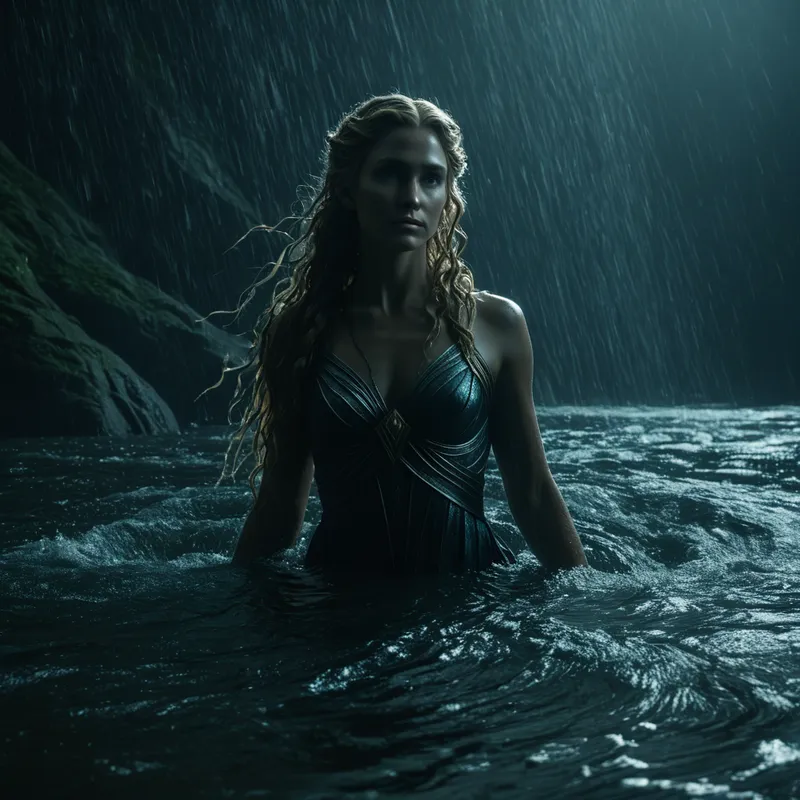
Amidst this chaos flowed a river not of earth, but of the deep earth’s secret heart. The Styx coiled through the sunless gorges of Tartarus, a frigid, black torrent. Its banks were not of soil, but of silence. Its nymph, the goddess Styx, daughter of Oceanus, was mighty, and she held a power even the thunder-god coveted: her children, Zelos, Nike, Kratos, and Bia—Zeal, Victory, Strength, and Force.
Zeus, battling from the heights of Mount Olympus, sent out a cry to all powers. "Who will stand with me? Who will pledge their might to the new order?" The rivers and nymphs trembled, weighing the fury of the Titans against the lightning’s promise.
Styx did not hesitate. She was the first to come. She left her dark channel and ascended to Olympus, her form dripping with the profound chill of her waters. Before the assembled gods, she brought her four formidable children. "Lord of the Bright Sky," she intoned, her voice like stones grinding in the deep. "I, Styx, and my children pledge ourselves to you. Let my river be the witness. Let any god who swears an oath upon my black waters suffer a terrible fate if they break it: a breathless trance for a great year, exiled from nectar and ambrosia, from council and laughter."
A hush fell. The very air tightened. Zeus, understanding the gravity of this gift—the very essence of binding commitment—accepted. He decreed that thenceforth, the oath by Styx would be the most holy and fearsome covenant. He kept her children always near his throne: Nike at his side, Kratos and Bia as his eternal enforcers.
And so, the river’s function was sealed. It became the great divider. When a mortal soul shed its body, it came to the Styx’s ashen shore. There, the aged, shrouded ferryman, Charon, would, for a coin placed upon the tongue of the dead, pole his skiff across the implacable current. To drink of its waters was to forget; to be immersed was to be invulnerable, yet utterly bound. The hero Achilles knew this truth, his heel forever whispering of the one spot the sacred waters did not touch.
Cultural Origins & Context
The myth of the Styx flows from the deepest wells of Greek thought, emerging in the epic poetry of Homer and the systematizing theogony of Hesiod. It was not merely a story of geography in the afterlife, but a foundational social and theological concept. In a culture where oral contracts and public oaths bound everything from treaties to testimony, the need for an absolute, supernatural guarantor was paramount.
The Styx provided this. It was the divine legal framework. When gods swore "by the Styx," it was the ultimate act of credibility, for even they were subject to its dreadful penalty. This myth was passed down by bards and poets, serving a critical societal function: it gave tangible, terrifying form to the abstract principle of horkos (oath). It taught that some boundaries, once crossed, incur an existential cost, a spiritual death that precedes the physical one. The river’s role as the entrance to Hades further cemented its cultural meaning as the ultimate point of no return, a concept every Greek understood from the moment they placed an obol in a loved one’s mouth for Charon’s fare.
Symbolic Architecture
The River Styx is not a river. It is the archetypal symbol of the Uncrossable Boundary, the Liquid Threshold. Its symbolism is triune.
First, it is the Waters of Severance. It physically and spiritually separates the realm of the living (consciousness, light, activity) from the realm of the dead (the unconscious, shadow, memory). It represents the necessary barrier between ego and the vast, unknown psyche. One cannot "visit" the unconscious without paying a price—the coin of attention, the effort of introspection.
Second, it is the Essence of the Binding Oath. Styx’s pledge to Zeus transforms the river from a geographical feature into a moral and psychic force.
To swear by the Styx is to stake one’s very essence on a promise. It symbolizes the moment a potential becomes a commitment, when a thought is forged into a destiny, with all the perils of failure inherent in that act.
Third, it is the Paradox of Invulnerability and Vulnerability. The story of Achilles reveals the river’s alchemical secret: total immersion grants invincibility, but at the cost of a hidden, fatal flaw. This is the core deal of the psyche. To become "invulnerable" in the world—to develop a strong persona—we often submerge parts of our true selves in the unconscious (the dark waters). That submerged self, however, remains the vulnerable heel, the point where fate can strike.
The Dreamer's Resonance
When the River Styx flows through modern dreams, it heralds a profound psychological transition. The dreamer is at a boundary they feel is irrevocable. Common motifs include standing before a dark body of water with no bridge, waiting for a ferry that may or may not come, or dropping a crucial object (the coin) into inky depths.
Somatically, this can feel like a heavy lethargy, a "breathless trance" akin to the gods’ punishment. Psychologically, it is the process of the ego confronting a necessary "death"—the end of a life phase, a relationship, an identity, or a long-held belief. The dream-Styx is the psychic representation of the liminal space between deaths and rebirths. The anxiety is not about the far shore (the new state), but the crossing itself—the terrifying release of the known for the unknown. The dream asks: What coin are you carrying? What are you willing to pay to be ferried across this inner change? What part of you must be left behind on the shore of who you used to be?

Alchemical Translation
The myth of the Styx models the critical, non-negotiable stage of psychic transmutation: the Oath to the Depths. Individuation is not a casual exploration. It requires a Stygian oath—a solemn commitment of the conscious ego to engage with the unconscious, no matter how dark or chilling that journey becomes.
The first step is Pledging the Children—offering one’s innate strengths (our zeal, our drive for victory, our inner strength and force) to the service of the greater, ruling Self (the Zeus principle of order and consciousness). This is the conscious decision to use one’s power for integration, not inflation.
The crossing with Charon is the Active Imagination phase. The coin is the focused attention we must pay to enter the inner world. Charon, the reluctant guide, is the instinctive, almost automatic process that begins once we pay that fee, carrying us into the landscape of shadow and memory.
The alchemical goal is not to avoid the river, but to become like the goddess Styx herself: to be the boundary, to contain the transformative waters, and to derive one’s sacred authority from the very act of witnessing and binding truth.
Finally, the myth teaches that this process confers a paradoxical power. By willingly immersing ourselves in the waters of the unconscious (confronting our shadows, our grief, our forgotten oaths), we gain a form of resilience. We are "dipped in the Styx." Yet, the process is never complete. The "Achilles’ heel" remains—the recognition of our enduring humanity, our specific vulnerability, which keeps us grounded and connected, even as we become more whole. The ultimate transmutation is understanding that the river of oath and the river of death are the same: to swear to be true to oneself is to let the old self die, so the new may cross over into being.
Associated Symbols
Explore related symbols from the CaleaDream lexicon: