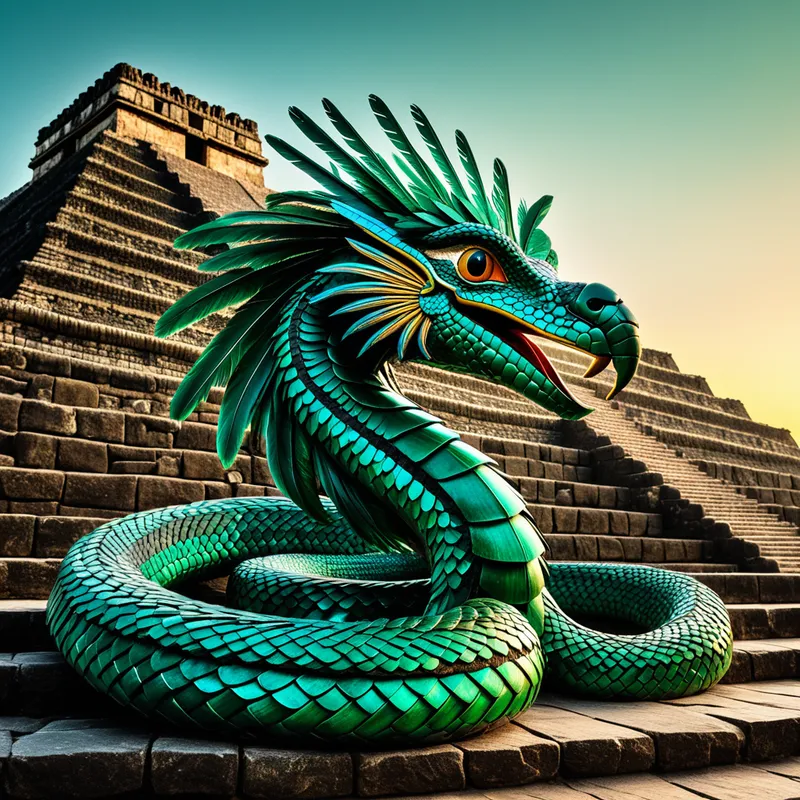
Quetzalcoatl Myth Meaning & Symbolism
The myth of the Feathered Serpent, a god-king torn between spirit and flesh, whose fall and promised return mirror the soul's struggle for redemption.
The Tale of Quetzalcoatl
Hear now the tale of the Plumed Serpent, the breath of dawn, the wind that stirs the maize. In the time of the Fifth Sun, the great city of Tollan shone like a jewel. Its streets were paved with jade, its gardens sang with birds of paradise, and its people knew no want. Their ruler was not a man of war, but a priest-king, a god made flesh: Ce Acatl Topiltzin Quetzalcoatl.
He was a being of profound contradiction, woven from earth and sky. His heart was a temple of compassion, his laws were just, and he forbade the offering of human hearts to the sun, teaching that only the sacrifice of snakes, birds, and butterflies—symbols of transformation—would suffice. Under his hand, corn grew tall, jade workers crafted wonders, and the arts of peace flourished. The air itself was sweet with the scent of flowers and the promise of a world ordered by wisdom, not blood.
But in the shadows of this radiant city, darker forces coiled. His brother, the mirror-twin Tezcatlipoca, the Smoking Mirror, watched with a jealous eye. Tezcatlipoca was the embodiment of change, chaos, and raw power—the necessary shadow to Quetzalcoatl’s luminous order. He descended to Tollan, not with an army, but with a trickster’s grin and a mirror that showed not a reflection, but the hidden truths of the soul.
Disguised as a venerable elder, Tezcatlipopa offered the king a gift: a draught of pulque, the fermented sap of the maguey. “It is mere medicine for your age,” he whispered. But it was a potion of forgetting. Quetzalcoatl, who had lived a life of austere purity, drank. The sacred fire in his spirit dimmed; the world tilted. In his intoxication, he called for his sister, the priestess Quetzalpetlatl, and in a moment of profound shame, broke his own sacred vows.
When dawn came, and the haze of the pulque cleared, Quetzalcoatl saw the ruin within. He saw his own fallen nature, the flesh that had betrayed the spirit. The city, once a reflection of his inner order, now felt like a cage of his own failure. Grief-stricken, he ordered a stone chest to be built, placed within it his finest ornaments and the symbols of his rule, and then sealed it deep within a mountain. He dressed in a garment of feathers and snake skin, and with his face painted black in mourning, he walked to the edge of the sea.
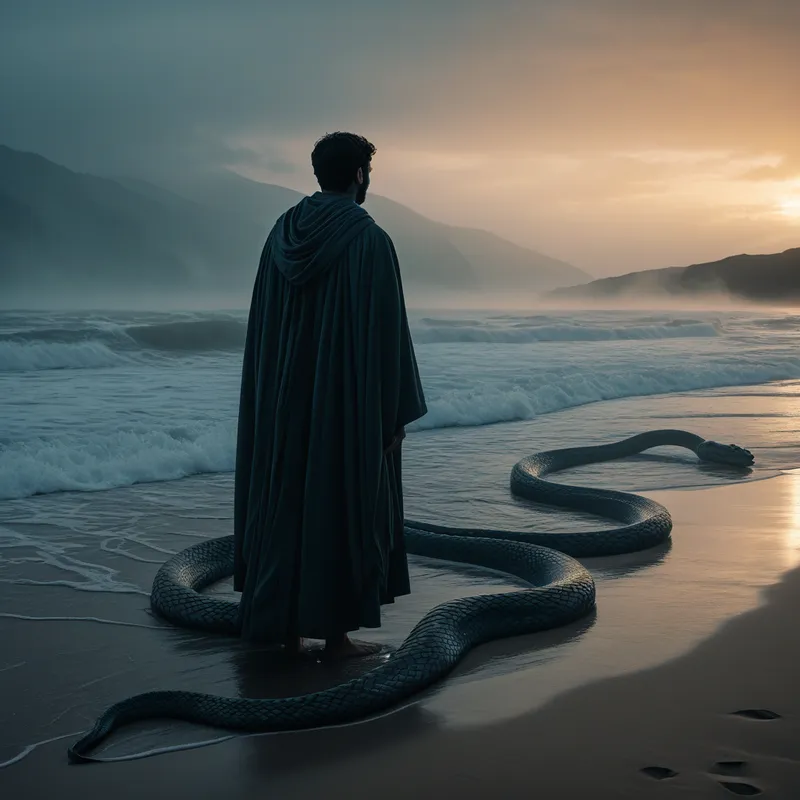
There, on the eastern shore, he built a raft of serpents. As he stepped upon it, his heart burning with remorse, he set himself alight. His ashes and heart did not scatter to the wind, but rose into the heavens. He became the Morning Star, Tlahuizcalpantecuhtli, a beacon of hope and a promise whispered on the wind: that one day, from the east, he would return.
Cultural Origins & Context
This profound narrative was not born in a vacuum, but in the crucible of Mesoamerican history. The figure of Quetzalcoatl has roots far older than the Aztec (Mexica) empire, stretching back to the Classic Maya as Kukulkan and to the ancient city of Teotihuacan. By the time the Mexica ascended to power in the 14th and 15th centuries, they had absorbed and reinterpreted this deity into their own complex cosmovision.
The myth was preserved in oral tradition by tlamatinime (wise ones) and recited in the calmecac schools for the nobility. It functioned on multiple societal levels. Politically, it served as a foundational charter, explaining the rise and fall of previous civilizations (like the revered Toltecs) and justifying the Aztec’s own martial ideology by contrasting it with Quetzalcoatl’s failed pacifism. Ritually, it was tied to the cycles of Venus and the wind, essential for agriculture. But at its heart, it was a moral and existential drama. It asked the people of the Fifth Sun, a world destined for cataclysm, a haunting question: Can purity survive in a world that demands sacrifice? Can spirit dwell untarnished in the vessel of flesh?
Symbolic Architecture
Quetzalcoatl is the ultimate symbol of synthesized duality. He is the Quetzalcoatl—the earth-bound, cyclical, instinctual serpent married to the sky-bound, aspirational, spiritual quetzal bird. He is not a hybrid, but a transcendent third thing, a being who holds the tension of opposites within a single form.
The true self is not found by choosing spirit over flesh, but by enduring the sacred tension where both coexist, where the serpent’s wisdom grounds the bird’s flight.
His story is a map of the soul’s inevitable confrontation with its own shadow, represented by Tezcatlipoca. The Smoking Mirror does not lie; it reveals the hidden, denied aspects of the self. Quetzalcoatl’s “fall” is not a moral failure in a simplistic sense, but a tragic encounter with his own humanity—his capacity for desire, weakness, and embodiment. The pulque represents the intoxicating, overwhelming power of the unconscious, which, when unexpectedly encountered, can shatter a too-rigid conscious identity built solely on purity and control.
His self-immolation and transformation into the Morning Star symbolize the necessary death of a naive, one-sided consciousness. It is an alchemical calcinatio—burning away the dross of a failed ideal to liberate the essential core, which then ascends to become a guiding light, a symbol of hope and cyclical return.
The Dreamer's Resonance
When this myth stirs in the modern psyche, it often manifests in dreams of profound inner conflict and potential rebirth. You may dream of being a revered leader who makes a catastrophic, shameful error, feeling the weight of a community’s disappointed gaze. You may dream of magnificent, feathered wings that are inexplicably heavy, tangled, or soiled—the aspiration weighed down by a sense of unworthiness or past action.
The somatic experience is one of a gut-wrenching split: a feeling of being torn between a high, spiritual calling and a base, instinctual pull. The dreamer might feel the serpent’s coil in their belly (anxiety, desire) while sensing the quetzal’s feathers itching between their shoulder blades (ambition, transcendence). This is the psyche working to integrate the persona—the “good,” acceptable, spiritual self—with the repressed shadow elements of passion, aggression, or earthly need that have been demonized. The dream is the Tezcatlipoca moment, forcing a confrontation with what the conscious self has refused to see.
Alchemical Translation
The journey of Quetzalcoatl is a master narrative for the Jungian process of individuation—becoming whole by integrating the conscious and unconscious. The first stage is the identification with a one-sided ideal (the wise, pure ruler). This is a necessary beginning, but it is fragile. Life, in the form of the trickster-shadow (Tezcatlipoca), inevitably intervenes, shattering this perfection through a crisis—often a failure, addiction, betrayal, or deep humiliation that reveals our flawed humanity.
The fall from grace is not the end of the journey, but its true beginning. It is the crack through which the unconscious floods in, demanding to be acknowledged.
The subsequent depression, shame, and exile (Quetzalcoatl’s mourning and flight) represent the nigredo, the dark night of the soul. This is not a pathology to be cured, but a sacred incubation. In this darkness, the old, rigid self-concept dies. The alchemical fire of this suffering is not punitive, but transformative. The key is not to bypass the shame, but to consciously endure it, to understand its message.
The final act—the fiery transformation and ascension as the Morning Star—is the rubedo, the reddening, the birth of the philosophic gold. This is the birth of the Self. The integrated individual is no longer a naive “pure spirit” nor a defeated “base creature.” They have become the Plumed Serpent: grounded in the reality of the body and the earth (the serpent), yet capable of visionary insight and creative flight (the feathers). They carry the memory of their fall not as a wound, but as the source of their compassion and depth. They become a guiding light for their own life, a promise that from the ashes of every failed ideal, a more complete, resilient, and authentic consciousness can dawn.
Associated Symbols
Explore related symbols from the CaleaDream lexicon: