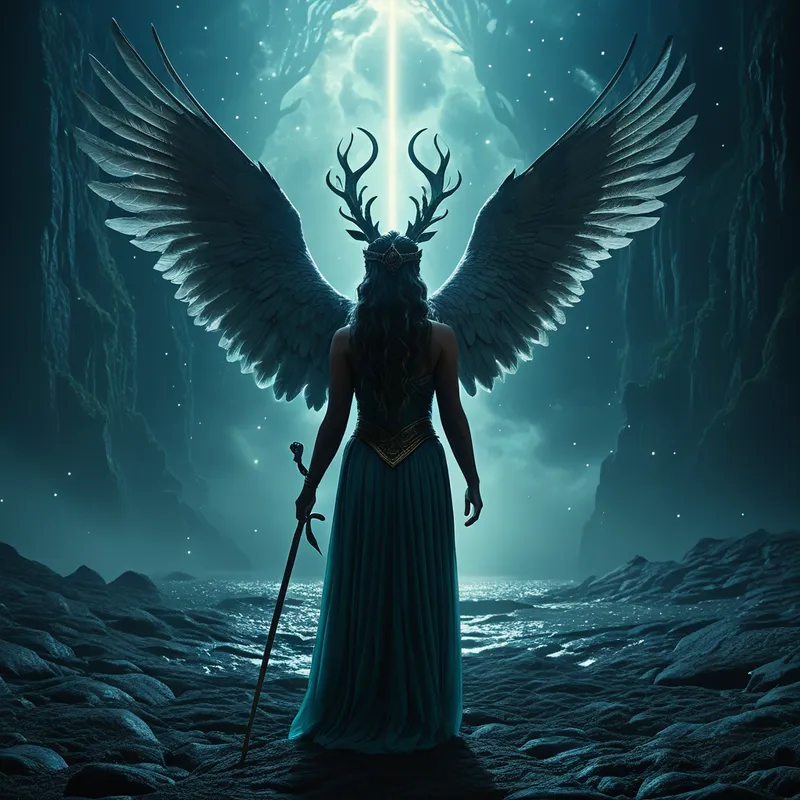
Quetzalcoatl and Tezcatlipoca Rivalry
The cosmic struggle between the feathered serpent god of wisdom and the smoking mirror god of chaos defines Aztec mythology's dualistic worldview.
The Tale of Quetzalcoatl and Tezcatlipoca Rivalry
In the beginning, there was only the primordial sea, Tehom, and the great earth monster, Tlaltecuhtli, whose body was the raw, fertile potential of all that could be. From [the void](/myths/the-void “Myth from Buddhist culture.”/), the twin principles of consciousness emerged: the plumed serpent, [Quetzalcoatl](/myths/quetzalcoatl “Myth from Aztec culture.”/), whose heart was [the wind](/myths/the-wind “Myth from Various culture.”/) and whose mind was [the morning star](/myths/the-morning-star “Myth from Astrological culture.”/), and his eternal counterpart, [Tezcatlipoca](/myths/tezcatlipoca “Myth from Mesoamerican culture.”/), the smoking mirror, whose foot was obsidian and whose reflection was the night sky. They were brothers, yet they were rivals, two halves of a single, restless soul.
Their first great act was one of violent creation. Seeing Tlaltecuhtli’s form adrift in the endless waters, they knew a world could not be born from such formlessness. In a pact of terrible necessity, they descended. Quetzalcoatl, the wise, and Tezcatlipoca, the cunning, transformed themselves into great serpents. They coiled around [the earth](/myths/the-earth “Myth from Hindu culture.”/) monster, gripping her limbs, and with a cosmic heave, they tore her body asunder. Her lower half they flung upward to become [the sky](/myths/the-sky “Myth from Persian culture.”/); her upper half they anchored below to become the earth. From her hair grew trees and flowers, from her skin the grass and plains, from her eyes the springs and wells, and from her mouth the rivers and caves. Her cries of agony became the winds and storms, and the gods promised her that human blood would one day fall like rain to soothe her eternal pain. Thus, from a primal act of conflict, [the world](/myths/the-world “Myth from Tarot culture.”/) was born.
But the rivalry did not end with creation; it became the engine of the ages. In the mythic era of the first sun, Tezcatlipoca ruled as the sun. His reign was one of giants and raw power, but it was unstable. Quetzalcoatl, in an act of challenge, struck his brother from the sky with a great club. Tezcatlipoca, falling, transformed into a jaguar that devoured the giants, ending that world. When Quetzalcoatl then took his turn as the sun, his era was one of gentle winds and nourishment. Yet Tezcatlipoca, ever [the trickster](/myths/the-trickster “Myth from Various culture.”/), would not allow such peace. He descended, disguised himself, and offered Quetzalcoatl a gift: a mirror. When the feathered serpent gazed into it, he saw not his divine radiance, but a mortal, aging face. Stricken with shame and self-awareness, his reign was undermined. Later, with a more devastating trick, Tezcatlipoca offered him the intoxicating pulque. Quetzalcoatl, in his drunkenness, broke his own priestly vows. Consumed by guilt and impurity, he was driven into exile, setting himself aflame on the eastern shore as his heart ascended to become the planet [Venus](/myths/venus “Myth from Alchemical culture.”/), the morning star.
Their struggle was not merely destructive; it was creative tension. They were the twin poles of existence: Quetzalcoatl, the civilizing force who discovered maize, gifted arts and knowledge, and abhorred human sacrifice; Tezcatlipoca, the sovereign of fate, the patron of warriors, the instigator of conflict and change who demanded the sacred offerings of blood. One built, the other tested. One illuminated, the other obscured. One sought order, the other embodied the [chaos](/myths/chaos “Myth from Greek culture.”/) that makes order necessary.
Cultural Origins & Context
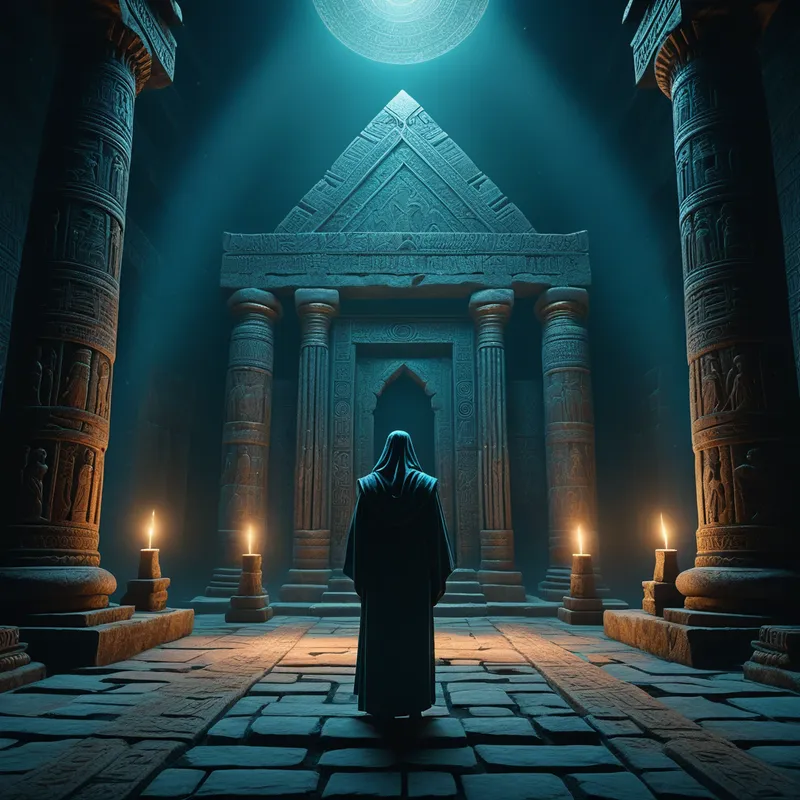
This foundational rivalry is woven into the very fabric of Aztec, or more accurately, Nahua, cosmology. It reflects a worldview that saw the universe not as a static creation, but as a dynamic, perilous, and cyclical process maintained by opposing yet complementary forces. The Aztec world was Nahui Ollin, [the Fifth Sun](/myths/the-fifth-sun “Myth from Aztec culture.”/), born from the sacrifice of the gods at Teotihuacan. This precarious era was believed to be sustained only by the energy of tonalli (life force), most potently offered through nextlahualli (the debt payment) of human blood and hearts. The Quetzalcoatl-Tezcatlipoca dynamic explained why the world required such severe sustenance.
Quetzalcoatl was deeply associated with the priestly class, learning, the wind ([Ehecatl](/myths/ehecatl “Myth from Mesoamerican culture.”/)), and the planet Venus. His cult center was the great city of Cholula. Tezcatlipoca was the god of the nocturnal sky, destiny, sorcery, and the tlatoani (the ruler). He was the patron of the Aztec capital, Tenochtitlan. Their rivalry thus mirrored real social and political tensions between the wisdom of priests and the power of kings, between the ideals of peaceful cultivation and the necessities of imperial warfare. The myth of Quetzalcoatl’s exile and promised return from the east was famously, and tragically, conflated by the Aztec emperor Moctezuma II with the arrival of the Spanish conquistadors under Cortés, a historical cataclysm born from mythological expectation.
Symbolic Architecture
The rivalry presents a symbolic [architecture](/symbols/architecture “Symbol: Architecture in dreams often signifies structure, stability, and the framing of personal identity or life’s journey.”/) of profound duality. Quetzalcoatl, the [Feathered Serpent](/symbols/feathered-serpent “Symbol: The Feathered Serpent represents a blend of wisdom, duality, and the interplay between the earthly and the spiritual.”/), is a union of opposites: the [serpent](/symbols/serpent “Symbol: A powerful symbol of transformation, wisdom, and primal energy, often representing hidden knowledge, healing, or temptation.”/) of [earth](/symbols/earth “Symbol: The symbol of Earth often represents grounding, stability, and the physical realm, embodying a connection to nature and the innate support it provides.”/), instinct, and cyclical renewal, married to the quetzal [bird](/symbols/bird “Symbol: Birds symbolize freedom, perspective, and the connection between the earthly and spiritual realms, often representing the soul’s aspirations or personal growth.”/) of sky, [spirit](/symbols/spirit “Symbol: Spirit symbolizes the essence of life, vitality, and the spiritual journey of the individual.”/), and transcendent [beauty](/symbols/beauty “Symbol: This symbol embodies aesthetics, harmony, and the appreciation of life’s finer qualities.”/). He is the [axis](/symbols/axis “Symbol: A central line or principle around which things revolve, representing stability, orientation, and the fundamental structure of reality or consciousness.”/) mundi, the world [tree](/symbols/tree “Symbol: In dreams, the tree often symbolizes growth, stability, and the interconnectedness of life.”/) connecting [heaven](/symbols/heaven “Symbol: A symbolic journey toward ultimate fulfillment, spiritual transcendence, or connection with the divine, often representing life’s highest aspirations.”/) and [earth](/symbols/earth “Symbol: The symbol of Earth often represents grounding, stability, and the physical realm, embodying a connection to nature and the innate support it provides.”/). Tezcatlipoca, whose name means “Smoking Mirror,” is the surface that both reveals and distorts. His mirror, made of [obsidian](/symbols/obsidian “Symbol: A volcanic glass symbolizing protection, transformation, and hidden truths. It represents sharp clarity and dark, reflective depths.”/), does not show the outer world, but the inner [truth](/symbols/truth “Symbol: Truth represents authenticity, honesty, and the quest for knowledge beyond mere appearances.”/), the [shadow](/symbols/shadow “Symbol: The ‘shadow’ embodies the unconscious, repressed aspects of the self and often represents fears or hidden emotions.”/), the hidden intentions and the fickle [nature](/symbols/nature “Symbol: Nature symbolizes growth, connectivity, and the primal forces of existence.”/) of [fate](/symbols/fate “Symbol: Fate represents the belief in predetermined outcomes, suggesting that some aspects of life are beyond human control.”/). His missing foot, replaced with an [obsidian mirror](/symbols/obsidian-mirror “Symbol: Represents introspection and the confronting of one’s inner truth, often associated with shadow work.”/) or a [serpent](/symbols/serpent “Symbol: A powerful symbol of transformation, wisdom, and primal energy, often representing hidden knowledge, healing, or temptation.”/), signifies a sacrifice for power, a divine wound that grants omniscience.
This is not a battle between good and evil, but between consciousness and the unconscious, between the ego’s desire for order (Quetzalcoatl) and the psyche’s inherent, chaotic vitality (Tezcatlipoca). The smoking mirror is the psyche’s own depth, showing the self what it does not wish to see.
Their cyclical destruction and creation of world ages speaks to a [universe](/symbols/universe “Symbol: The universe symbolizes vastness, interconnectedness, and the mysteries of existence beyond the individual self.”/) in constant, necessary [flux](/symbols/flux “Symbol: A state of continuous change, instability, or flow, often representing the impermanent nature of existence and experience.”/). [Stability](/symbols/stability “Symbol: A state of firmness, balance, and resistance to change, often represented by solid objects, foundations, or steady tools.”/) is an illusion; growth only occurs through the [tension](/symbols/tension “Symbol: A state of mental or emotional strain, often manifesting physically as tightness, pressure, or unease, signaling unresolved conflict or anticipation.”/) of opposites. One cannot exist without the other. A world of pure Quetzalcoatl would be [static](/symbols/static “Symbol: Static represents interference, disruption, and the breakdown of clear communication or signal, often evoking feelings of frustration and disconnection.”/), devoid of challenge and evolution. A world of pure Tezcatlipoca would be formless, predatory [chaos](/symbols/chaos “Symbol: In Arts & Music, chaos represents raw creative potential, uncontrolled expression, and the breakdown of order to forge new artistic forms.”/). Their struggle is the divine dialectic.
The Dreamer’s Resonance
Within the inner landscape, the Quetzalcoatl-Tezcatlipoca dynamic plays out daily. Quetzalcoatl is our aspirational self: the part that seeks knowledge, creates art, strives for ethical purity, and builds a coherent identity. He is the voice that says, “I should be better.” Tezcatlipoca is the trickster within: the sudden, disruptive emotion; the shadowy impulse that shatters our self-image; the critical inner voice that exposes our hypocrisies; the unforeseen change of fortune that forces adaptation.
When we gaze into Tezcatlipoca’s smoking mirror, we do not see our curated [persona](/myths/persona “Myth from Greek culture.”/). We see our aging face, our hidden envy, our capacity for deceit, our primal rage. This confrontation, like Quetzalcoatl’s, can lead to a crisis of shame and exile from our own idealized self. Yet this very shattering is initiatory. It is only by integrating this shadow—the Tezcatlipoca energy—that we achieve a more complete, resilient consciousness. The rivalry reminds us that psychological wholeness is not a state of peaceful resolution, but a dynamic, ongoing engagement with our inner opposites. Our creativity often requires the “violent” act of tearing apart old structures (Tlaltecuhtli) to build anew.
Alchemical Translation
In the alchemical vessel of the soul, this myth maps the opus contra naturam—the work against nature, which is really work with the deepest nature. The initial [separatio](/myths/separatio “Myth from Alchemical culture.”/), the tearing apart of the primordial unity, is necessary for consciousness to emerge from the unconscious sea. Quetzalcoatl represents the [albedo](/myths/albedo “Myth from Alchemical culture.”/), the whitening: the spirit striving for refinement, wisdom, and sublimation. Tezcatlipoca is the [nigredo](/myths/nigredo “Myth from Alchemical culture.”/), the blackening: the descent into the dark, chaotic base matter of the [psyche](/myths/psyche “Myth from Greek culture.”/), the confrontation with the [prima materia](/myths/prima-materia “Myth from Alchemical culture.”/) of one’s own raw nature.
The promised return of Quetzalcoatl is the symbol of the Self’s eventual integration. It is not the triumph of light over dark, but the dawn of a consciousness that has made peace with its own darkness, where the plumed serpent carries the wisdom of the mirror within its scales.
Their eternal struggle is the fire that fuels the alchemical transformation. The friction between our ideals and our instincts, our order and our chaos, generates the psychic heat necessary for transformation. The goal is not to defeat one’s inner Tezcatlipoca, but to recognize him as the necessary counterpart, the sovereign of fate who tests and tempers the spirit, so that the Quetzalcoatl within does not become rigid, but remains vital and truly wise.
Associated Symbols
Explore related symbols from the CaleaDream lexicon:
- Serpent — The embodiment of earthly wisdom, cyclical time, and the instinctual force that must be integrated with the spiritual (the bird’s feathers) to achieve wholeness.
- Mirror — The surface of reflection that reveals not the outer appearance, but the inner truth, [the shadow](/myths/the-shadow “Myth from Jungian culture.”/) self, and the elusive nature of reality and identity.
- Duality — The fundamental condition of existence, where meaning and creation arise from the tension and interplay between opposing yet complementary forces.
- Chaos — The primordial, formless potential from which all order is born and into which it may dissolve, a necessary creative force rather than mere disorder.
- Order — The principle of structure, law, and civilization that emerges from chaos, yet remains perpetually vulnerable to it, requiring constant renewal.
- Sacrifice — The necessary offering of energy, often in the form of a cherished ideal or a part of [the self](/myths/the-self “Myth from Jungian culture.”/), to sustain the cosmos and facilitate transformation.
- Shadow — The hidden, often rejected aspects of the self that hold immense power and must be confronted for psychological integration.
- Trickster — The archetypal agent of disruption, change, and revelation who breaks rigid structures and conventions, forcing adaptation and growth.
- Hero — The figure who engages in the great struggle, not to achieve final victory, but to navigate the tension between cosmic opposites and embody the quest for consciousness.
- Rebirth — The cyclical promise of renewal that follows the destruction wrought by divine conflict, symbolizing the psyche’s capacity for regeneration after crisis.
- Journey — The path of exile, quest, and return that follows a fall from grace, representing the soul’s necessary pilgrimage toward self-knowledge.
- Conflict — The sacred, creative tension that is the engine of cosmic and psychological evolution, the fire that forges reality and identity.