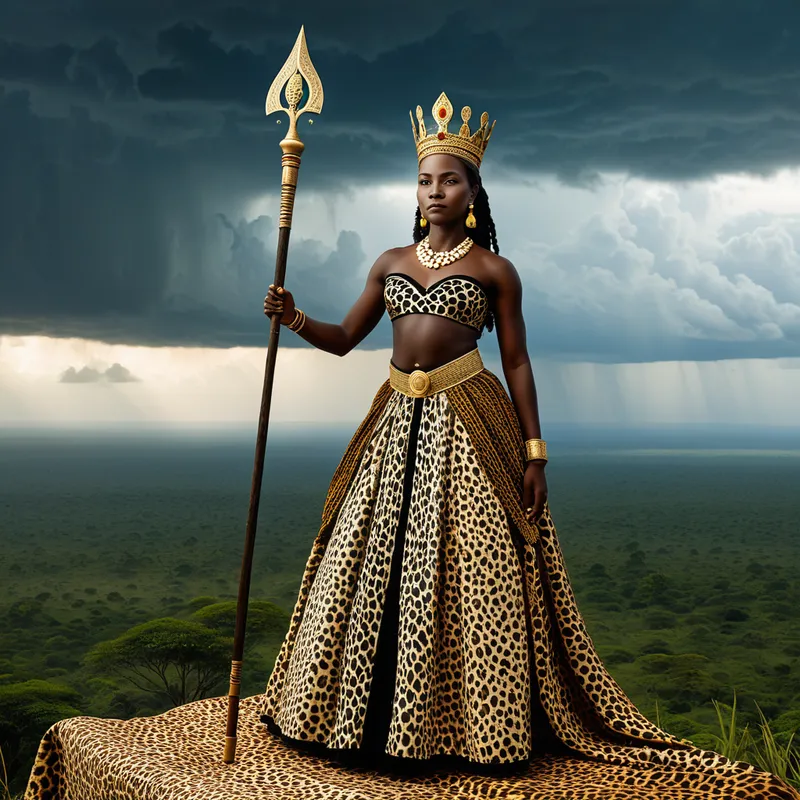
Queen Nzinga Warrior Queen Myth Meaning & Symbolism
A myth of a queen who became a warrior, a diplomat who became a legend, embodying the unyielding spirit of resistance and the alchemy of identity.
The Tale of Queen Nzinga Warrior Queen
Hear now the tale that the wind carries over the red earth of the highlands, the story whispered by the inselbergs and sung by the waters of the Kwanza. It begins not with a queen, but with a kingdom gasping for breath. Ndongo, a land of iron and fire, felt the cold shadow of a new sun—the sun of a distant king who sailed on wooden wings, bearing not gifts, but chains.
Into this crucible of fear was born Nzinga Mbande. From her first breath, the spirits of the land stirred. They say when she cried, it was not the wail of an infant, but the sharp call of a hawk. She learned the language of the court and the secrets of the forest with equal grace, her mind a loom weaving threads of statecraft and survival. But her brother, the Ngola, ruled with a heart clouded by the Portuguese threat, a fear that sometimes turned its gaze inward, toward his own kin.
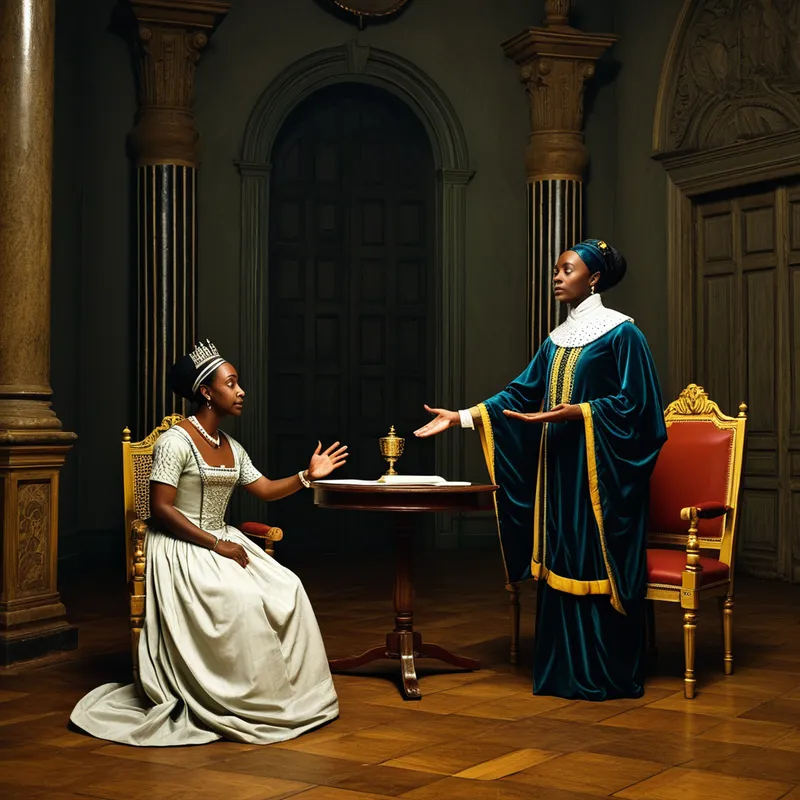
When the shadow of the foreign governor fell upon the land, demanding submission, it was Nzinga who was sent into the lion’s den. The air in the governor’s stone hall in Luanda was thick with the smell of foreign incense and arrogance. Chairs were provided for the Portuguese; for Nzinga, only the cold floor. She did not rage. She did not plead. With a stillness that silenced the room, she looked to her attendant. A wordless command. The attendant moved, knelt on hands and knees, and upon that living foundation of loyalty and flesh, Nzinga sat. She created her own throne, her back straight as a spear, her eyes meeting the governor’s from a position of invented, unassailable authority. In that moment, she was no longer a petitioner. She was the embodiment of the land itself, refusing to be looked down upon.
The peace forged that day was written on water, soon scattered by the winds of betrayal and her brother’s death. Then, the final mask fell. Nzinga did not merely assume the mantle of rule; she transmuted it. To secure her power in a lineage that flowed through brothers, she declared herself King. She took not one, but dozens of husbands—her Kimbares—turning the custom of polygamy on its head, making men symbols of alliance and political currency. She became the wife to no man, but the sovereign to all.
For decades, she was the storm that would not pass. From her mountain strongholds, she led her people, the mighty Mbundu, in a dance of resistance that was part war, part cunning diplomacy. She aligned with former enemies, the Jaga, adopting their fierce tactics, becoming more formidable than any pure-born warrior. She offered sanctuary to all who fled the slave traders, building a new nation, Matamba, as a fortress of freedom. She fought, negotiated, retreated, and struck again, a spirit of the land made flesh, until her very name became a charm against despair and a curse on the lips of those who would enslave. She did not die in battle, but in her bed, an old woman whose dreams were finally quiet, having held the line between her world and the devouring tide for a lifetime. The earth itself seemed to sigh when her great heart stilled, accepting back the queen who had become its fiercest protector.
Cultural Origins & Context
This is not a myth lost in the mists of prehistory, but a legend woven from the very real threads of the 17th century Angolan highlands. The story of Queen Nzinga Mbande (c. 1583 – 1663) exists in the liminal space between documented history and mythic amplification. It was passed down through the oral traditions of the Mbundu people, recounted by griots and elders around evening fires, and later recorded by Portuguese chroniclers—albeit through a colonial lens that could not help but paint her as a terrifying and exceptional anomaly.
Its societal function was multifaceted. For a people enduring the catastrophic rupture of the transatlantic slave trade, Nzinga’s story was a narrative of unbroken will. It served as a foundational myth of resistance, a proof that the European advance was not an unstoppable force of nature. It also functioned as a complex model of leadership, showcasing a sovereign who was fluid, strategic, and utterly pragmatic, using every tool—gender, religion, alliance, terror—to preserve her people’s autonomy. She became the ultimate symbol of adaptive intelligence and indomitable sovereignty in the face of existential threat.
Symbolic Architecture
At its core, the myth of Nzinga is a masterclass in the [alchemy](/symbols/alchemy “Symbol: A transformative process of purification and creation, often symbolizing personal or spiritual evolution through difficult stages.”/) of [identity](/symbols/identity “Symbol: Identity represents the sense of self, encompassing personal beliefs, cultural background, and social roles.”/) under extreme pressure. She represents the psyche’s [capacity](/symbols/capacity “Symbol: A measure of one’s potential, limits, or ability to contain, process, or achieve something, often reflecting self-assessment or external demands.”/) for radical self-redefinition when old structures—of [gender](/symbols/gender “Symbol: Gender in arts and music represents the expression, performance, and cultural construction of identity through creative mediums.”/), succession, diplomacy—prove fatal.
The throne is not a given object; it is a function of consciousness. One does not find it; one must, with absolute authority, conjure it into being from the materials at hand.
The act of creating a [throne](/symbols/throne “Symbol: A seat of authority, power, and sovereignty, representing leadership, divine right, or social hierarchy.”/) from the [body](/symbols/body “Symbol: The body in dreams often symbolizes the dreamer’s self-identity, personal health, and the relationship they have with their physical existence.”/) of her attendant is the myth’s central symbolic [node](/symbols/node “Symbol: A point of connection, intersection, or decision in a network, representing junctions in life paths, relationships, or systems.”/). It is the ultimate [rejection](/symbols/rejection “Symbol: The experience of being refused, excluded, or dismissed by others, often representing fears of inadequacy or social belonging.”/) of externally imposed [reality](/symbols/reality “Symbol: Reality signifies the state of existence and perception, often reflecting one’s understanding of truth and life experiences.”/). It declares: I will not participate in your [paradigm](/symbols/paradigm “Symbol: A fundamental model or framework in arts and music that shapes creative expression, perception, and cultural understanding.”/) of my inferiority. I will build my own [reality](/symbols/reality “Symbol: Reality signifies the state of existence and perception, often reflecting one’s understanding of truth and life experiences.”/), my own value, from the very loyalty and substance of my own world. Her subsequent adoption of male titles and reversal of marital norms is not a rejection of femininity, but an explosive [expansion](/symbols/expansion “Symbol: A symbol of growth, increase, or extension beyond current boundaries, often representing personal development, opportunity, or overwhelming change.”/) of it. She embodies the [Animus](/symbols/animus “Symbol: In Jungian psychology, the masculine inner personality in a woman’s unconscious, representing logic, action, and spiritual guidance.”/) not as an inner male figure, but as accessed sovereign power—strategic, penetrating, and form-giving. She integrates it wholly, becoming a complete, self-authorizing entity.
Her alliances with the fierce Jaga represent the conscious [integration](/symbols/integration “Symbol: The process of unifying disparate parts of the self or experience into a cohesive whole, often representing psychological wholeness or resolution of internal conflict.”/) of the [Shadow](/symbols/shadow “Symbol: The ‘shadow’ embodies the unconscious, repressed aspects of the self and often represents fears or hidden emotions.”/). To survive, she does not shy away from the ruthless, “savage” tactics of her enemies; she learns them, masters them, and directs their ferocity toward the [defense](/symbols/defense “Symbol: A protective mechanism or barrier against perceived threats, representing boundaries, security, and resistance to external or internal challenges.”/) of her own core values. She becomes a living bridge between the cultivated court and the untamed [forest](/symbols/forest “Symbol: The forest symbolizes a complex domain of the unconscious mind, representing both mystery and potential for personal growth.”/), between diplomacy and war.
The Dreamer’s Resonance
To dream of Nzinga is to dream at the precipice of a profound psychic negotiation. It often surfaces when the dreamer’s core identity or values are under siege—by a domineering authority, a corrosive institution, or an internalized belief system that demands submission.
Somatically, one might feel a tightening in the jaw, a steeliness in the spine, a heat rising in the chest—the body preparing to stand its ground. Psychologically, it is the process of gathering disparate, often conflicting, parts of the self (the diplomat, the warrior, the outcast, the ruler) for a council of war. The dream may present impossible rooms where you are given no seat, or feature the startling, empowering act of creating your own support from an unexpected source. It is the psyche rehearsing the act of sovereign declaration, of drawing a line in the sand of the soul and stating, “From here, I govern.”

Alchemical Translation
The Nzinga myth provides a brutal but brilliant map for the modern individuation process, particularly the stage of confronting and overcoming the tyrannical father or oppressive collective norms. Her journey models psychic transmutation in three fiery stages.
First, Confrontation and Inversion: The old order (colonial power, patriarchal succession) reveals its hostile, life-negating face. The ego, like Nzinga in the governor’s hall, must refuse its assigned role. This is the alchemical nigredo, the blackening, where one faces the utter inadequacy of old identities.
Individuation often begins not with a quest, but with a refusal. The first act of the true Self is to say ‘no’ to the false throne offered by the world.
Second, Strategic Dissolution and Re-formation: Here, the old self is deliberately broken down. Nzinga dissolves her identity as “sister of the king” or “woman in a man’s political sphere.” She enters a state of fluid, pragmatic chaos—allying with shadows, adopting new titles, bending gender. This is the albedo and citrinitas, the whitening and yellowing, where elements are separated and recombined with conscious intent.
Finally, Sovereign Integration: The new, self-created identity crystallizes. She is no longer reacting; she is ruling. She builds Matamba not as a replica of the old Ndongo, but as a new entity forged in the fires of resistance. This is the rubedo, the reddening, the birth of the conscious, autonomous Self who can hold the tension of opposites (mercy/ferocity, tradition/innovation) and govern the inner kingdom with unwavering authority. The goal is not to become a historical queen, but to perform the same alchemy within: to forge an inner sovereignty so potent that no external force can dictate the terms of your being.
Associated Symbols
Explore related symbols from the CaleaDream lexicon:
- Queen — The archetype of sovereign, self-contained authority and responsibility; Nzinga embodies its ultimate expression as a force that creates its own legitimacy.
- Warrior — The principle of focused will, defense of boundaries, and strategic action; Nzinga integrated this not as brute force, but as an essential aspect of her rulership.
- Throne — Symbol of established power and center of governance; Nzinga’s myth teaches that the true throne is an act of consciousness, built from one’s own resources and authority.
- Mask — The persona adopted for survival and strategy; Nzinga expertly wore the masks of diplomat, king, and Jaga ally to protect her core purpose.
- Shadow — The unconscious, often feared aspects of the self; her alliance with the Jaga represents the conscious integration of shadow energies for a higher purpose.
- River — A symbol of life, adaptability, and a natural boundary; like the Kwanza River, Nzinga’s strategies were fluid, shaping the landscape of power around her.
- Mountain — A place of refuge, perspective, and unassailable strength; her mountain fortresses symbolize the inner high ground of principle and resilience.
- Fire — The element of transformation, purification, and fierce energy; it represents the burning will that fueled her decades-long resistance.
- Bridge — A connector of opposites; Nzinga served as a living bridge between cultures, tactics, and gender roles to ensure her people’s survival.
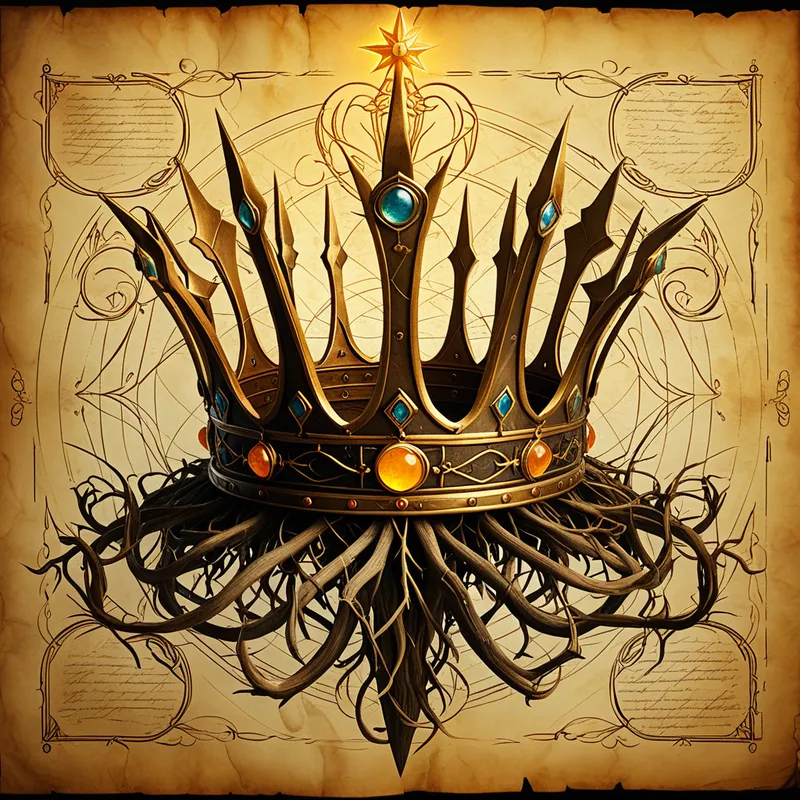
- Crown — The visible symbol of sovereignty and achieved identity; in this myth, the crown is not inherited but forged in the fires of confrontation and self-creation.
- Dance — Ritualized movement and strategy; her long resistance was a intricate political and military dance, constantly shifting steps to match her adversary.
- Root — Connection to ancestry, land, and source of strength; despite all her adaptations, Nzinga’s power was deeply rooted in her identity as Mbundu and protector of her land.