Qi Gong Myth Meaning & Symbolism
The myth of the cosmic artisan who sculpted the world not from matter, but from the primordial breath, teaching humanity the art of inner cultivation.
The Tale of Qi Gong
Before the ten thousand things had names, there was only the Hundun—a formless, breathless expanse. Silence was not peaceful; it was a pregnant, straining stillness, a world waiting to be exhaled.
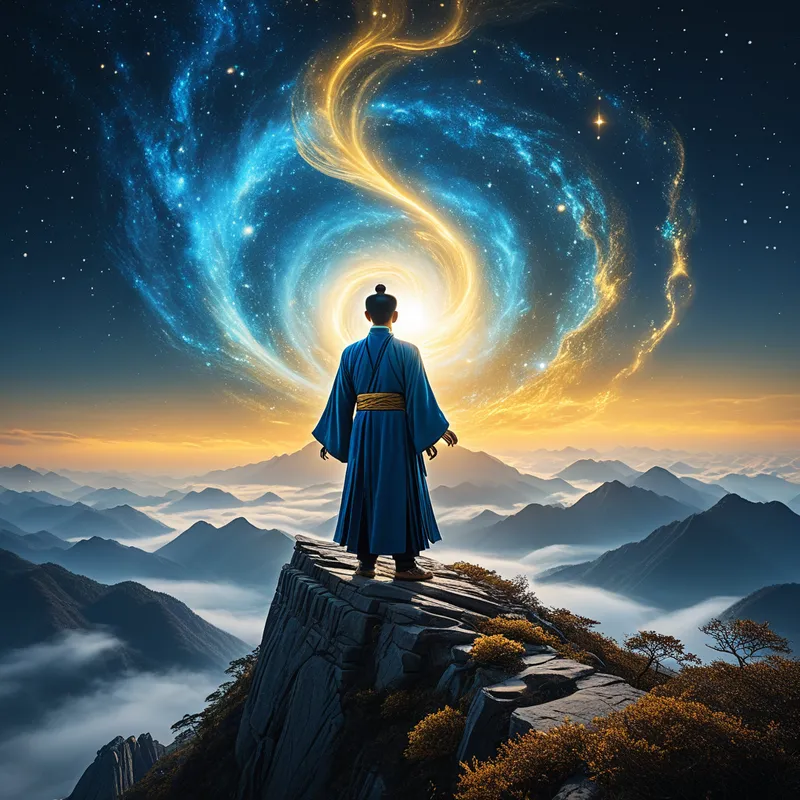
Then, from the heart of that stillness, a presence coalesced. He was not born, but breathed into being. The sages would later call him the Qi Gong. He had no face we could comprehend, but the impression of one shaped by wind and shadow. His body was not flesh, but the suggestion of a mountain range at dawn; his veins were the first, faint tracings of rivers yet to flow. In his chest, the silent void of the Hundun churned.
He looked upon the stillness and felt not emptiness, but potential. He raised a hand—a gesture that took an acon to complete—and placed it over his heart. Then, he drew the first breath.
It was not air he inhaled, but possibility. The stillness shuddered. He held that breath within, feeling it swirl and gather weight, becoming dense as a star yet light as a thought. This was the Yuan Qi. When he finally exhaled, the sound was the first sound: not a bang, but a deep, resonant tone that vibrated through the formless dark. Where his breath touched the void, mist coalesced. Where it settled, the mist grew heavy and became earth. His out-breath sculpted the mountain peaks; his in-breath carved the valleys between them.
He worked in cycles of immense, patient rhythm. With each inhalation, he gathered the scattered essence of things. With each exhalation, he gave that essence form and direction. He breathed forth the Yang, and the sun ignited, climbing the sky. He breathed forth the Yin, and the moon emerged, cool and reflective. The exhalation for the rivers was a long, streaming sigh. The inhalation for the forests was a deep, drawing gasp that pulled green life from the soil.
But the world was raw and wild, its energies clashing in violent storms and quaking earth. The Qi Gong saw this discord. He did not command it to cease, for that would be against the Dao. Instead, he sat at the axis of the new world, the place where the highest peak met the deepest sky. He closed his eyes and turned his attention inward. He began to breathe not to create, but to harmonize. He drew the chaotic winds into the still pool of his center. He mingled the fire of the sun with the water of the deep earth within his own being. His breath became a circuit, a flowing loop where all opposites met and merged.
As he breathed this alchemical breath, a miracle unfolded externally. The storms gentled into rain. The quaking earth settled, its energy channeled into the slow growth of roots. The world did not become static, but achieved a dynamic, singing balance—the seasons began their turn, the tides their faithful pulse. The work of the Qi Gong was complete not when the world was made, but when it learned to breathe along with him.
Cultural Origins & Context
The narrative of the Qi Gong is not found in a single, canonical text like the Daodejing, but is woven through the tapestry of early Taoist natural philosophy and esoteric practice. It is a "myth" less told around fires and more transmitted through the silent movements of masters in mountain clearings. Its origins are in the ancient Chinese observation of the natural world—the winds (Feng), the waters, the growth of plants—and the profound intuition that an invisible, animating force connected them all.
This myth served as the foundational allegory for the physical and spiritual practices that would later bear the name Qigong. It was the sacred history that justified the discipline. In Taoist monasteries and among hermits, the story was enacted daily through the exercises themselves. The practitioner, in assuming slow, deliberate postures and regulating their breath, was not merely exercising. They were ritually embodying the Qi Gong, participating in the ongoing act of cosmic and personal harmonization. The myth provided the why: you breathe and move in this specific way to emulate the primordial act that ordered the universe, thereby ordering your own internal universe.
Symbolic Architecture
At its core, the myth of the Qi Gong is a map of consciousness and a manual for inner creation. The Qi Gong himself is the archetype of the Zhenren, or authentic person, who operates from the center of being.
The first act of creation is not an outward projection, but an inward gathering. The cosmos was born from a centering breath.
The primordial Hundun represents the undifferentiated psyche—a state of potential rich with energy but also with latent chaos and conflict. The Qi Gong’s initial, world-sculpting breaths symbolize the early, often unconscious, projection of our inner energies outward to form the "landscape" of our lives: our relationships, endeavors, and identities. Yet, this created world is often turbulent, mirroring our own internal discord.
The pivotal turn in the myth is when the artisan stops creating out there and turns his attention in here. This is the symbolic shift from ego-driven action to soul-centered awareness. The mountain peak where he sits is the Zhong, the still point within the self. His alchemical breathing—the circulation and harmonization of Yang and Yin within—represents the conscious reconciliation of opposites within the psyche: activity and receptivity, logic and intuition, conscious and unconscious.
The Dreamer's Resonance
When this myth stirs in the modern unconscious, it often manifests in dreams of elemental turbulence and the search for inner regulation. One may dream of being in a house battered by wild storms, or of a landscape inside one's own body that is either parched and cracked or flooded and swampy. These are somatic metaphors for dysregulated Qi—energy that is either stagnant, deficient, or excessively chaotic.
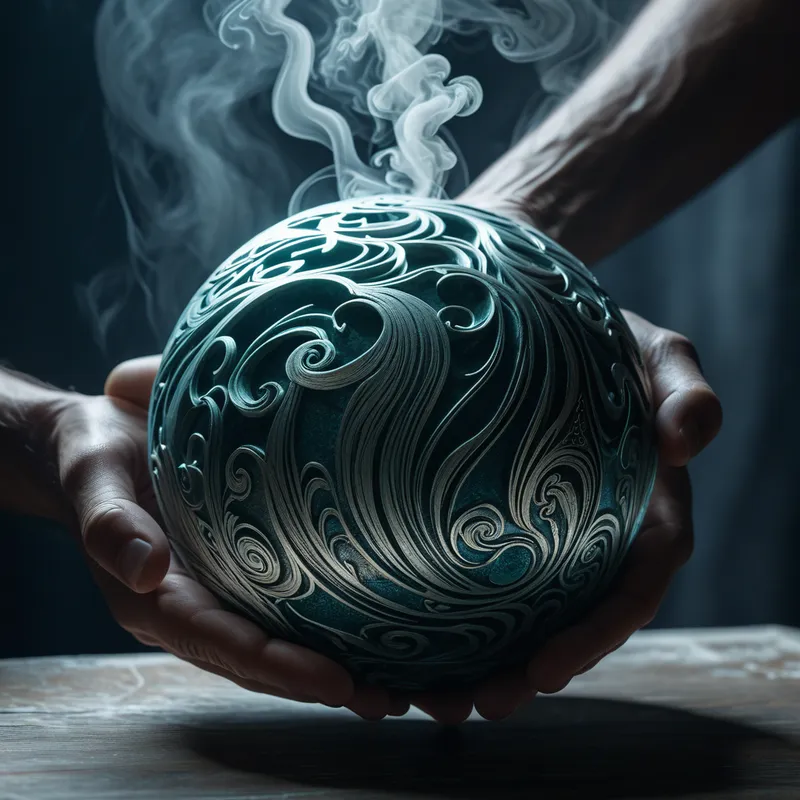
The figure of the Qi Gong may appear as a calm guide in the dream, often not speaking, but simply demonstrating a slow, rhythmic motion or breath. The dreamer might find themselves in a vast, empty hall learning to breathe in a way that makes the walls resonate, or holding a small, chaotic cloud in their hands and gently smoothing it into a sphere. These dreams signal a profound psychological process: the ego's recognition that it cannot control the outer storm by force, and must instead learn the art of inner circulation and balance. It is the psyche's innate intelligence initiating a course correction toward wholeness.

Alchemical Translation
For the individual, the myth of the Qi Gong models the entire path of Neidan, or internal alchemy, which Jung recognized as a parallel to individuation. The journey begins with the "Hundun" of our unexamined life—a mix of inherited patterns, unconscious drives, and societal pressures that create a world of recurring conflict and disharmony.
Individuation is not about building a better fortress of the self, but about learning the breath that harmonizes the wilderness within.
The first stage, "Lian Jing Hua Qi" (refining essence into energy), is mirrored in the Qi Gong’s initial, formative breaths. It is the often-messy work of engaging with life, giving form to our energies in the world, and experiencing the resulting friction. The inevitable crisis—the stormy, quaking world—is the catalyst for the true alchemy.
The second and crucial stage, "Lian Qi Hua Shen" (refining energy into spirit), is the myth's central act. We must retreat to our inner mountain peak—through meditation, introspection, or creative solitude—and turn the breath inward. This is the conscious work of psychosynthesis. We learn to "breathe" our anger until it becomes resolve, to "circulate" our grief until it becomes depth, to "balance" our ambition with receptivity. We become the artisan of our own inner climate.
The final harmony that manifests in the external world is not a life without challenge, but a life lived in dynamic flow. The seasons of success and failure, the tides of relationship, are met not with resistance, but with the resilient, adaptable breath of the centered self. One becomes, like the Qi Gong, not a ruler over one's domain, but the living axis around which a harmonious world can naturally turn. The myth teaches that our supreme creative act is not what we make, but how we breathe ourselves into being.
Associated Symbols
Explore related symbols from the CaleaDream lexicon: