Puck's Love Potion Myth Meaning & Symbolism
A mischievous spirit's magical error creates a night of chaotic, misplaced desire, revealing the thin veil between enchantment and the true nature of the heart.
The Tale of Puck’s Love Potion
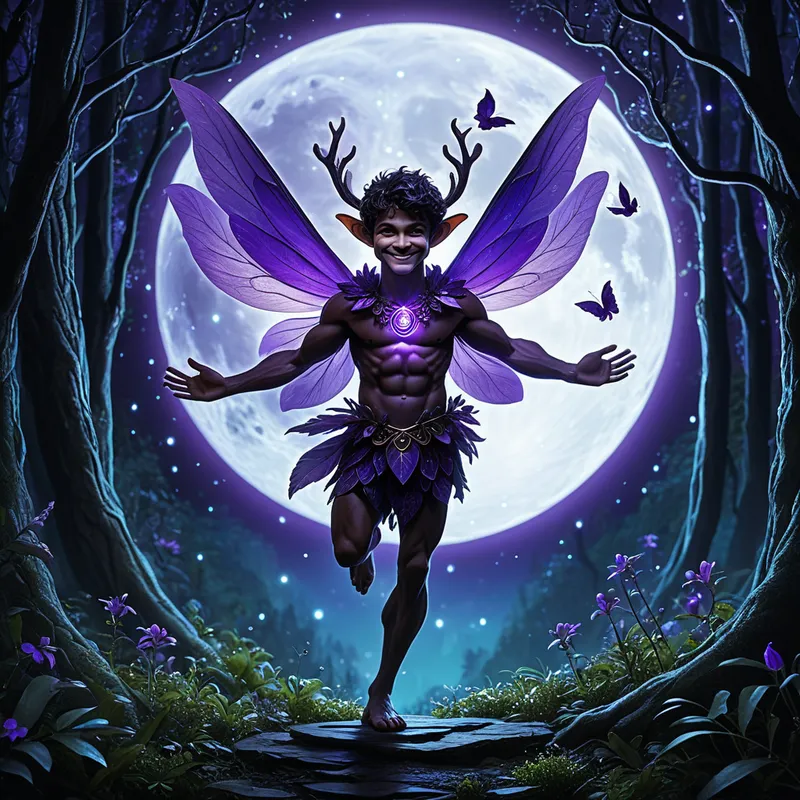
Hear now of a night when [the moon](/myths/the-moon “Myth from Tarot culture.”/) wore a veil of silver mist, and the ancient woods of Athens breathed with a magic older than its marble temples. This is not a tale of gods on high, but of spirits in [the hollow hills](/myths/the-hollow-hills “Myth from Celtic culture.”/), of the Puck, whom some call Robin Goodfellow. His master, the great King Oberon, sat brooding upon a mossy throne, his heart a tempest. He had quarreled with his radiant Queen, Titania, and in his ire, he desired a jest most cruel.
He summoned Puck, whose feet knew every root and whose laughter echoed in every fox’s den. “Fetch me the little western flower,” Oberon commanded, his voice like distant thunder. “Once hit with Cupid’s arrow, it turned purple with love’s wound. Its juice, laid on sleeping eyelids, makes man or woman madly dote upon the next live creature that they see.”
Puck, delighting in chaos, sped over land and sea to where the purple flower grew. He plucked it, a tiny star of potent violet, and brought it to his lord. Oberon, spying the human folly unfolding in his domain—a maiden, Helena, lovesick and scorned; two youths, Lysander and Demetrius, tangled in rivalry—decided to weave mortal affairs into his revenge. He bade Puck anoint the eyes of the disdainful youth, Demetrius, so he would wake and love Helena.
But the forest at midnight is a [labyrinth](/myths/labyrinth “Myth from Various culture.”/) of shadows. Here slept not one Athenian youth, but two. Puck, finding a “Athenian garment,” poured the lustrous juice upon the eyes of Lysander, who loved Hermia true. The spell was cast, a silent, seismic shift within the soul.
Lysander awoke, and his gaze fell not on Hermia, but on Helena, who had stumbled into the glade. The potion’s alchemy was instant and absolute. His old love was forgotten, a discarded page; his new passion was a blazing sun. “Not Hermia but Helena I love!” he cried, and the forest seemed to shudder at the wrongness of it.
Oberon, seeing Puck’s “true love turned, and not a false turned true,” sent the sprite to mend the error. Yet Puck, the eternal jester, compounded the chaos. Now both youths, Lysander and the correctly anointed Demetrius, chased the bewildered Helena, while poor Hermia awoke to a world where her love had vanished like morning dew. Friendships shattered, voices rose in anger and despair, and the fairy king watched his simple trick unravel into a symphony of human anguish.
Only when the mortals, exhausted by the phantom passions, fell into a deep, enchanted sleep did Oberon intervene. The antidote—another herb’s juice—was applied. The spell was lifted, but not erased; Demetrius remained enchanted, his love for Helena now “true” by magic’s law. The dawn broke, cool and clear. The lovers awoke, their affections neatly paired by fairy craft, the night’ madness a fading, dreamlike fever. And Puck, with a final sweep of his broom, promised to clean away the lingering traces of the night’s sweet, terrible confusion.

Cultural Origins & Context
This myth springs not from an ancient oral tradition, but from the vibrant, self-conscious theatrical culture of Elizabethan England, crystallized by William Shakespeare in A Midsummer Night’s Dream (c. 1595). It is a literary myth that instantly felt archetypal, woven from threads of English folklore, classical comedy, and Renaissance courtly entertainment. The figure of Puck was a genuine folk entity, a household spirit known for helpful chores and cruel pranks, whom Shakespeare elevated to a principal agent of the supernatural.
The tale was passed down not by village bards, but by actors on the wooden “O” of the Globe Theatre, performed for a cross-section of London society—from groundlings to the Queen herself. Its societal function was multifaceted: as a festive comedy for weddings, a sophisticated exploration of love’s irrationality for the court, and a populist entertainment featuring clowns and magic. It served to examine the very nature of desire, authority, and artistic creation, holding a mirror up to a society obsessed with order yet fascinated by the chaotic, transformative power of the imagination and the natural world. It is a myth about the making of myths, where the playwright is the Oberon and the comic spirit is his pen.
Symbolic Architecture
At its core, the myth presents love not as a [virtue](/symbols/virtue “Symbol: A moral excellence or quality considered good, often representing inner character, ethical principles, or spiritual ideals in dreams.”/) of the [heart](/symbols/heart “Symbol: The heart symbolizes love, emotion, and the core of one’s existence, representing deep connections with others and self.”/), but as a force of [nature](/symbols/nature “Symbol: Nature symbolizes growth, connectivity, and the primal forces of existence.”/)—capricious, blinding, and easily hijacked. The love-in-idleness is the perfect [symbol](/symbols/symbol “Symbol: A symbol can represent an idea, concept, or belief, serving as a powerful tool for communication and understanding.”/) for this: a flower born from a stray [arrow](/symbols/arrow “Symbol: An arrow often symbolizes direction, purpose, and the pursuit of goals, representing both the journey and the destination.”/), its power operating through the passive, vulnerable state of sleep. It represents the [projection](/symbols/projection “Symbol: The unconscious act of attributing one’s own internal qualities, emotions, or shadow aspects onto external entities, people, or situations.”/) of the [anima](/symbols/anima “Symbol: The feminine archetype within the male unconscious, representing soul, creativity, and connection to the inner world.”/) or [animus](/symbols/animus “Symbol: In Jungian psychology, the masculine inner personality in a woman’s unconscious, representing logic, action, and spiritual guidance.”/). We do not see the other person; we see a divine [image](/symbols/image “Symbol: An image represents perception, memories, and the visual narratives we create in our minds.”/) cast from our own unconscious onto them.
The potion does not create love; it commands the gaze. It forces the soul to worship the first idol it beholds upon waking.
Oberon symbolizes the ordering, patriarchal principle—[the ego](/myths/the-ego “Myth from Jungian culture.”/) or the conscious will that seeks to arrange [the world](/myths/the-world “Myth from Tarot culture.”/) (and others’ affections) to its design. Puck is the [trickster](/symbols/trickster “Symbol: A boundary-crossing archetype representing chaos, transformation, and the subversion of norms through cunning and humor.”/), the embodiment of the unconscious [psyche](/myths/psyche “Myth from Greek culture.”/) itself: mercurial, amoral, and literalminded. He follows the [letter](/symbols/letter “Symbol: A letter symbolizes communication, messages, and the sharing of thoughts and feelings.”/) of Oberon’s command (“the Athenian”) but utterly misses its [spirit](/symbols/spirit “Symbol: Spirit symbolizes the essence of life, vitality, and the spiritual journey of the individual.”/). This is the nature of the unconscious when clumsily invoked; it manifests our desires in ways that shatter, rather than heal, our conscious arrangements. The resulting [chaos](/symbols/chaos “Symbol: In Arts & Music, chaos represents raw creative potential, uncontrolled expression, and the breakdown of order to forge new artistic forms.”/) among the four lovers is the [psyche](/myths/psyche “Myth from Greek culture.”/) in civil war, where every feeling-part (Hermia’s loyalty, Helena’s insecurity, Lysander’s inconstancy, Demetrius’s aggression) is divorced from its rightful object and set adrift.
The Dreamer’s Resonance
To dream of being under the influence of Puck’s potion is to experience a profound somatic disorientation. One may dream of feeling overwhelming, inexplicable passion for a stranger, a friend, or even an object, while feeling cold indifference toward a longtime partner or cherished value. This is not a dream of romance, but of possession.
The dreamer is undergoing a process where a powerful complex—a bundle of thoughts, feelings, and memories—has been autonomously activated. The “potion” is the trigger. The psychological process is one of forced re-evaluation. The dream asks: What have I been sleepwalking through? What “true love” have I taken for granted, and what “idol” am I now, suddenly and painfully, worshipping? The chaotic chase through the forest in the myth mirrors the dreamer’s frantic, confused attempt to reconcile these split-off parts of themselves. The somatic signature is often a feeling of heart-racing anxiety coupled with a strange, detached observation, as if watching oneself from the trees—the ego witnessing its own enchantment.

Alchemical Translation
The alchemical opus modeled here is the [solve et coagula](/myths/solve-et-coagula “Myth from Alchemical culture.”/): dissolve and coagulate. The night in the forest is the [nigredo](/myths/nigredo “Myth from Alchemical culture.”/), the blackening, where all stable identities and relationships are dissolved in the chaotic solvent of the potion. Lysander is not himself; Hermia is abandoned; social order crumbles. This is a necessary, if terrifying, stage in individuation. The conscious personality must be broken down so that its constituent parts can be seen in their raw, conflicted state.
Oberon’s final intervention with the antidote represents the albedo, the whitening, the attempt at ordering and reconciliation. But note: the process is not reversed. Demetrius remains changed. The new configuration of couples is not a return to the old order, but a new synthesis born of the chaotic experience.
The ultimate transmutation is not in the correction of the error, but in the acceptance that the error itself was the catalyst for a more complex, less naive form of love and self-knowledge.
For the modern individual, the myth warns against the “Oberonic” fantasy of controlling the psyche’s deep currents with a willful command. It invites us to acknowledge our inner Puck—the unpredictable, creative, and often embarrassing unconscious. The “love potion” is any unconscious content that erupts to disrupt our carefully laid plans: a sudden infatuation, a rage, a depressive episode, a creative mania. The path to wholeness lies not in blaming [the trickster](/myths/the-trickster “Myth from Various culture.”/), but in following the chaotic thread it provides back into the forest of [the self](/myths/the-self “Myth from Jungian culture.”/), to rediscover what parts of us we have been sleeping beside, and what idols we have been blindly worshipping. The goal is not a perfect, spell-free life, but a conscious relationship with the magic that forever stirs in the moon-drenched corners of the soul.
Associated Symbols
Explore related symbols from the CaleaDream lexicon: