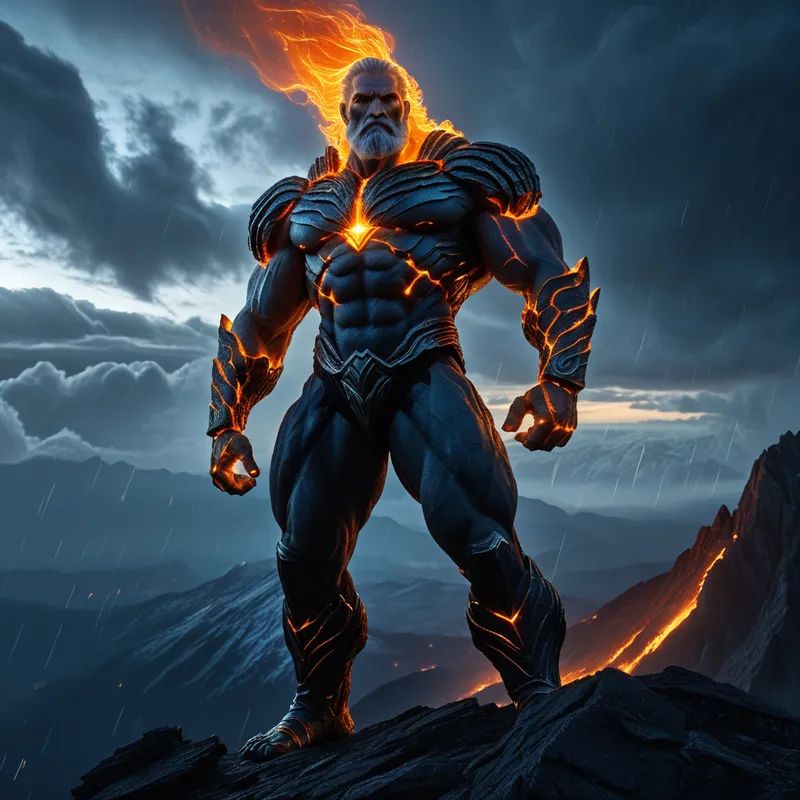
Prometheus's Gift Myth Meaning & Symbolism
The Titan Prometheus defies Zeus to steal divine fire for humanity, gifting them knowledge and technology at the cost of eternal torment.
The Tale of Prometheus's Gift
In the beginning, after the great war of the gods, the world was young and humanity was but a shadow. They huddled in caves, their lives brief, brutish, and dark, eating their meat raw, trembling at every thunderclap from the heavens. They were creatures of clay, shaped by the hands of the cunning Prometheus, but they lacked the vital spark.
High atop Mount Olympus, the new king, Zeus, surveyed his domain. He had little love for these fragile mortals. To him, they were a potential threat, a chaos to be managed. When the time came to decide humanity’s portion in a great sacrificial feast, Prometheus, who loved his creations, played a trick. He wrapped the nourishing meat in the unappealing stomach of an ox, and the bare, gleaming bones in rich, succulent fat. Zeus, choosing the seemingly better portion, was deceived and chose the bones. From that day, the smoke of bones and fat would be the gods’ share, while humanity kept the meat for their sustenance.
But this deception ignited a cold fury in Zeus. In punishment, he withheld the greatest gift of all: Fire. He gathered all celestial flame from the earth, leaving humanity to shiver in perpetual twilight.
Prometheus watched his children suffer. His heart, a forge of compassion, could not abide it. He journeyed to the sun-chariot of Helios, or to the very hearth of Olympus—stories differ—and with a stalk of giant fennel, he stole a single, burning coal of divine fire. He hid it in the hollow stalk and descended to the world of men.
He placed the ember in the midst of a human gathering. The people drew back in fear, then in wonder. They saw the flame dance—a living, breathing thing of light and heat. Prometheus showed them how to tend it, how to cook food, how to forge metal, how to push back the night. With fire came pottery, medicine, art, and the first stories told around its warmth. The spark of the gods became the torch of civilization. Humanity was no longer a creature of mere survival; they had a future.
On Olympus, Zeus saw the distant glow of a thousand hearths where before there was only dark. His rage was a tempest that shook the foundations of the world. The theft was an act of ultimate rebellion. For his crime of compassion and intellect, Zeus devised a punishment of eternal, exquisite agony.
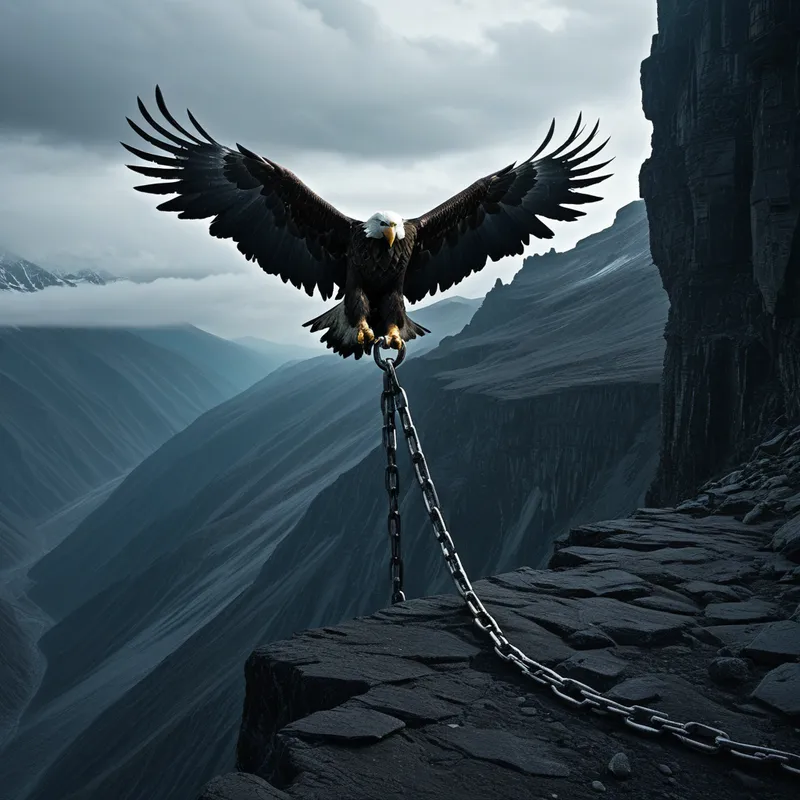
Prometheus was seized by the might of Hephaestus and the force of Kratos and Bia. They dragged him to the most desolate peak of the Caucasus Mountains. There, with unbreakable adamantine chains, they bound the Titan to the naked rock. Zeus sent his eagle, a monstrous bird with talons of bronze, to feast each day upon Prometheus’s immortal liver. Each night, the organ would regrow, ensuring the torture was as infinite as his defiance. And there he remained, a testament to the price of awakening, his cries carried by the wind for ages, until the hero Heracles would one day set him free.
Cultural Origins & Context
This foundational myth comes to us primarily from the epic poetry of Hesiod, in his Theogony and Works and Days (8th-7th century BCE), and later from the tragic playwright Aeschylus in his masterpiece Prometheus Bound. It was not merely a story but a central pillar in the Greek understanding of their place in the cosmos. Told by bards and performed in theaters, it served a crucial societal function: it explained the human condition.
The myth justified the Greek ritual practice of animal sacrifice (the division of the sacrificial feast) and accounted for the origin of technology (techne). More profoundly, it explored the fraught relationship between humanity and the divine. The Greeks lived in a world where the gods were powerful, jealous, and often inscrutable. Prometheus’s act framed human advancement not as a gift from a benevolent god, but as a hard-won prize stolen from a reluctant and punitive sky-father, establishing a narrative of progress born from struggle, intelligence, and suffering.
Symbolic Architecture
At its core, Prometheus’s Gift is the myth of the awakening of consciousness. Fire is the ultimate symbol of this psychic event. It is not just warmth or tool-making; it is the light of the mind—reason, foresight, self-awareness, and creative impulse.
The stolen fire is the moment the unconscious clay becomes a conscious self, able to see its own shadow and dream of its own future.
Prometheus represents the archetypal principle of provident thought (his name means "Forethought"). He is the intellect that questions, the compassion that acts, and the rebellious spirit that challenges arbitrary authority for a higher purpose. He is the personification of human ingenuity and the drive toward progress. Zeus, in this context, symbolizes the established, conservative order—the ruling consciousness that seeks to keep potential contained, fearing the chaos and responsibility that true knowledge unleashes.
The punishment is equally symbolic. The liver was considered the seat of passions and desires in ancient Greek thought. The eternal devouring represents the perpetual cost of consciousness: the anxiety, the existential dread, the burdens of knowledge and choice that "eat away" at us. Yet, the liver’s regeneration signifies the resilience of the conscious spirit; the pain is endless, but so is the capacity to endure and regenerate meaning.
The Dreamer's Resonance
When this myth stirs in the modern unconscious, it often manifests in dreams of profound personal rebellion and awakening. The dreamer may find themselves stealthily taking something forbidden—a key, a book, a glowing object—from a powerful, authoritarian figure or a lofty, intimidating institution. There is a palpable mix of exhilaration and terror.
Somatically, this can correlate with feelings of tightness in the chest (the binding) or a gnawing anxiety in the gut (the devoured liver). Psychologically, the dreamer is navigating the "Promethean moment": the act of claiming one’s own authority, knowledge, or creative power against an internal or external "Zeus." This could be overcoming parental expectations, breaking free from dogmatic beliefs, or embracing a taboo aspect of one’s own identity. The eagle’s attack may appear as nightmares of persecution, criticism, or the sudden, sharp pains of guilt that follow a bold act of self-assertion. The dream is the psyche’s dramatization of the inevitable conflict that arises when one’s burgeoning consciousness challenges the ruling order of their life.

Alchemical Translation
The alchemical journey modeled by Prometheus is the quintessential process of individuation—becoming one’s true, conscious self. It begins in the nigredo, the blackness: humanity’s primitive, unconscious state. The theft of fire is the albedo, the whitening: the illuminating insight that separates one from the collective mass. It is the acquisition of self-knowledge, however painful.
The chains on the rock are the crucible. The suffering is not meaningless torture, but the necessary separatio and calcinatio—the burning away of naive innocence to forge a conscious, enduring spirit.
The modern individual undergoes this when they "steal fire"—perhaps by pursuing a truth that their family or culture denies, by embracing a creative calling that offers no security, or by accepting the painful light of psychological insight through therapy or introspection. The ensuing "punishment" is the loneliness, doubt, and responsibility that comes with that knowledge. The regenerating liver is the symbol of the psyche’s incredible capacity for renewal and integration. Each time we are "devoured" by the consequences of our consciousness—by anxiety, by isolation, by the burden of choice—we have the chance to regrow, stronger and more complex.
The myth does not end with the theft, but with the eventual release by Heracles, the heroic ego. This signifies that the fully integrated Self does not remain eternally in martyrdom. The conscious, suffering principle (Prometheus) must eventually be reconciled with the capable, action-oriented part of the psyche (Heracles) to achieve wholeness. The gift, once stolen and paid for in agony, must ultimately be mastered and integrated into a complete life. We are all, in some way, both the thief of the divine spark and the Titan bound to the rock, learning that true consciousness is both our greatest gift and our most sacred wound.
Associated Symbols
Explore related symbols from the CaleaDream lexicon: