Pre-Islamic Arabia Al-Jahiliyya Myth Meaning & Symbolism
A mythic portrait of an era defined by tribal chaos, poetic fire, and a deep, unfulfilled longing for a unifying truth beyond the desert's harsh horizon.
The Tale of Pre-Islamic Arabia Al-Jahiliyya
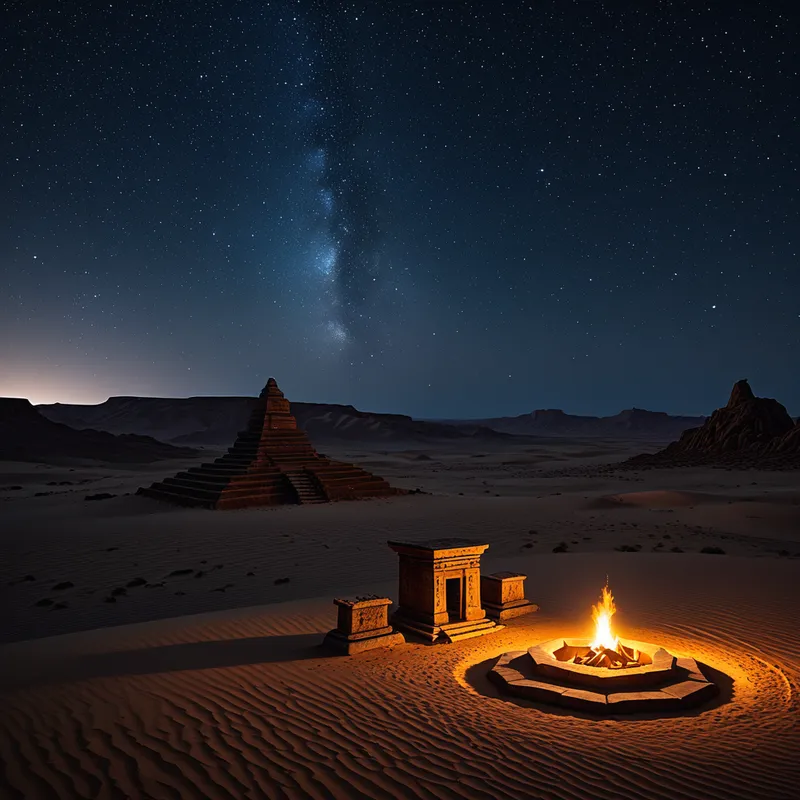
Listen, and let the wind carry you back to a time before the word. To the Al-Jahiliyya. The land was a vast, breathing entity of sun-bleached stone and restless sand, a stage for a drama written not in ink, but in blood and star-dust.
Here, the world was ruled not by one, but by many. The Allah of the high desert was a distant, silent sovereign. Closer to the heart were his daughters: Al-Lat, the Earth Mother, her presence in the sacred stone; Al-Uzza, the Mighty One, her power in the acacia grove; and Manat, the cutter of life’s threads, her shrine marked by dark, weathered rock. They were powers to be placated, forces as capricious as the desert storm.
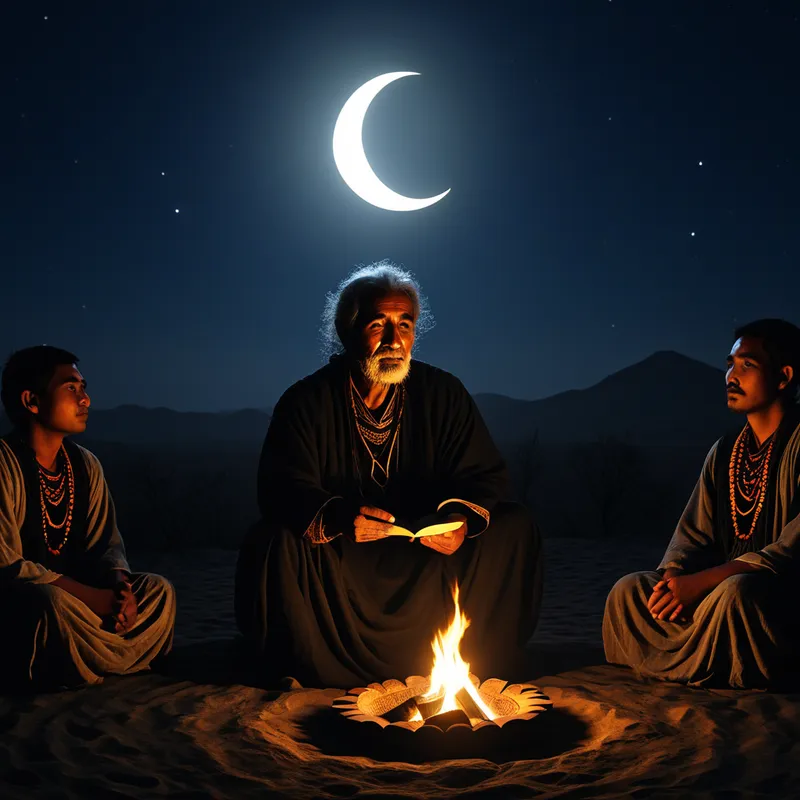
But the true gods of this age were the tribe and the poet. Kinship was a fortress in the wilderness, and honor its only currency. When the moon was a sliver of silver, men would gather by the fire. The air, thick with the scent of roasting meat and bitter coffee, would grow still as the sha’ir—the poet-seer—rose. His words were not mere speech; they were incantations. He would unleash a qasida, an ode that began with the lament of lost love at a abandoned campsite, traced the perilous journey on a lean-throated dromedary, and culminated in blistering satire or soaring boast for his clan. His tongue was a sword, his memory the tribe’s living scripture. To have a great poet was to have a weapon that could shatter an enemy’s reputation without a single arrow loosed.
Yet, beneath the bravado of raid and reprisal, beneath the fervent worship at the Ka’ba crowded with idols, there thrummed a deep, unspoken discord. The law was the law of the sand—shifting, merciless. The blood feud, the tha’r, was an endless chain of grief, pulling generation after generation into its crimson spiral. The orphan wailed by the roadside, and the powerful swallowed the wells of the weak. The world felt fragmented, a brilliant mosaic of proud, warring pieces with no unifying picture. The poets themselves, for all their power, sang of a deep haneen—a yearning nostalgia for a lost unity, a homesickness for a home they had never known. The desert, in its immense, star-filled silence, seemed to be waiting. Listening for a word that would make the scattered stones speak as one.
Cultural Origins & Context
This is not a myth with a single author or a definitive text. It is a collective cultural memory, a psychological portrait of an era constructed from the fragments that survived its passing. The primary sources are the Mu’allaqat (the “Suspended Odes”), a handful of magnificent poems said to have been inscribed on linen and hung on the Ka’ba. These poems, along with other surviving verses, are our windows into the Jahili soul.
The tale was passed down not by priests of a unified creed, but by the rawis (reciters) who memorized the poets’ words with flawless precision, and by the tribes themselves, for whom genealogy and heroic anecdote were sacred history. Its societal function was multifaceted: it codified social values (hospitality, courage, vengeance), provided a cosmological framework through its polytheism, and offered a means of transcendence and fame through poetry. The myth of the Jahiliyya is, in essence, the story a civilization tells about its own childhood—a time of fierce beauty, raw passion, and profound spiritual disorientation, remembered in the light of what came after.
Symbolic Architecture
Psychologically, Al-Jahiliyya represents the state of the unintegrated psyche. It is the inner [landscape](/symbols/landscape “Symbol: Landscapes in dreams are powerful symbols representing the dreamer’s emotional state, personal journey, and the broader context of life situations.”/) of [chaos](/symbols/chaos “Symbol: In Arts & Music, chaos represents raw creative potential, uncontrolled expression, and the breakdown of order to forge new artistic forms.”/) that precedes the [birth](/symbols/birth “Symbol: Birth symbolizes new beginnings, transformation, and the potential for growth and development.”/) of [consciousness](/symbols/consciousness “Symbol: Consciousness represents the state of awareness and perception, encompassing thoughts, feelings, and experiences.”/). The warring tribes symbolize the conflicting complexes, impulses, and values within an individual—honor (superego) clashing with vengeance ([shadow](/symbols/shadow “Symbol: The ‘shadow’ embodies the unconscious, repressed aspects of the self and often represents fears or hidden emotions.”/)), tribal loyalty ([persona](/symbols/persona “Symbol: The social mask or outward identity one presents to the world, often concealing the true self.”/)) warring with individual yearning (the Self).
The poet, or sha’ir, is the nascent voice of the psyche attempting to articulate itself. He is not yet a [prophet](/symbols/prophet “Symbol: A messenger or seer who receives divine revelations, often warning of future events or guiding moral direction.”/) with a divine [revelation](/symbols/revelation “Symbol: A sudden, profound disclosure of truth or insight, often through artistic or musical means, that transforms understanding.”/), but a sensitive through whom the raw, archetypal energies of the [collective unconscious](/symbols/collective-unconscious “Symbol: The Collective Unconscious refers to the part of the unconscious mind shared among beings of the same species, embodying universal experiences and archetypes.”/)—love, [loss](/symbols/loss “Symbol: Loss often symbolizes change, grief, and transformation in dreams, representing the emotional or psychological detachment from something or someone significant.”/), pride, [despair](/symbols/despair “Symbol: A profound emotional state of hopelessness and loss, often signaling a need for transformation or surrender to deeper truths.”/)—erupt into beautiful, yet ultimately unresolved, form.
The desert is not emptiness, but potential. It is the tabula rasa of the soul, the necessary void in which the first, defining word can echo.
The countless idols in the Ka’ba symbolize a fragmented spirituality, where the transcendent is broken into manageable, yet competing, projections. The deep haneen—the yearning—is the pull of the Self, the central [archetype](/symbols/archetype “Symbol: A universal, primordial pattern or prototype in the collective unconscious that shapes human experience, behavior, and creative expression.”/) of wholeness, felt as an [absence](/symbols/absence “Symbol: The state of something missing, void, or not present. Often signifies loss, potential, or existential questioning.”/), a haunting [memory](/symbols/memory “Symbol: Memory symbolizes the past, lessons learned, and the narratives we construct about our identities.”/) of a unity that has yet to be consciously realized.
The Dreamer’s Resonance
When this myth stirs in the modern dreamer, it often manifests as dreams of being lost in a vast, beautiful, but meaningless landscape. One might dream of attending a chaotic, glittering party where everyone speaks a language you half-understand, or of searching through a library where all the books are written in fascinating but illegible scripts. There is a somatic feeling of restless energy without direction—a potent but unfocused libido.
This is the psyche experiencing its own Jahiliyya. It indicates a period where old values (the “gods” or idols one worshipped—career, status, a relationship) have lost their numinous power, but no new, unifying principle has emerged. The dreamer is in the “desert” between identities. The psychological process is one of de-structuring: the necessary, often painful, dissolution of a too-rigid or outgrown psychic order, creating the fertile chaos from which a more authentic consciousness can be born.
Alchemical Translation
The alchemical journey modeled by this myth is the nigredo—the blackening, the descent into chaos and putrefaction. It is the first, non-negotiable stage of individuation. The triumph of the Jahiliyya myth is not in its resolution, but in its intense, poetic expression of the problem. It teaches that one must fully inhabit the desert, must feel the depth of the fragmentation and the yearning, before transformation is possible.
For the modern individual, this means having the courage to cease fleeing the inner chaos. It is to sit by the campfire of one’s own conflicted soul and, like the sha’ir, begin to give voice to the fragments. To write the “ode” of one’s own grief, pride, and longing without yet demanding a neat conclusion. This act of conscious articulation is the first step in gathering the scattered tribes of the psyche.
The birth of a unifying consciousness requires the respectful burial of the old, fragmented gods. One must first fully acknowledge the idol before it can be surrendered.
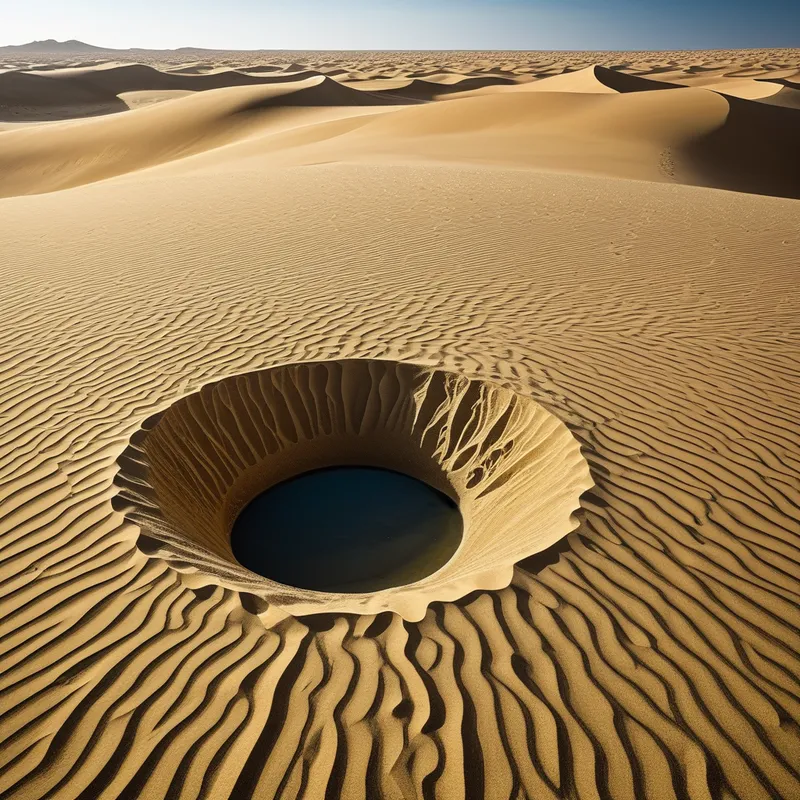
The journey out of the personal Jahiliyya begins when the yearning for wholeness becomes stronger than the loyalty to the familiar chaos. It is the moment the search for water becomes a pilgrimage, and the solitary voice in the desert begins to listen for a reply.
Associated Symbols
Explore related symbols from the CaleaDream lexicon:
- Desert — The archetypal landscape of the Jahiliyya, representing both barren isolation and the pure, unformed potential of the psyche awaiting the rain of consciousness.
- Poet — The sha’ir embodies the nascent, creative spirit struggling to articulate meaning from chaos, representing the psyche’s first attempt to understand itself through art and language.
- Tribe — Symbolizes the complex, often conflicting, loyalties and identities (the persona, the familial complexes) that define the individual before the emergence of a unified Self.
- Idol — Represents a fragmented aspect of the divine or the transcendent, a partial truth mistaken for the whole, which must eventually be re-integrated or surrendered.
- Thirst — The core somatic experience of Jahiliyya, signifying the spiritual and psychological yearning (haneen) for meaning, connection, and wholeness that drives the search.
- Fire — The campfire of tribal gathering and poetic recitation, symbolizing the fierce, illuminating, but contained energy of human culture and passion in the vast darkness.
- Star — The distant, guiding lights in the desert sky, representing faint intuitions, hopes, and the fragmented, yet beautiful, glimpses of a higher order amidst the chaos.
- Well — The scarce source of life in the desert, symbolizing the hidden depth of the unconscious where the nourishing waters of the Self might be found, if one knows where to dig.
- Blood — The currency of the blood feud (tha’r), representing the compulsive, unconscious cycles of vengeance, guilt, and inherited trauma that bind the psyche to its past.
- Moon — The crescent that lights the night journeys and gatherings, a symbol of cyclical time, fleeting beauty, and the reflective, poetic consciousness that emerges in the dark.
- Cup — The vessel for bitter coffee shared in hospitality, representing both the offering of one’s essence to another and the container needed to hold the intoxicating, bitter waters of experience.
- Journey — The essential structure of the poetic qasida and the tribal migration, symbolizing the psychic movement through loss, challenge, and memory in search of a new dwelling place for the soul.