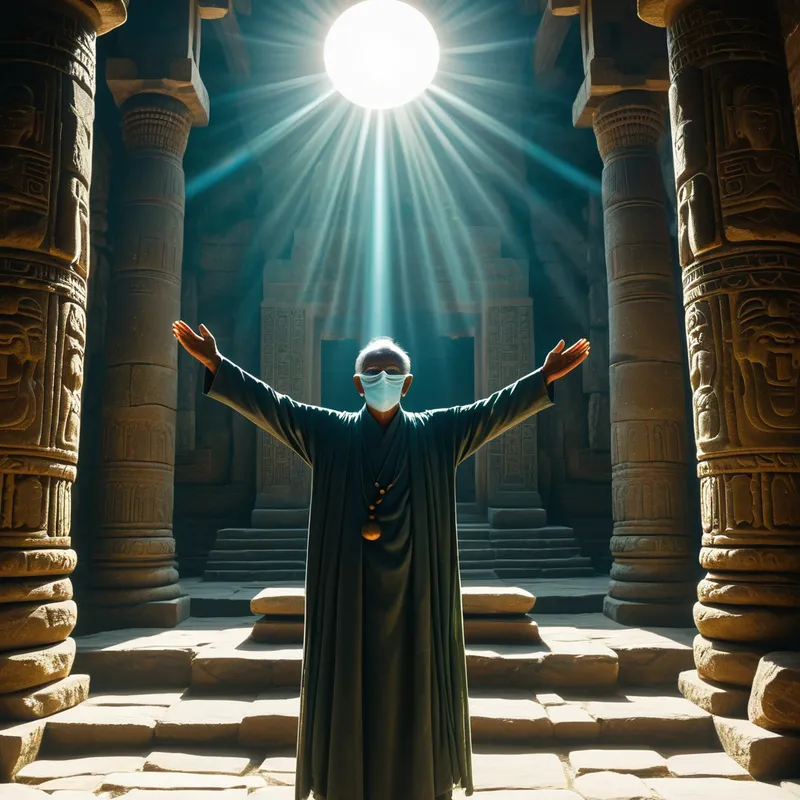
Prayer Beads Myth Meaning & Symbolism
A myth of a seeker who, guided by a sage, transforms scattered thoughts into a sacred circle, forging a tool for focus and a bridge to the divine.
The Tale of Prayer Beads
Listen. In the time before time was counted, when the world was a chorus of wind and thought, there lived a seeker whose mind was a storm. His name is lost, but his condition is known to all: a cacophony of wants, fears, memories, and tomorrows, a flock of birds all flying in different directions, tearing his inner sky to tatters. He could not hear the whisper of the river for the shouting of his own blood. He could not see the steadfastness of the mountain for the flickering of his own doubts.
He wandered, this fractured man, until he came to the foot of a high, silent place where a sage was said to dwell. The sage did not live in a palace, but in a cave that was neither dark nor light, a space between. When the seeker poured out his anguish—"My soul is scattered like seeds on stone!"—the sage did not offer a philosophy. He offered a task.
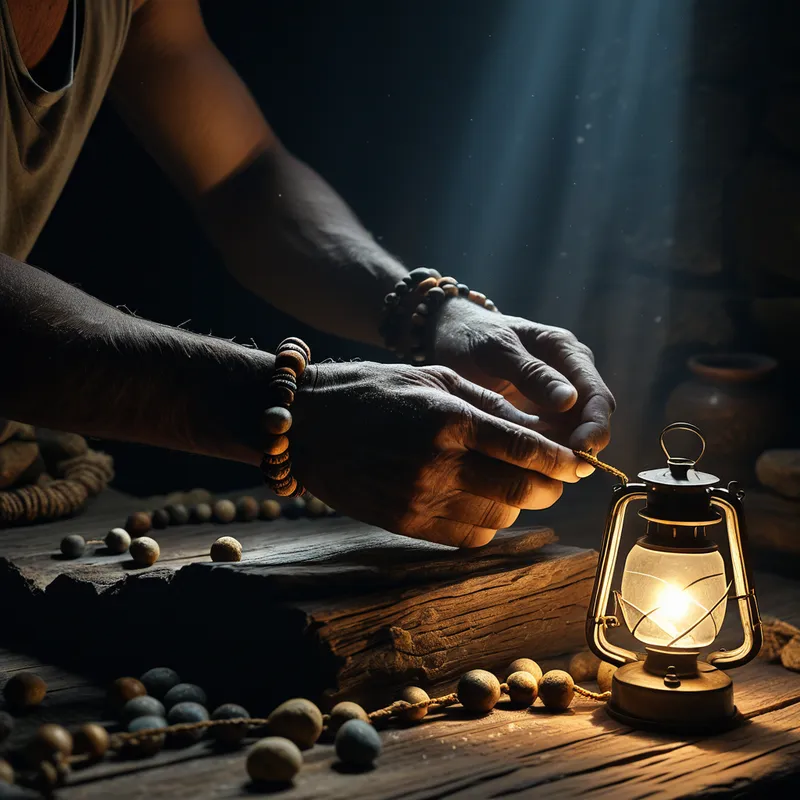
"Go to the riverbed," the sage said, his voice like dry leaves. "Gather one hundred and eight stones. Not any stones. You must listen for them. Find the stone that remembers the moon's pull, the one that holds the echo of the first rain, the one still warm from a forgotten sun. Gather them not with greed, but with listening."
For days and nights, the seeker knelt on the bank, his world shrinking to the texture of wet gravel, the song of the current, the patient search. One by one, stones called to him: a smooth black orb, a red one striated like a heartbeat, a milky white one holding a sky within. Each choice was a letting go of a clamoring thought. Each discovery was a moment of pure, unadorned attention.
He returned, his pouch heavy, his mind quieter but now filled with a new anxiety: possession. "I have them," he said, "but now I fear losing them!"
The sage took a length of cord, strong and plain. "The circle does not begin with the first bead," he murmured, "but with the knot that holds the void." He tied a firm, unseen knot. "This is the Ain Soph, the unknowable. From it, all proceeds."
Then, he instructed the seeker to string the stones. But as the seeker's fingers, clumsy with intent, tried to pass the cord, he fumbled. A stone dropped. He gasped, a pang of loss shooting through him. The sage was unmoved. "The dropped bead is as sacred as the one strung. It is the prayer forgotten, the breath lost. Acknowledge it, and continue."
Slowly, painstakingly, a circle emerged. When the last stone was added, the sage tied another knot, sealing the circle. "Behold," he said, placing the loop in the seeker's hands. "You have drawn a line around your chaos. You have taken the scattered pieces of your attention—each a world, each a worry—and given them a shared orbit. Now, move your thumb from bead to bead. Let each touch be a return. Not to the stone, but to the moment you chose it from the roar of the river. Let each bead be an anchor, pulling you back from the sea of distraction to the shore of the now."
The seeker began. And as his thumb found the rhythm—touch, breath, remembrance—the storm within began to still. The circle in his hand became a wheel turning the mill of his soul, grinding scattered wheat into the flour of presence. He did not find a god outside himself that day. He found the thread that connected all the fragmented gods within.
Cultural Origins & Context
This is not a myth from a single scroll or epic, but a story whispered in the very function of the object itself, emerging independently across the sacred landscapes of humanity. It is the ur-myth of the rosary, the mala, the misbaha, the japa mala. In monasteries, mosques, temples, and lonely hermitages, the physical act of passing beads through fingers became the vessel for this narrative.
It was passed down not by bards, but by masters to disciples in the quiet moments of instruction. "Let each bead be a step," a Buddhist monk might say. "Let each bead be a name of the Divine," a Sufi sheikh might instruct. The societal function was dual: it was a practical technology for focus, a mnemonic device for the illiterate and learned alike to hold complex litanies or mantras. More profoundly, it was an externalization of an internal process—a physical model for the taming of the wandering mind, making the intangible journey of consciousness tangible, holdable, and repeatable. It democratized contemplation, placing a universe of order into the palm of every seeker.
Symbolic Architecture
The myth is a masterclass in symbolic psychology. The scattered stones represent the ego-consciousness in its natural, untamed state: a plurality of competing complexes, memories, and desires with no central organizing principle. The seeker is the nascent self, aware of its own dissonance.
The circle is the primary symbol of the psyche in its quest for wholeness. It contains multiplicity but imposes unity, direction, and return.
The riverbank is the liminal space where the conscious mind (the seeker) engages with the unconscious (the flowing, timeless river of psychic material). Choosing stones "by listening" symbolizes the act of active imagination, selectively engaging with contents of the unconscious, not to be possessed by them, but to recognize their intrinsic value and individuality. The cord is the Self, the enduring thread of continuity that can bear the weight of all one's experiences. The fumbling and the dropped bead are crucial; they represent failure, distraction, and the acceptance of imperfection as part of the sacred process, not its negation.
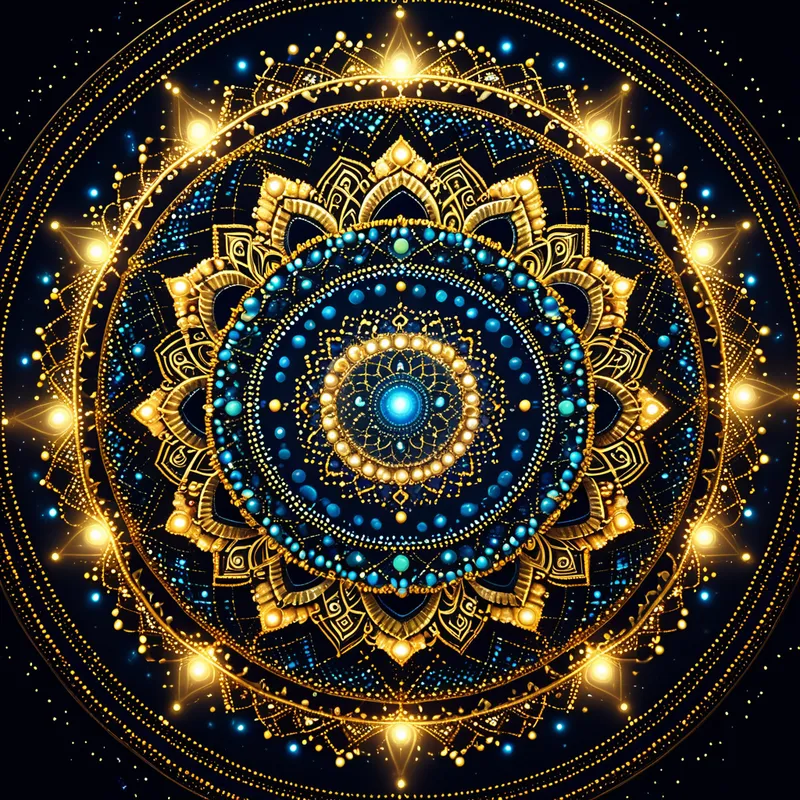
The completed circle is the mandala, a symbol of the integrated psyche. The rhythmic touching is ritual, the embodied practice that, through repetition, rewires the chaos into a patterned, harmonic resonance.
The Dreamer's Resonance
When this myth activates in the modern dreamer, it often manifests as dreams of searching for, untangling, or restringing beads. One may dream of a necklace breaking in a moment of stress, beads scattering across a floor that becomes an abyss. Or of patiently, desperately trying to thread a needle with a cord that keeps fraying, connecting beads that are impossibly heavy or luminous.
Somatically, this echoes a process of recollection. The psyche is attempting to gather its own scattered energies—the disparate roles we play, the unprocessed emotions, the forgotten passions—and find a thread to connect them. The anxiety in the dream is the ego's resistance to this ordering, fearing the loss of its familiar, fractured autonomy. The profound relief felt upon successfully stringing a single bead in a dream is the somatic recognition of a micro-synthesis, a tiny moment of psychic cohesion. The dream is the unconscious practicing the myth, training the dreamer in the art of gathering a self.
Alchemical Translation
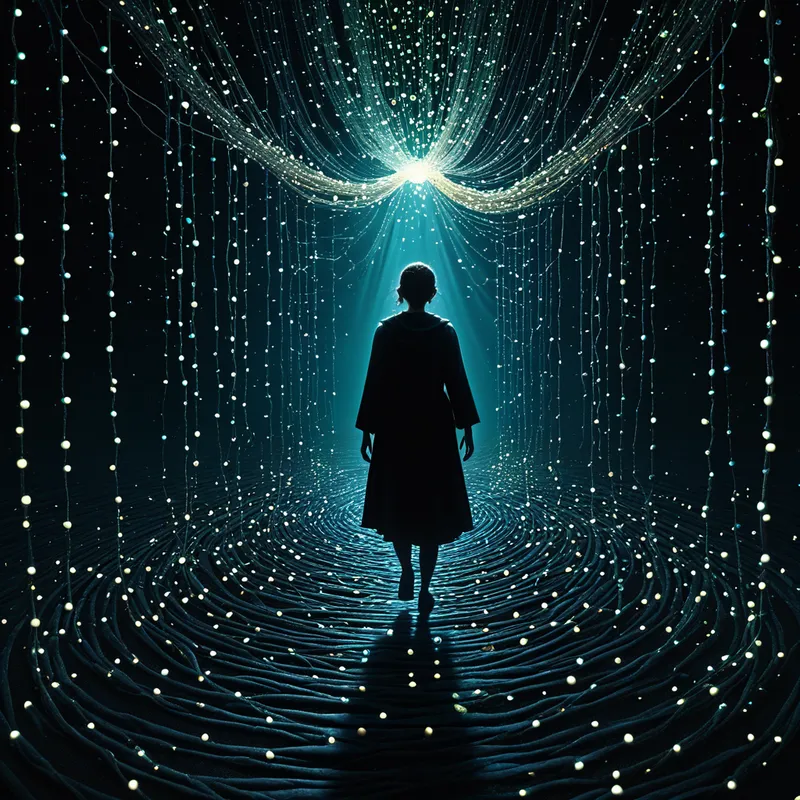
The alchemical operation modeled here is Coagulatio: the making solid, the bringing together of the spiritus mundi (the world spirit, represented by the river's endless flow) into a corpus (a body, the solid circle of beads). The seeker's journey is the individuation process in miniature.
First, the nigredo: the black chaos of the scattered mind, the seeker's initial suffering. Then, the albedo: the washing and selective gathering at the river, the work of discrimination and conscious choice. Finally, the rubedo: the reddening, the creation of the enduring, circulating form, the Philosopher's Stone held in the hand.
For the modern individual, the "prayer beads" are any consistent, rhythmic practice that draws a circle around our digital-age fragmentation. It could be the daily journal entry, the mindful walk, the deliberate breath, the regular creative act. Each iteration is a bead. The practice itself is the cord. The myth teaches that transformation does not come from a single, heroic insight, but from the humble, repetitive return to the circle we have drawn around our intention. We do not conquer the chaos. We invite each fragment of it, one by one, to take its place on a shared string, until the very thing that bound us—the rhythm of return—becomes the axis of our newfound, singular peace.
Associated Symbols
Explore related symbols from the CaleaDream lexicon: