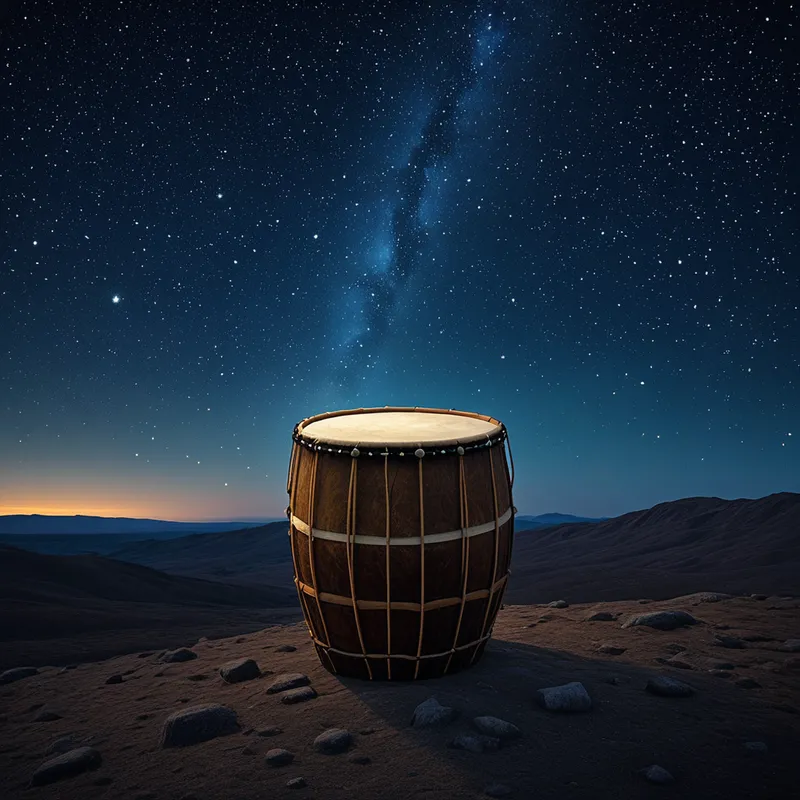
Powwow Drum Myth Meaning & Symbolism
A myth where the first drum's heartbeat summons the world into being, teaching that rhythm is the bridge between spirit, land, and people.
The Tale of Powwow Drum
In the time before time, when [the world](/myths/the-world “Myth from Tarot culture.”/) was a silent thought in the mind of the Great Mystery, there was only a deep, waiting stillness. The land lay formless, the waters were mute, and the winds held their breath. In this pregnant silence, the first people walked, but they walked in a dream. They could see the beauty of the mountains and rivers, but they could not feel them. They had no song for the sunrise, no dance for the rain. Their hearts beat alone, out of rhythm with the heart of [the world](/myths/the-world “Myth from Tarot culture.”/).
A great longing grew among them, a loneliness that echoed in the hollow of their chests. They gathered in council beneath the oldest tree, its branches scratching at the starless sky. An elder, her eyes holding the depth of forgotten lakes, spoke of a vision. She had seen, in the space between sleep and waking, a great Medicine Circle where all things were connected by a single, pulsing thread of sound. “We must find the heartbeat,” she whispered, her voice like dry leaves. “The heartbeat that sleeps in the belly of the world.”
A young man, whose name has been lost to [the wind](/myths/the-wind “Myth from Various culture.”/), was chosen for his pure intent and quiet spirit. He was sent not on a journey across land, but inward, into [the dreamtime](/myths/the-dreamtime “Myth from Aboriginal Australian culture.”/). He fasted, he prayed, and he lay upon [the earth](/myths/the-earth “Myth from Hindu culture.”/) until he could feel the slow, cold pulse of the stone beneath him. For four days and nights, he descended, not into a cave, but into the very soul of silence.
There, in that absolute dark, he encountered not a beast or a god, but a profound absence—a void that yearned to be filled. He felt his own heart thudding, a frail, lonely drum against the immense quiet. Despair began to claim him. But as he prepared to let go, he remembered the elder’s words: “Listen not with your ears, but with your bones.”
He stilled his own breath. He let his awareness sink deeper than thought. And then, he felt it. Not a sound, but a vibration. A deep, slow, resonant thrum that came from everywhere and nowhere. It was the potential of all rhythm, the mother of all pulse. It was the heartbeat of the Wakan Tanka itself.
In his vision, he saw how this vibration could be caught. He saw the trunk of the sacred tree, offering its body. He saw the hide of the buffalo, who gave its life so the people might live, offering its skin. He saw the four directions binding them in a circle. When he returned to the people, his eyes were clear, and his hands knew what to do.
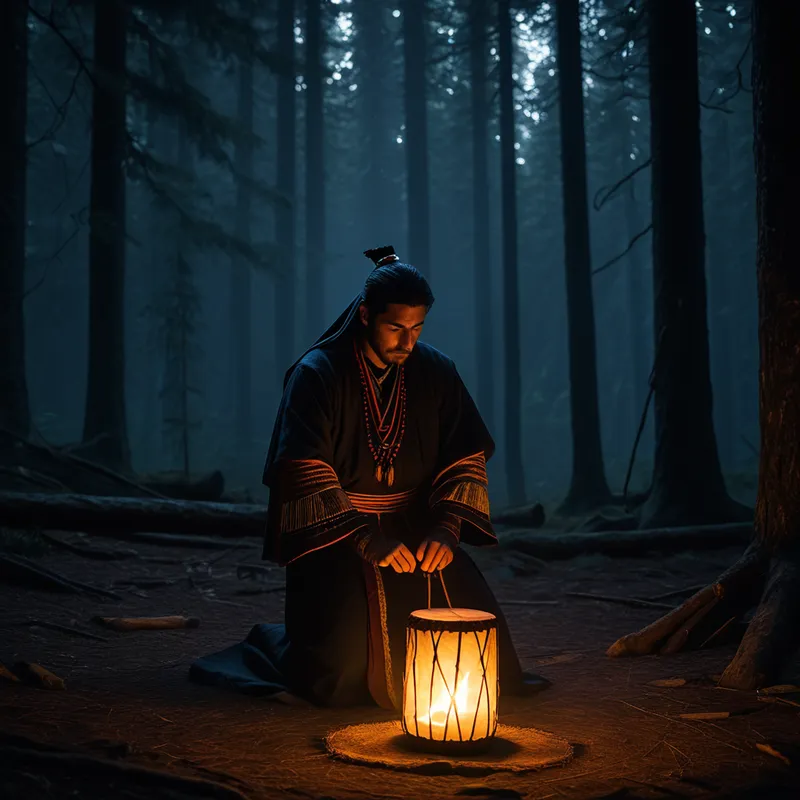
With reverence, he fashioned the first drum. He stretched the hide over the hollowed wood, and as he tied the final sinew, the circle was complete. The people gathered around, breath held. The young man lifted the first drumstick, carved from an eagle’s bone. He closed his eyes, found the memory of the world’s heartbeat in his own chest, and struck.
BOOM.
The sound was not loud, but it was immense. It rolled out from the circle like a wave. And the world awoke. The mountains hummed in harmony. The rivers began to chatter. The wind sighed into a melody. The people felt the vibration in their feet, rising up their legs, filling their chests, until their own hearts synchronized with the deep, resonant boom. Tears streamed down faces as, for the first time, they did not just see the world—they felt it. They were no longer separate. [The drum](/myths/the-drum “Myth from West African / Diasporic culture.”/)‘s voice had woven them into the living tapestry of creation. The first song had begun, and it was the song of belonging.
Cultural Origins & Context
The story of the first drum is not a single, fixed myth from one nation, but a profound archetypal narrative found in various forms across many Native American cultures, particularly among Plains and Woodlands peoples like the Lakota, Ojibwe, and others. It is a foundational story, often told by elders and spiritual leaders during ceremonies or when a new drum is brought into a community. Its transmission is oral, sacred, and experiential—it is often felt as much as it is heard, during the very act of drumming and singing.
The drum is not merely an instrument; it is considered a living being, a relative. Its societal function is multifaceted: it is the heartbeat of the community during powwows, the call to prayer in ceremony, the engine of the dance, and the unifying pulse in social and spiritual life. This myth provides the spiritual justification for that centrality. It explains why the drum has the power to alter states of consciousness, to heal, and to summon community. It teaches that the act of drumming is not performance, but participation—a sacred responsibility to keep the world’s heartbeat alive and to maintain the connection between the people, the land, and the spirit world.
Symbolic Architecture
At its core, the myth presents the drum as the [axis](/symbols/axis “Symbol: A central line or principle around which things revolve, representing stability, orientation, and the fundamental structure of reality or consciousness.”/) mundi of audible, tangible form. It is the manifested center where [spirit](/symbols/spirit “Symbol: Spirit symbolizes the essence of life, vitality, and the spiritual journey of the individual.”/) becomes sound, and sound creates cohesive [reality](/symbols/reality “Symbol: Reality signifies the state of existence and perception, often reflecting one’s understanding of truth and life experiences.”/).
The silent, pre-drum world symbolizes a state of psychic [fragmentation](/symbols/fragmentation “Symbol: The experience of breaking apart, losing cohesion, or being separated into pieces. Often represents disintegration of self, relationships, or reality.”/) and alienation. The people can perceive but not connect, representing a [consciousness](/symbols/consciousness “Symbol: Consciousness represents the state of awareness and perception, encompassing thoughts, feelings, and experiences.”/) that is observational but not participatory. The drum is the technology of [connection](/symbols/connection “Symbol: Connection symbolizes relationships, communication, and bonds among individuals.”/), the [symbol](/symbols/symbol “Symbol: A symbol can represent an idea, concept, or belief, serving as a powerful tool for communication and understanding.”/) of [the Self](/myths/the-self “Myth from Jungian culture.”/) in Jungian terms—the archetypal [blueprint](/symbols/blueprint “Symbol: A blueprint represents the foundational plan or design for something, often symbolizing potential, structure, and the mapping of one’s inner self or future.”/) of wholeness that unites conscious and unconscious, individual and collective.
The drum is the circle made sound, the boundary that creates connection, the membrane where the “I” resonates with the “All.”
Its [construction](/symbols/construction “Symbol: Construction symbolizes creation, building, and the process of change, often reflecting personal growth and the need to build a solid foundation.”/) is deeply alchemical: [wood](/symbols/wood “Symbol: Wood symbolizes strength, growth, and the connection to nature and the environment.”/) (the vertical, world-[tree](/symbols/tree “Symbol: In dreams, the tree often symbolizes growth, stability, and the interconnectedness of life.”/) spirit), hide (the horizontal, earthly, sacrificial [body](/symbols/body “Symbol: The body in dreams often symbolizes the dreamer’s self-identity, personal health, and the relationship they have with their physical existence.”/)), and the circle (the eternal, containing shape) are combined to capture the transcendent, formless [heartbeat](/symbols/heartbeat “Symbol: The heartbeat represents life, vitality, and the essence of being alive, symbolizing emotional connectivity and personal integrity.”/). The young man’s [journey](/symbols/journey “Symbol: A journey in dreams typically signifies adventure, growth, or a significant life transition.”/) is not one of conquest, but of receptive listening. His [triumph](/myths/triumph “Myth from Roman culture.”/) is one of ego-surrender; he becomes a hollow [vessel](/symbols/vessel “Symbol: A container or structure that holds, transports, or protects something essential, representing the self, emotions, or life journey.”/) through which a universal [pattern](/symbols/pattern “Symbol: A ‘Pattern’ in dreams often signifies the underlying structure of experiences and thoughts, representing both order and the repetitiveness of life’s situations.”/) can flow. He is the first [mediator](/symbols/mediator “Symbol: A figure who resolves conflicts between opposing parties, representing balance, communication, and the integration of differences.”/), modeling that true power comes from aligning one’s personal [rhythm](/symbols/rhythm “Symbol: A fundamental pattern of movement or sound in time, representing life’s cycles, emotional flow, and universal order.”/) with the primordial, archetypal [pulse](/symbols/pulse “Symbol: Represents life force, vitality, and the rhythm of existence. It symbolizes connection to one’s own body and the passage of time.”/).
The Dreamer’s Resonance
When this myth pattern activates in the modern [psyche](/myths/psyche “Myth from Greek culture.”/), it often manifests in dreams of hearing a deep, resonant, rhythmic sound—a heartbeat from the walls, a drum from underground, a pulse in the silence. Somatic sensations accompany it: a vibration in the chest, a feeling of the ground shaking, or a powerful urge to move or dance.
Psychologically, this signals a critical phase where the dreamer’s unconscious is attempting to re-establish a fundamental rhythm that has been lost. It often occurs during times of profound isolation, creative blockage, or a sense of being out of sync with one’s own life. The dreaming ego is in the position of the pre-drum people: perceptive but disconnected. The emerging drumbeat is the call of the Self, initiating a process of synchronization.
The dream is an invitation to stop seeking outside for connection and to begin the arduous, inward journey to find one’s own authentic pulse—the unique rhythm of one’s soul that, when struck, will naturally harmonize with the larger patterns of life, relationship, and purpose. It is a call to move from observation to participation.

Alchemical Translation
The myth of [the Powwow](/myths/the-powwow “Myth from Native American culture.”/) Drum is a perfect map for the process of individuation. The initial state represents the unindividuated psyche, where the individual is part of a collective but feels no true, vibrant connection to it or to the depths of their own being.
The young man’s inward journey is the descent into the unconscious. [The void](/myths/the-void “Myth from Buddhist culture.”/) he encounters is the terrifying, silent face of the unintegrated Self. His despair is the crucial “dark night of the soul,” where [the ego](/myths/the-ego “Myth from Jungian culture.”/)‘s resources are exhausted. His breakthrough—listening with his bones—is the shift from ego-led striving to a receptive, body-based intelligence, a trusting in the wisdom of the deeper psyche.
To find your rhythm, you must first become quiet enough to hear the world’s. Individuation is not about forging a new self, but tuning the one you are to the ancient song.
Fashioning the drum is the symbolic integration. The ego (the young man) takes the raw, archetypal energy (the world’s heartbeat) and, using the gifts of nature and sacrifice (wood, hide), gives it a form in the realm of consciousness. The circle is [the mandala](/myths/the-mandala “Myth from Architectural culture.”/) of the integrated psyche.
Finally, the first strike and the community’s response model the ultimate goal. The individual who has connected to their own primal rhythm (individuated) does not become isolated. Instead, they become the catalyst for the community’s awakening. Their authentic “beat” creates a resonant field that allows others to find and harmonize with their own. The psychic transmutation is complete: personal wholeness leads to a deeper, more authentic capacity for unity. The drum reminds us that our most sacred task is to listen for our unique pulse, and having found it, to have the courage to let it sound.
Associated Symbols
Explore related symbols from the CaleaDream lexicon: