Poukai the Giant Bird Myth Meaning & Symbolism
A tale of a monstrous bird that terrorized a tribe, defeated by a hero who mastered its own power, symbolizing the conquest of inner chaos.
The Tale of Poukai the Giant Bird
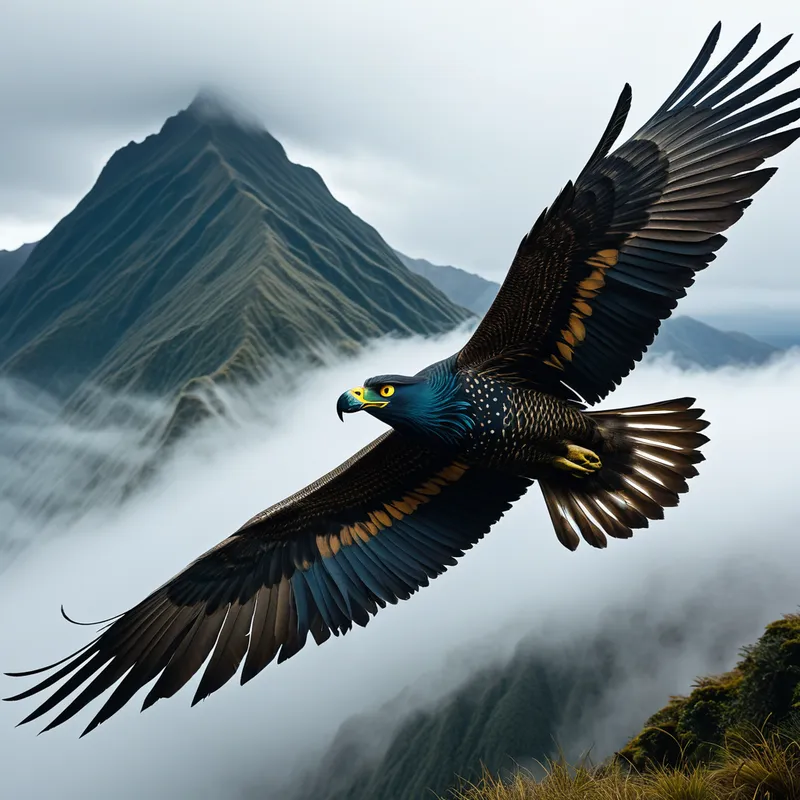
In the time when the world was young and the mountains still whispered secrets to the sky, a shadow fell upon the land of Te Ika-a-Māui. It was not the shadow of a cloud, but of a creature born of ancient, forgotten nightmares. From the highest, most treacherous peaks of the Taranaki region, it descended: Poukai, the giant bird.
Its wings, when spread, blotted out the sun, casting villages into a sudden, chilling twilight. The beat of those wings was not a sound, but a pressure, a thrum that vibrated in the chest and stilled the heart. Its cry was the shriek of splitting stone. This was no ordinary bird, but a [taniwha](/myths/taniwha “Myth from Maori culture.”/) of the air, a devourer. It fed not on fish or forest creatures, but on the people themselves. It would swoop from its eyrie, a fortress of bones and woven branches high on a cliff, and carry off warriors, children, elders—any who strayed too far from the communal fire. Fear, thick and sour, settled over the tribes. The songs of the people grew quiet, the paths between pā grew over, and the eyes of the children were forever turned upward, scanning the sky.
But in one village, a fire of a different kind was kindling. A young man, whose name some say was Hatupatu, though the bird’s challenger has many names, could bear the terror no longer. He had seen the empty spaces at the hearth, felt the grief that hung heavier than mist. While others counseled caution and hiding, he heard a different call—not the bird’s shriek, but the silent cry of his people’s stifled spirit. He announced his intention: he would climb to the monster’s nest and end its reign.
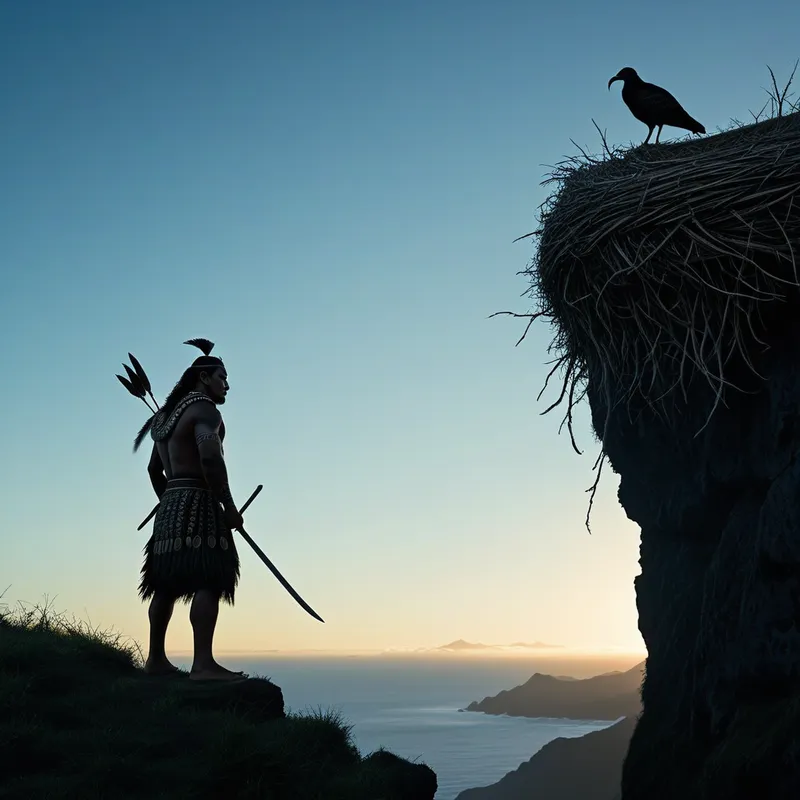
The elders warned him it was tapu, a journey to certain death. But the hero had prepared. He had observed the bird’s patterns, its favored winds, the times it hunted. He smeared his body with red kōkōwai, not for war, but for a different kind of battle—a battle of will against instinct, of cunning against brute force. His weapons were not only a spear and a club, but patience and a plan.
The climb was a descent into the realm of the primal. He scaled cliffs where no human handhold existed, crossed chasms on roots that groaned under his weight, and felt the air grow thin and cold. Finally, he reached the ledge below the great nest. The stench of death and old bones was overwhelming. He could hear the rustle of immense feathers above. He waited, a stone come to life, as the sun began to sink.
With a gust that nearly tore him from the ledge, Poukai returned, a dark comet landing in its fortress. The hero moved. As the giant bird settled, he sprang from his hiding place. He did not strike at its body, which was armored like stone, but at its means of dominion. With furious, precise blows, he shattered the great bones of its wings. The creature’s rage-filled shrieks shook the mountain, but it was earthbound, its terrible grace broken. In its thrashing, the hero delivered the final blow. The shadow that had plagued the land was still.
He returned not just with a tale of victory, but with the monster’s own feathers. The people, seeing him descend from the sky-place alive, knew the fear was broken. The sun seemed brighter, the air sweeter. The hero who faced the devourer had not just slain a beast; he had reclaimed the sky for his people.
Cultural Origins & Context
The myth of Poukai, also known regionally as Pouakai or the bird of Hokioi, belongs to the rich oral tradition of the Māori, the indigenous Polynesian people of Aotearoa</ab- br>. These stories, or pūrākau, were not mere entertainment but the living library of a culture, encoding history, ecological knowledge, social values, and spiritual truths. The Poukai narrative is found in several tribal (iwi) traditions, particularly those of the Taranaki and South Island regions.
It functioned on multiple levels. On one hand, it served as an etiological myth, potentially explaining the existence of massive, now-extinct fauna like the moa or the Haast’s eagle, whose bones may have inspired tales of giant birds. On a deeper societal level, it was a parable of communal survival. The story reinforced the value of the pā (fortified village) as a place of safety, the danger of venturing alone into the untamed wilderness (wao nui), and the absolute necessity of courage and innovative strategy in the face of existential threats. The hero’s success was a testament to mātauranga (knowledge and wisdom) triumphing over blind terror.
Symbolic Architecture
At its core, the myth of Poukai is a masterful map of the psyche confronting a monolithic, devouring fear. The giant [bird](/symbols/bird “Symbol: Birds symbolize freedom, perspective, and the connection between the earthly and spiritual realms, often representing the soul’s aspirations or personal growth.”/) is not an external [monster](/symbols/monster “Symbol: Monsters in dreams often symbolize fears, anxieties, or challenges that feel overwhelming.”/) but the embodiment of a collective, paralyzing [anxiety](/symbols/anxiety “Symbol: Anxiety in dreams reflects internal conflicts, fears of the unknown, or stress from waking life, often demonstrating the subconscious mind’s struggle for peace.”/)—the [shadow](/symbols/shadow “Symbol: The ‘shadow’ embodies the unconscious, repressed aspects of the self and often represents fears or hidden emotions.”/) of the tribe, made manifest.
The predator from above represents that which attacks from the realm of thought and spirit, a fear so vast it darkens the sun of consciousness itself.
The bird’s aerial domain signifies fears that are abstract, overwhelming, and seemingly beyond reach or control—[disease](/symbols/disease “Symbol: Disease represents turmoil, issues of control, or unresolved personal conflicts manifesting as physical or emotional suffering.”/), [famine](/symbols/famine “Symbol: A profound lack or scarcity, often of food, representing deprivation, survival anxiety, and systemic collapse.”/), the capriciousness of [nature](/symbols/nature “Symbol: Nature symbolizes growth, connectivity, and the primal forces of existence.”/), or the [terror](/symbols/terror “Symbol: An overwhelming, primal fear that paralyzes and signals extreme threat, often linked to survival instincts or deep psychological trauma.”/) of a neighboring tribe. Its [nest](/symbols/nest “Symbol: A ‘nest’ symbolizes safety, home, and the nurturing aspects of personal and familial connections.”/), a [fortress](/symbols/fortress “Symbol: A fortress symbolizes security and protection, representing both physical and psychological safety from external threats.”/) of bones on a high peak, is the isolated, fortified seat of this psychic complex, built from the remains of past traumas and defeats. The [hero](/symbols/hero “Symbol: A hero embodies strength, courage, and the ability to overcome significant challenges.”/)’s [journey](/symbols/journey “Symbol: A journey in dreams typically signifies adventure, growth, or a significant life transition.”/) is the arduous [path](/symbols/path “Symbol: The ‘path’ symbolizes a journey, choices, and the direction one’s life is taking, often representing individual growth and exploration.”/) of [consciousness](/symbols/consciousness “Symbol: Consciousness represents the state of awareness and perception, encompassing thoughts, feelings, and experiences.”/) ascending to meet this unconscious content. His red ochre is the [symbol](/symbols/symbol “Symbol: A symbol can represent an idea, concept, or belief, serving as a powerful tool for communication and understanding.”/) of [mana](/symbols/mana “Symbol: A spiritual energy or life force in Polynesian cultures, now widely adopted in gaming as a resource for magical abilities.”/) and tapu, a conscious [application](/symbols/application “Symbol: An application symbolizes engagement, integration of knowledge, or the pursuit of goals, often representing self-improvement and personal development.”/) of sacred power and [identity](/symbols/identity “Symbol: Identity represents the sense of self, encompassing personal beliefs, cultural background, and social roles.”/) to face the profane [terror](/symbols/terror “Symbol: An overwhelming, primal fear that paralyzes and signals extreme threat, often linked to survival instincts or deep psychological trauma.”/). By crippling the wings, he does not destroy the fear’s essence but grounds it, renders it comprehensible and manageable. The victory is not annihilation, but [integration](/symbols/integration “Symbol: The process of unifying disparate parts of the self or experience into a cohesive whole, often representing psychological wholeness or resolution of internal conflict.”/)—the feathers, the [symbol](/symbols/symbol “Symbol: A symbol can represent an idea, concept, or belief, serving as a powerful tool for communication and understanding.”/) of the bird’s power, are brought back to the [community](/symbols/community “Symbol: Community in dreams symbolizes connection, support, and the need for belonging.”/).

The Dreamer’s Resonance
When the archetype of Poukai stirs in the modern dreamer, it often signals a confrontation with a “devouring” complex. This is not everyday anxiety, but a somatic, primal fear that feels ancestral and too big to face. The dreamer may experience dreams of being stalked by a large bird, of a shadow passing over them, or of looking up at a terrifying, dominant presence.
Psychologically, this is the process of a latent, overpowering fear—of failure, abandonment, annihilation—breaking into consciousness. The body may respond with a feeling of weight on the chest, a sense of being pinned, or waking in a cold sweat. The dream is the psyche’s way of saying the fear can no longer live unchallenged in the high, remote places of the unconscious. It must be faced, or it will continue to “carry off” parts of one’s vitality, creativity, and peace. The dreamer is being called to become the hero of their own inner landscape, to identify the source of this shadow and begin the climb toward it.

Alchemical Translation
The myth models the alchemical nigredo, the blackening, and the subsequent albedo. The initial state of the tribe is the nigredo—a collective depression, a life in shadow, ruled by a merciless, externalized fear. The hero’s decision to act is the first stirring of the individual will, the spark in the darkness.
The climb to the nest is the arduous, solitary work of introspection, where one must traverse the rugged terrain of memory, shame, and old wounds to locate the core structure of one’s fear.
The confrontation is the critical moment of psychic transmutation. The hero does not rage blindly; he employs strategy (conscious insight) to ground the aerial terror (make the abstract fear concrete). Shattering the wings is the act of disempowering the fear’s ability to dominate one’s entire perspective. It is the realization, “This fear does not have to control my life.”
The return with the feathers is the albedo, the whitening. The integrated fear, now stripped of its autonomous, terrifying power, becomes a source of strength and wisdom (mana). The feathers are a trophy of integration, proof that what once devoured can now adorn and empower. For the modern individual, this is the process of individuation: facing the personal or ancestral “Poukai,” understanding its structure, grounding its overwhelming power, and ultimately reclaiming the psychic energy it had captive, using it to build a more whole and fearless self.
Associated Symbols
Explore related symbols from the CaleaDream lexicon:
- Bird — The primary symbol of aerial dominion and predatory fear, representing thoughts or anxieties that attack from above, beyond easy reach or control.
- Mountain — The lofty, treacherous, and isolated domain of the monstrous, symbolizing the arduous climb into the heights of one’s own unconscious to confront a dominant complex.
- Fear — The raw, devouring emotion made manifest in the Poukai, representing a collective or personal terror that paralyzes and consumes vitality.
- Hero — The conscious aspect of the self that chooses to undertake the perilous journey of confrontation, armed with strategy and sacred intent.
- Shadow — The Poukai itself is a classic shadow archetype, a monstrous personification of everything the tribe fears and has repressed.
- Journey — The essential narrative structure of the myth, mapping the path from victimhood under fear to mastery through direct engagement.
- Bone — The building blocks of the Poukai’s nest, representing the structural remains of past traumas and losses upon which present fears are constructed.
- Sky — The realm of the Poukai, symbolizing the domain of spirit, thought, and abstract terror, which must be reclaimed for wholeness.
- Cave — Analogous to the cliffside nest, a dark, hidden recess where a monstrous aspect of the psyche resides, waiting to be brought to light.
- Light — The symbolic prize of the hero’s quest, the restored sun and safety of the community, representing consciousness reclaimed from the shadow.
- Giant — The overwhelming scale of the challenge, indicating a fear or complex that feels larger-than-life and insurmountable from the perspective of the ego.
- Death — The ever-present threat of the Poukai, symbolizing the psychic death of vitality, hope, and community when ruled by unconfronted terror.