The Dream of Strategy: Blueprints of the Inner Sovereign
The Somatic Echo
Before the mind grasps the concept, the body knows the dream of strategy. It is not a thought, but a posture. A tightening across the shoulders, a subtle forward lean of the spine, as if bracing against a console only you can see. The breath becomes shallow, measured—not in panic, but in calculation. There is a peculiar, humming stillness in the skull, a pressure behind the eyes that feels less like tension and more like the focused heat of a lens concentrating light. Your hands might feel heavy, as if they remember the weight of tools you’ve never held, or light, tingling with the phantom feedback of invisible controls. This is the somatic architecture of command awakening. It is the ghost-sensation of a helm beneath your palms, long before any ship appears on the horizon.
The Dreamer's Log
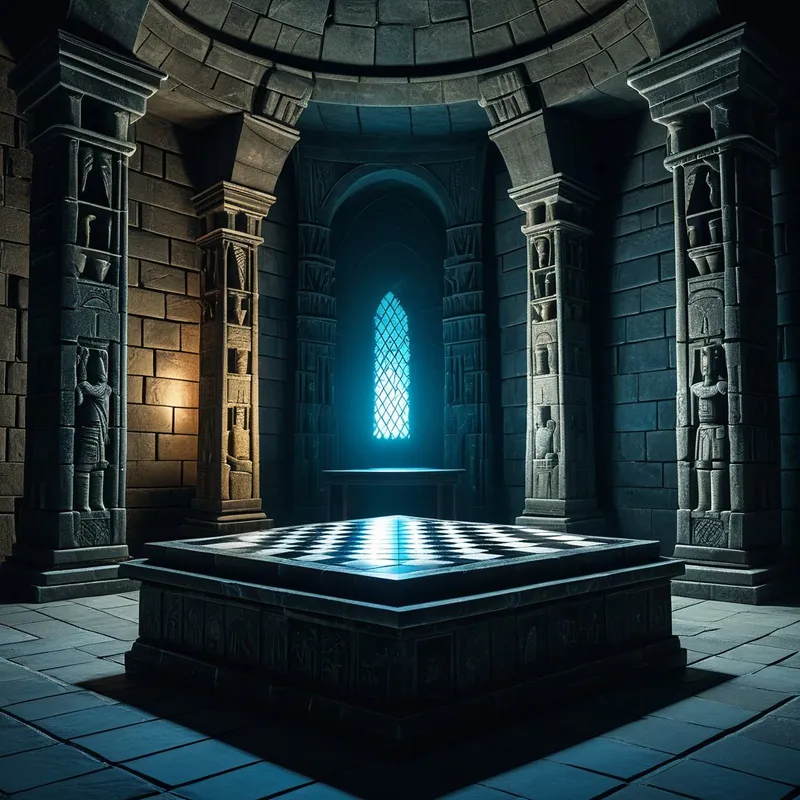
The dreamer stands in a cavernous, forgotten server room, but the servers are monoliths of carved basalt. On a central stone table, a chessboard glows with internal light. They reach to move their queen, but their hand passes through it like smoke. The opposing pieces—faceless, smooth obsidian—inch forward on their own. A voice, their own but layered with static, echoes: “You are consulting the wrong map.”
Alchemical Interpretation: The psyche signals that conscious, rigid planning has become spectral and ineffective, while the autonomous, shadow-driven patterns of the opponent (an internal force) advance unimpeded, demanding a shift from external maneuver to internal cartography.
The False Lead
A dream of strategy is not a mere puzzle to be solved, nor is it an anxiety-dream about daily logistics. It is not about “figuring out” a problem in the conventional sense. To mistake it for simple planning is to hear a symphony and note only the metronome. The terror here is not of failure, but of misapplied sovereignty—of realizing you have been expertly playing a game whose rules were designed to ensure your depletion. The grief is not for a lost battle, but for the years spent building fortifications around an empty throne. This dream does not come to make you a better tactician in the world; it comes to reveal the world for which you are meant to be the sovereign.
Psychological Architecture
Here, the Shadow work is one of reclamation and brutal honesty. It asks: What part of you has been acting as a mercenary general, fighting battles for a cause you did not choose? This is the realm of the internal family systems, where exiled parts—the Orphan who learned cunning to survive, the Rebel who strategizes sabotage, the Shadow Ruler who maintains control through silent threats—have taken up strategic roles in your inner polity. The dream of strategy exposes this hidden cabinet.
The individuation process is the dissolution of this shadow-cabinet and the direct assumption of command by the conscious Self. It is the terrifying, liberating moment when you stop receiving intelligence reports filtered through layers of internal bureaucracy and instead become the intelligence. You feel the movement of every exiled part, not as a threat to be managed, but as data points on a vast, living map of your own being. The pressure is immense: to hold the complexity without fracturing, to feel the pull of a dozen contradictory strategies (the part that wants to flee, the part that wants to attack, the part that wants to hide) and to synthesize from them a third, unforeseen path—your own.
Mythic Resonance
We see this in the myth of Odysseus, the strategist par excellence. His journey home is not a straight line of force, but a winding path of cunning, adaptation, and sometimes devastating compromise. His brilliance with the Trojan Horse is shadowed by the cost: a decade of circuitous, soul-scouring voyage. The myth whispers that the ultimate strategy is not about conquering the external foe, but about navigating the internal sea of one’s own pride, trauma, and desire, all while keeping the faint, fixed star of home—the integrated Self—in view. Similarly, the Hindu concept of Dharma is not a rigid rulebook, but a strategic alignment. It is the dynamic, moment-to-moment calculation of right action based on one’s essential nature and place in the cosmic order. Arjuna on the battlefield of Kurukshetra is paralyzed not by lack of strategy, but by a crisis of context. Krishna’s counsel is the ultimate strategic briefing: revealing the larger map, the eternal scale, upon which the immediate battle is but a single move.
Symbolic Nodes
- Chessboards, Game Maps, Blueprints: The conscious mind’s attempt to model a system of conflict or creation.
- Control Rooms, Helms, Dials & Levers: The seat of agency and the interface with a larger, complex system.
- Tangled Wires/Knots vs. Clean Circuits/Paths: The state of internal communication—chaotic interference or clear command.
- Unmoving Pieces or Frozen Clocks: Strategic paralysis; the cost of over-analysis or fear of initiating action.
- An Opponent Who is a Mirror or Shadow: The strategic challenge is with a disowned part of the self.
- A Tool That Morphs or Fails: The inadequacy of a previously trusted mental model or coping mechanism.
Archetypal Resonance
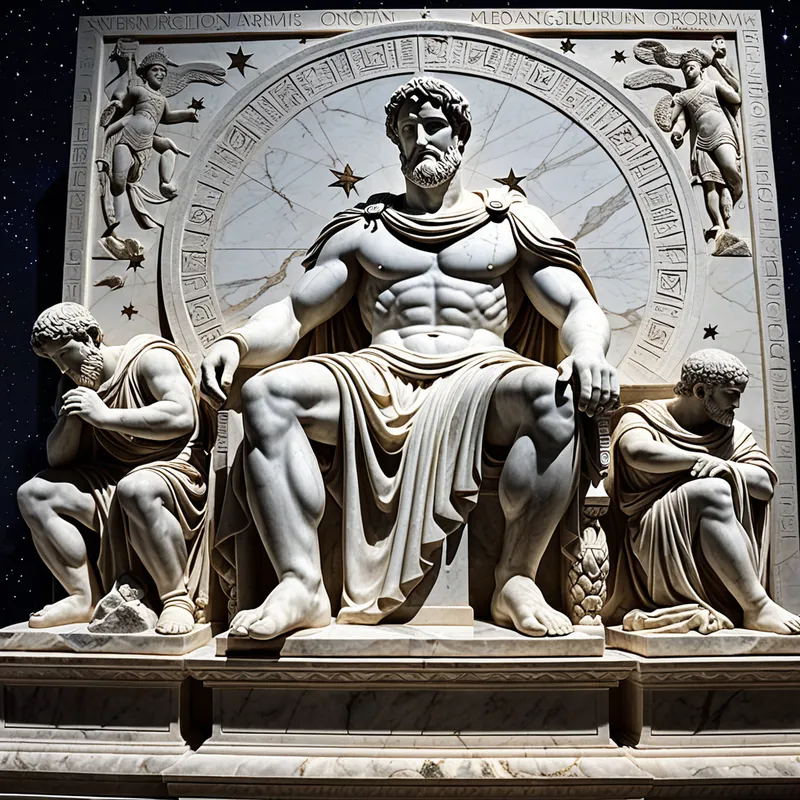
The Ruler Archetype is the core energy activated in the dream of strategy. Its emergence is the somatic echo of that shoulder-bracing, helm-gripping posture—the body preparing for the weight of sovereignty. This is not about controlling others, but about the terrifying, alchemical potential of establishing unshakable order within the inner kingdom. The Shadow Ruler, the tyrant or control-freak, is what appears when this archetype is feared and thus distorted; it strategizes to dominate internal exiles and external life, creating a brittle, paranoid regime. The mature Ruler’s strategy is one of enlightened stewardship: it seeks to understand the needs of all inner parts (the citizens), allocate resources (energy, attention) wisely, and establish laws (boundaries, values) that allow the entire psyche to thrive in harmonious, dynamic order. The dream is its war room, where the fate of the kingdom is decided.
The Alchemical Process
The transmutation here is from Chaotic Reaction to Coherent Response. The prima materia is the raw, undigested data of your life—the conflicts, desires, and fears that seem like random attacks or obstacles. The heat is applied in the crucible of the pause. It is the unbearable, pressurized moment between stimulus and your ingrained, automatic reaction. In that pause, the old, shadow-led strategies scream for execution.
The alchemical fire is sustained attention held in that gap. Within it, the chaotic elements begin to separate. You see the orphan’s strategy for safety, the rebel’s strategy for freedom, the caregiver’s strategy for peace—all operating independently. The solve et coagula (dissolve and recombine) is the work of the nascent Ruler: to dissolve the allegiance to these fragmented plans and recombine their core intelligence into a single, sovereign directive that serves the whole Self. The gold produced is not a guaranteed “win,” but Sovereign Calm—the capacity to engage with complexity from a center of unshakeable, strategic poise.

The Integration Protocol
Question 1: Where in my waking life do I feel like a competent, even brilliant, tactician in a game I never wanted to play? What is the unspoken rule of that game that ensures my energy is drained?
Question 2: When I feel strategic paralysis or anxiety, if I listen beneath the fear, what two or three exiled “inner advisors” are shouting contradictory plans? (e.g., “Hide everything!” vs. “Burn it all down!” vs. “Just please them!”)
Question 3: If my inner kingdom were perfectly ordered and at peace, not through suppression but through enlightened governance, what is the first, simplest law (boundary or value) I would decree?
Action 1 (Somatic Cartography): For one day, do not change any action. Instead, before each significant action or reaction, place a hand on your sternum. Feel the physical posture of your strategy. Are you braced? Leaning? Retreating? Simply map the somatic signature of your automatic commands.
Action 2 (Uncoded Briefing): Take a large sheet of paper. In the center, draw a simple circle representing your core self. Without thinking, let your hand draw lines, shapes, and symbols radiating outwards that represent the current “strategic initiatives” operating in your life. Use abstract marks, not words. Which look like fortifications? Which look like tangled knots? Which look like clear, strong paths?
Action 3 (Ritual of the New Protocol): Based on your third reflection question, physically enact your first “law.” If the law is “Resources flow to creation, not defense,” then literally move money from a savings account to a course or tool, or move time from a defensive chore to a creative one. Light a candle as you do it, stating softly: “This action follows the new protocol.”
Final Validation
The exhaustion you feel is real. It is the fatigue of a fragmented parliament, of a war room where every voice is a ghost of a past wound, shouting plans born of old survival. To dream of strategy is to be shown the magnificent, daunting blueprint of your own integrated command. The path is not to think harder, but to listen deeper—to become the silent, spacious chamber in which the chaos of counsel resolves into a single, clear note of knowing. The sovereignty it offers is not over your life, but from within it. You are not just moving pieces on the board. You are learning, at last, to be the board, the pieces, and the hand that moves them—all at once.