Poseidon's Waves Myth Meaning & Symbolism
The myth of Poseidon's tempestuous power, where the sea god's fury tests mortals, symbolizing the soul's confrontation with primal, unconscious forces.
The Tale of Poseidon's Waves
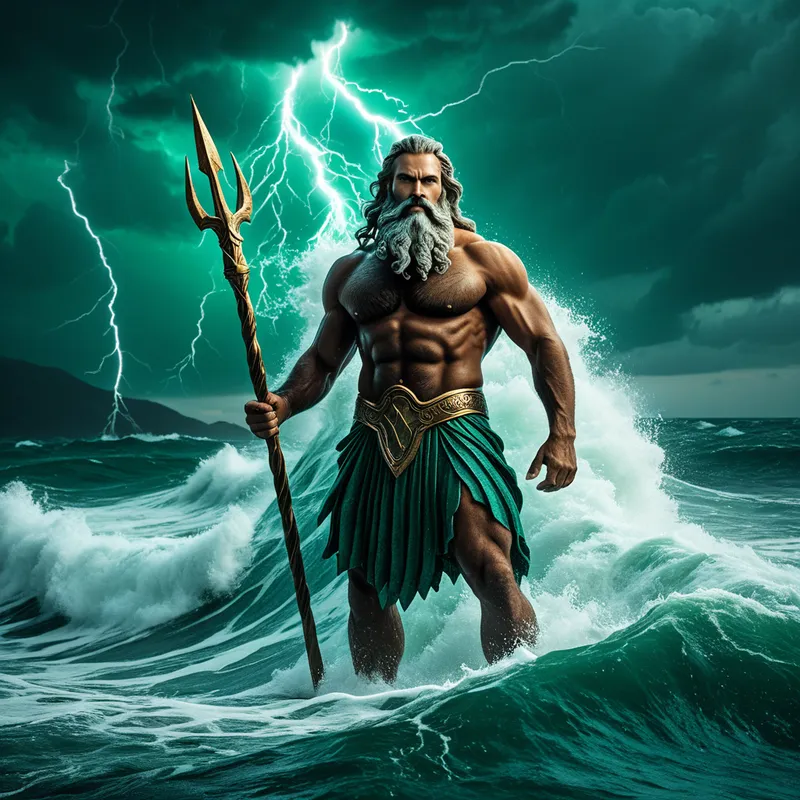
Hear now the tale not of a single wave, but of the sea’s very soul, given form and fury in the god who holds the earth in his watery grasp. Before the first ship dared to cross the wine-dark sea, there was only the deep, the formless salt-chaos from which all life first stirred. From this abyss, the brothers drew lots: Zeus took the shimmering air, Hades the silent realm of shades, and to Poseidon fell the rolling plains of ocean. His domain was not a placid mirror, but a living, breathing beast with a thousand moods.
When Poseidon is pleased, his waves are gentle as a lover’s sigh, cradling the hulls of ships, their rhythm a lullaby for sailors. Dolphins leap in his wake, and the sea teems with bounty. But let his pride be wounded—let a mortal king forget his due sacrifice, let a hero boast of surpassing the gods, let his own turbulent heart be stirred—and the face of the world changes. The air grows heavy with the scent of ozone and salt. The horizon, once a clean line, bruises to a deep purple. Then comes the sound: a low groan from the deep, as if the bedrock of the world is shifting. It is the breath of the Earth-Shaker.
Then he rises. Not from the waves, but as the waves. His form is the towering wall of water that blots out the sun, his voice the shriek of the gale through rigging, his wrath the riptide that pulls a strong swimmer to the abyss. He needs no army; the sea itself is his weapon. He lifts his trident, and the ocean floor quakes, spawning tsunamis that race toward the shore. He strikes the water, and whirlpools open like hungry mouths. In such moments, human endeavor is reduced to splinters and prayers. The proud vessel becomes a toy, the brave captain a child weeping for his mother. This is the myth: the eternal, cyclical drama of a force that gives life and can snuff it out in an instant, a power so vast it mirrors the chaos of the cosmos itself.
Cultural Origins & Context
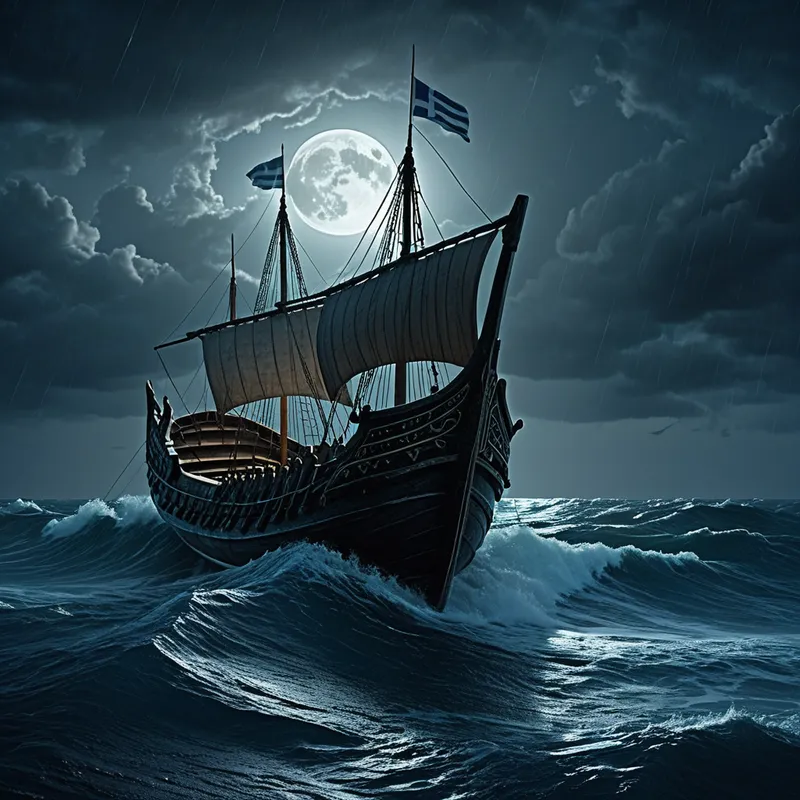
This was not a single story penned by one author, but a living, breathing understanding woven into the very fabric of Hellenic life. The tales of Poseidon’s fury were sung by bards in smoky halls, recounted by fishermen mending nets, and invoked in the prayers of every merchant who loaded a ship at Piraeus. Homer, in his Odyssey, gives us the most enduring narrative frame: the god’s relentless persecution of Odysseus for blinding his son, the Cyclops Polyphemus. This was a masterclass in the cultural function of the myth.
For a people whose world was bounded by the Mediterranean, the sea was the ultimate paradox: the source of trade, travel, and sustenance, and simultaneously the most immediate and terrifying natural threat. The myth of Poseidon’s Waves served as a theological explanation for this capricious reality. It taught respect (sebas) for forces beyond human control. Rituals and sacrifices—throwing prized horses into the sea, libations of wine—were not mere superstition but a crucial psychological and social technology. They were a way to negotiate with the uncontrollable, to enact a semblance of order upon the chaos, acknowledging that human fortune was forever at the mercy of a deeper, older will.
Symbolic Architecture
Beneath the narrative of divine pique lies a profound symbolic architecture. Poseidon’s domain is the classical symbol of the unconscious—vast, deep, teeming with life and hidden monsters, essential for existence yet fundamentally alien to the ordered light of conscious reason. His waves, therefore, are not merely water; they are the sudden upwellings of psychic content that the conscious mind (Olympus) has failed to integrate or honor.
The wave does not hate the ship; it is simply the sea remembering its own boundless power.
The trident is a key. A tool for fishing and a weapon, it represents the god’s—and by extension, the unconscious’s—ability to pierce the surface. It stirs up what is buried, creates fissures in what seemed solid (earthquakes), and asserts a primal sovereignty. The storm, then, is a symbolic crisis. It is the necessary, often violent, disruption that occurs when the ego becomes too rigid, too arrogant, or too forgetful of its dependence on the deeper, instinctual self. The wave that destroys the old vessel is also the force that washes the survivor onto a new, unknown shore, initiating transformation.
The Dreamer's Resonance
When this myth stirs in the modern psyche, it often manifests in dreams of overwhelming aquatic force. To dream of a colossal wave approaching, of being caught in a tempest at sea, or of floodwaters breaching one’s home is to dream the pattern of Poseidon’s Waves. Somaticly, one might awake with a racing heart, a sense of suffocation, or the residual feeling of being tossed about.
Psychologically, this signals that contents of the personal or collective unconscious are rising with an urgency that can no longer be ignored. It is not necessarily a prophecy of literal disaster, but an image of an internal emotional or psychological tsunami. The dream-ego’s position is critical: Are you on the shore, watching in awe? Are you in a boat, fighting for control? Are you submerged, struggling for air? Each position reflects a different relationship to the emerging chaos—from detached observation to frantic resistance to complete engulfment. The dream is the psyche’s dramatic enactment of a pressure that has been building beneath the surface of conscious life, demanding acknowledgment.

Alchemical Translation
The alchemical journey, or the path of individuation, is mirrored perfectly in the ordeal of the storm. The initial state is one of identification with the conscious persona—the sturdy ship on a planned course. The wave is the nigredo, the blackening, the dissolution of that artificial order. It is a brutal, involuntary immersion in the primal waters of the unconscious.
To be broken by the wave is not failure, but the first condition for being remade by the sea.
The survival of this ordeal—the clinging to wreckage, the desperate swim—represents the albedo, the whitening, where the ego, humbled and stripped bare, begins to discern new patterns in the chaos. One learns to read the currents instead of fighting them. Finally, reaching a new, unknown land (as Odysseus repeatedly does) symbolizes the rubedo, the reddening, or the creation of a new, more resilient consciousness that has integrated the power of the wave. The individual no longer merely sails on the sea of the unconscious but learns to carry its salt in their blood, its rhythm in their breath. They achieve a form of sovereignty—not by controlling the waves, but by understanding their nature and respecting their source. The trident’s power is, in part, internalized; one gains the ability to stir one’s own depths with purpose, to channel chaotic energy into creative force, becoming both the vessel and, in a sacred sense, the ruler of the inner ocean.
Associated Symbols
Explore related symbols from the CaleaDream lexicon: