
Poli'ahu Snow Goddess Myth Meaning & Symbolism
The myth of Poli'ahu, the serene snow goddess of Mauna Kea, and her fiery rivalry with Pele, embodying the eternal dance of ice and fire, stillness and passion.
The Tale of Poli’ahu Snow Goddess
Listen, and feel the chill wind from the summit. High above the world of swaying palms and warm surf, where the air is thin and the stars press close, dwells Poli’ahu. She is the cloak of Mauna Kea, the white-mantled one, daughter of the sky and the cold breath of space. Her home is the realm of silence, of glistening frost and snow that blankets the sleeping earth in a dream of peace. Her beauty is not of the fiery bloom, but of the still, crystalline moment—a beauty so profound it holds the promise of deep rest and clarity.
Below, in the secret, molten heart of the earth, stirred another power: Pele. Her beauty was a tempest, her hair the flow of lava, her passion the roar of the crater. She heard tales of the snow goddess’s beauty and sovereignty, and a restless, jealous fire ignited within her. Disguising herself as a woman of stunning, earthly allure, Pele ascended the slopes. She found Poli’ahu and her sister goddesses at play, sliding down the grassy hills on their holua sleds. Challenged to a contest, the disguised Pele joined, her sled flying with unnatural speed and heat.
Poli’ahu, gracious and noble, welcomed the stranger. Yet as they raced, a strange warmth began to melt the very ground. Suspicion dawned. In a final, furious descent, Pele’s disguise burned away, revealing her true, volcanic form. Lava burst from the earth, chasing Poli’ahu’s sled, threatening to consume her icy domain in a wave of primal fire.
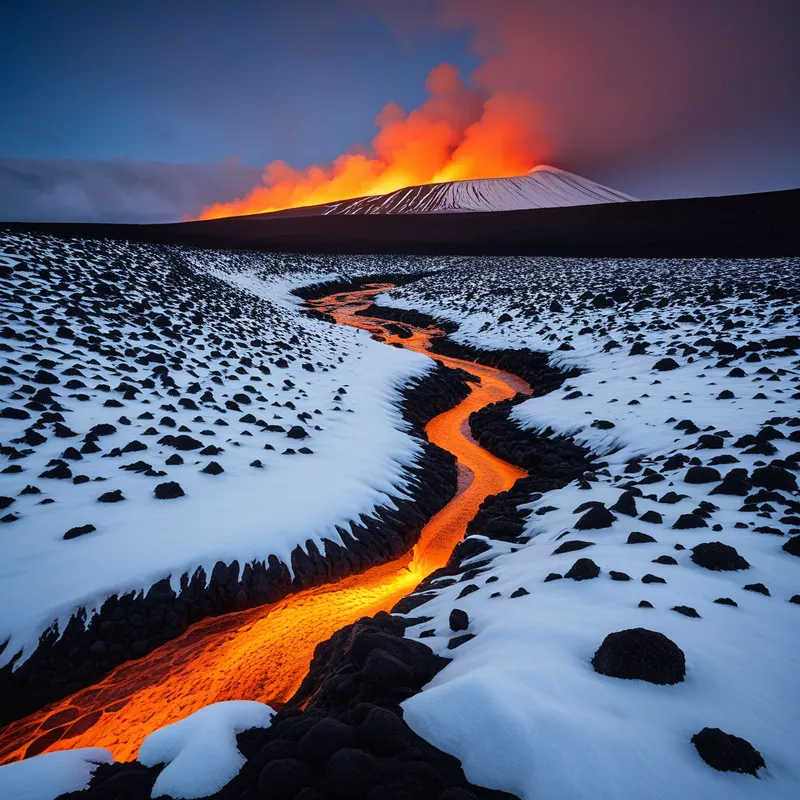
Driven from her own mountain, Poli’ahu fled toward the summit. With each step, her power returned. She called upon her father, Wākea, and her own profound essence. She turned, and from her being flowed not heat, but the true breath of creation’s opposite pole. A blizzard, fierce and purifying, roared down the mountainside. It met the advancing lava not with conflict, but with an embrace of absolute cold. The river of fire slowed, hardened, and was captured—a black, glassy river forever imprisoned in a tomb of ice and snow. Peace was restored. Poli’ahu resumed her mantle, and Pele retreated to her fiery pits, their territories defined in an eternal, respectful truce. The mountain stood complete, a testament to the necessary balance of fire’s passion and snow’s serene sovereignty.
Cultural Origins & Context
This myth originates from the oral traditions of the Kanaka Maoli. It is a moʻolelo deeply tied to the sacred geography of Hawaiʻi Island, specifically the majestic Mauna Kea. The story was not mere entertainment; it was a cosmological map and a social charter. It explained the visible, physical reality of snow-capped peaks in the tropics and the lava flows that harden on its slopes. More importantly, it articulated the Hawaiian understanding of kapu and balance. Each deity, or akua, had their realm and sphere of influence. Poli’ahu’s domain was the summit, a place of connection to the ancestors and the heavens, while Pele’s was the volcanic earth.
The tale was likely told by kāhuna and storytellers, serving to validate the social order, teach about respecting boundaries, and illustrate that true power comes in many forms—not just the explosive, but also the enduring and the calm. It reinforced that the world is a balance of opposing, yet complementary, forces (kuāuna), both of which are necessary for a whole and healthy cosmos.
Symbolic Architecture
At its [heart](/symbols/heart “Symbol: The heart symbolizes love, emotion, and the core of one’s existence, representing deep connections with others and self.”/), the myth of Poli’ahu and Pele is a profound archetypal [drama](/symbols/drama “Symbol: Drama signifies narratives, emotional expression, and the exploration of human experiences.”/) of complementary opposites. Poli’ahu is not merely “ice” to Pele’s “fire”; she represents [consciousness](/symbols/consciousness “Symbol: Consciousness represents the state of awareness and perception, encompassing thoughts, feelings, and experiences.”/), [clarity](/symbols/clarity “Symbol: A state of mental transparency and sharp focus, often representing resolution of confusion or attainment of insight.”/), sovereignty, and the power of containment. Her snow is the [blanket](/symbols/blanket “Symbol: A blanket typically symbolizes protection, comfort, and the desire for warmth and security.”/) that allows the [earth](/symbols/earth “Symbol: The symbol of Earth often represents grounding, stability, and the physical realm, embodying a connection to nature and the innate support it provides.”/) to rest, the [clarity](/symbols/clarity “Symbol: A state of mental transparency and sharp focus, often representing resolution of confusion or attainment of insight.”/) of high-altitude thought, and the [stillness](/symbols/stillness “Symbol: A profound absence of motion or sound, often representing inner peace, creative potential, or existential pause in artistic contexts.”/) that must follow [action](/symbols/action “Symbol: Action in dreams represents the drive for agency, motivation, and the ability to take control of situations in waking life.”/). Pele embodies the unconscious, raw creative force, [passion](/symbols/passion “Symbol: Intense emotional or physical desire, often linked to love, creativity, or purpose. Represents life force and deep engagement.”/), destruction-as-renewal, and untamed instinct.
The summit does not fight the fire; it contains it. Sovereignty is not the absence of passion, but the clarity that surrounds and gives form to it.
Their conflict is the necessary [friction](/symbols/friction “Symbol: Friction represents resistance, conflict, or the necessary tension required for movement and transformation in dreams.”/) that defines their respective natures and territories. Poli’ahu’s retreat is not a defeat, but a strategic withdrawal to her [source](/symbols/source “Symbol: The origin point of something, often representing beginnings, nourishment, or the fundamental cause behind phenomena.”/) of power—her own essence and her [connection](/symbols/connection “Symbol: Connection symbolizes relationships, communication, and bonds among individuals.”/) to the celestial. Her triumphant return with the [blizzard](/symbols/blizzard “Symbol: A blizzard often represents overwhelming struggles and challenges that can paralyze a person’s progress, both physically and emotionally.”/) symbolizes the [moment](/symbols/moment “Symbol: The symbol of a ‘moment’ embodies the significance of transient experiences that encapsulate emotional depth or pivotal transformations in life.”/) when conscious [awareness](/symbols/awareness “Symbol: Conscious perception of self, surroundings, or internal states. Often signifies awakening, insight, or heightened sensitivity.”/), pushed to its limit, calls upon its deepest reserves of [truth](/symbols/truth “Symbol: Truth represents authenticity, honesty, and the quest for knowledge beyond mere appearances.”/) to establish order and [boundary](/symbols/boundary “Symbol: A conceptual or physical limit defining separation, protection, or identity between entities, spaces, or states of being.”/). The resulting [landscape](/symbols/landscape “Symbol: Landscapes in dreams are powerful symbols representing the dreamer’s emotional state, personal journey, and the broader context of life situations.”/)—[lava](/symbols/lava “Symbol: Molten rock from Earth’s interior, symbolizing raw, transformative energy, destructive power, and primal creation emerging from deep unconscious forces.”/) flows frozen in mid-[movement](/symbols/movement “Symbol: Movement symbolizes change, progress, and the dynamics of personal growth, reflecting an individual’s desire or need to transform their circumstances.”/) under snow—is the perfect [symbol](/symbols/symbol “Symbol: A symbol can represent an idea, concept, or belief, serving as a powerful tool for communication and understanding.”/) of integrated psyche: passionate impulses acknowledged, honored, but ultimately cooled and shaped by conscious will into a lasting, beautiful form.
The Dreamer’s Resonance
When this myth stirs in the modern dreamer, it often signals a profound internal conflict between two powerful inner states. Dreaming of a serene, snowy mountain suddenly threatened by lava may point to a feeling of one’s hard-won peace, clarity, or mental stability being invaded by erupting, uncontrollable emotions—rage, passion, or primal fear. The dreamer may be Poli’ahu, fleeing a disruptive force that melts their composure.
Conversely, dreaming of being the lava, flowing toward something pure and cold, might indicate a powerful creative or destructive urge feeling blocked by what is perceived as cold rationality, emotional distance, or rigid structure in one’s life. The somatic experience can be one of overheating, pressure, or, in the moment of the blizzard’s arrival, a sudden, profound cooling and relief. This dream pattern is the psyche’s enactment of the alchemical stage of nigredo—the necessary conflict that precedes integration. The dream asks: Where in your life is fire threatening your ice, or ice stifling your fire? And what is the source of your truest, most sovereign power to find balance?
Alchemical Translation
The myth models the individuation process—the journey toward psychic wholeness—with exquisite precision. Initially, the conscious attitude (Poli’ahu) is innocent, engaged in its own realm, unaware of the depth of the opposing unconscious force (Pele). The eruption of Pele represents the unavoidable eruption of the Shadow or complex that can no longer be ignored. The conscious ego is overwhelmed and displaced.
The critical turn in the myth, and in individuation, is Poli’ahu’s flight to the summit—not away from the mountain, but to its highest, most essential point. Psychologically, this is the ego’s retreat not into denial, but into the core of the Self. It is a gathering of one’s fundamental truth and authority.
Transmutation occurs not when one force destroys the other, but when consciousness, rooted in its own sovereignty, meets the unconscious with a defining breath of its own nature.
The blizzard is the act of conscious discrimination and containment. It is the “cold” truth of one’s boundaries, values, and identity applied to the “hot” chaos of unintegrated impulses. The result is not the annihilation of Pele (the instincts), but her transformation. The lava is cooled into obsidian—a useful, sharp, beautiful stone. In the psyche, the raw emotion or compulsive drive is thereby integrated, given form, and made usable by the conscious personality. The individual becomes like Mauna Kea itself: a being capable of holding both fiery passion and serene stillness, with clear boundaries between them, creating a landscape of immense beauty and enduring strength.
Associated Symbols
Explore related symbols from the CaleaDream lexicon:
- Goddess — Poli’ahu embodies the divine feminine principle in its aspect of serene sovereignty, clarity, and majestic, calm authority over a domain.
- Mountain — Represents the sacred axis mundi, the connection between earth and sky, and the lofty, stable ground of consciousness and spiritual attainment that Poli’ahu rules.
- Snow — The primary symbol of Poli’ahu’s essence: purity, stillness, clarity, restorative rest, and the beautiful, fragile-yet-powerful force of containment.
- Fire — Represents the raw, transformative, and destructive-creative power of Pele, symbolizing unintegrated passion, instinct, and the eruptive unconscious.
- Snow-Capped Peaks — The visual and symbolic result of the myth: the eternal coexistence of opposing forces, with consciousness (snow) resting atop and defining the form of primal energy.
- Journey — The path of conflict, retreat, and return that both goddesses undertake, mirroring the soul’s journey through crisis toward integration and self-definition.
- Order — The ultimate outcome of the myth; the establishment of sacred boundaries and territories, creating a cosmic and psychological balance from chaos.
- Shadow — Pele, in her disguised and eruptive form, represents the repressed, fiery, and potent aspects of the self that must be confronted and integrated.
- Sovereignty — The core lesson of Poli’ahu; true power is the calm, unshakable authority to be oneself and define one’s realm without being consumed by another’s nature.
- Balance — The central theme enacted by the myth; the dynamic, respectful truce between ice and fire that creates a complete and healthy whole, both in nature and the psyche.
- Winter Snowfall — The active, powerful expression of Poli’ahu’s essence; not passive cold, but a deliberate, transformative force that blankets, quiets, and reshapes the landscape.
- Snowmelt — The inevitable, cyclical process hinted at in the truce; representing the thawing of rigid consciousness by integrated warmth, allowing for new growth and the flow of life.