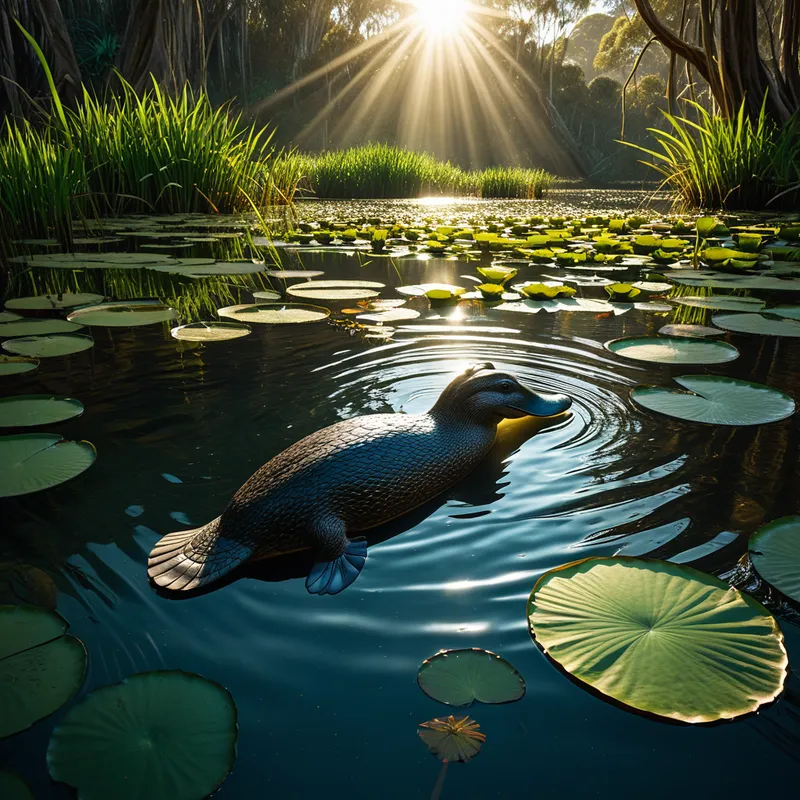
Platypus Spirit Myth Meaning & Symbolism
A creation myth of the platypus, born from conflict and compromise, becoming a sacred guardian of the waterways and a symbol of impossible unity.
The Tale of Platypus Spirit
Listen. In the Dreaming, the world was still being argued into shape. The great rivers were carved by the journeys of the Rainbow Serpent, and the land was painted with the footprints of the first animals. But the waters were a place of dispute.
The land animals, led by the proud Kangaroo and the watchful Echidna, held their councils on the sun-baked earth. The water animals, ruled by the swift Turtle and the clever Eel, governed the cool, deep pools and rushing streams. A line was drawn between them, a law of separation. "You belong to the earth," they declared to each other. "We belong to the water. This is the way."
But the spirit of the land and the spirit of the water yearned for a bridge. A great argument erupted one evening, as the sky bled purple and orange. The land animals accused the water folk of stealing the riverbanks. The water animals accused the land dwellers of muddying their clear depths. The conflict grew until the very air crackled with discord.
From this turmoil, a new life was sparked—not by one ancestor, but by the frustrated, creative clash of them all. A being began to form on the muddy bank where the two worlds met. It was an impossibility. It had the broad, flat tail of a beaver, sleek fur like an otter, and webbed feet for swimming. But from its face protruded the sensitive, leathery bill of a duck. The animals fell silent, staring in confusion and horror.
"What is this?" Kangaroo boomed. "It has fur! It is a land creature!" "No!" Turtle countered, rising from the water. "See its bill and webbed feet! It is clearly of the water!" "It lays eggs like Echidna or myself!" said the Goanna, scandalized. "But it swims better than any of us!" cried the Fish.
The creature, bewildered and alone, was rejected by both camps. It was too much of the other world for each to accept. Cast out, it slipped into the water, where it swam with graceful power, then emerged to dig a burrow in the riverbank. It lived in the in-between, a creature of both realms and neither.
Seeing its peaceful existence and its unique gifts—finding food in the murky depths where others could not, nurturing its young in a secret den—the ancestral spirits intervened. The Rainbow Serpent itself coiled in the deep pool and spoke in a voice like flowing water: "You are not a mistake of the argument. You are its resolution. You are the keeper of the threshold, the proof that the world is not divided, but connected. You are the Platypus, and your home is the meeting place. Your nature is the treaty."
And so, Platypus Spirit became the sacred guardian of the waterways, a living reminder of the creative power that emerges when opposites cease to fight and learn to combine. Its presence was a blessing, a sign of healthy country where the boundaries between worlds were soft and life-giving.

Cultural Origins & Context
This story belongs to the rich tapestry of Aboriginal Dreaming stories, with variations found among language groups whose country includes the eastern freshwater river systems where the platypus lives. It is a Dreaming track narrative, explaining the origin of a specific, remarkable animal and encoding vital ecological and social knowledge.
Traditionally, such stories were (and are) passed down orally through generations by elders, often accompanied by song, dance, and sand or body painting. The telling was not mere entertainment; it was an act of cultural transmission, law, and map-making. The story of Platypus Spirit functioned as a lesson in natural history, explaining the animal's unique biology and behavior. More profoundly, it served as a social allegory about conflict resolution, the value of community roles that transcend simple categories, and the sacredness of thresholds—the riverbanks, the dawn, the spaces between tribes. It taught that what is different is not necessarily wrong, but may be a necessary and sacred creation.
Symbolic Architecture
At its heart, the Platypus Spirit is the archetypal symbol of the coincidentia oppositorum—the coincidence of opposites. It is a walking, swimming paradox, a creature that defies easy categorization by embodying the traits of multiple, seemingly exclusive categories.
The Platypus does not choose between earth and water; it becomes the living bridge where both meet and are reconciled. Its power lies in its refusal to be only one thing.
Psychologically, it represents the emergent Self that arises when we stop forcing internal conflicts into either/or resolutions. The "land animals" and "water animals" within us—our logical mind and our emotions, our masculine and feminine energies, our need for solitude and for community—often wage war, each claiming sole sovereignty. The Platypus Spirit symbolizes the unexpected, third option that is born from the tension itself: a new, more complex identity that integrates the warring parts. Its venomous spur (a detail from biological reality often incorporated into the myths) adds a crucial dimension: this unified being carries a potent defense, a reminder that wholeness is powerful and must be respected, not trivialized.
The Dreamer's Resonance
When the pattern of the Platypus Spirit myth emerges in modern dreams, it often signals a profound process of psychic integration. To dream of a platypus, or of being a creature that belongs nowhere, points to a felt sense of being an outsider within one's own life or psyche. The dreamer may be struggling with a feeling of being "too much" of one thing for one group and "not enough" of it for another—too emotional at work, too analytical at home, too creative in a conventional family.
Somatically, this can feel like a deep tension, a pulling in two directions, often centered in the chest or gut. The dream is not merely highlighting alienation; it is presenting the blueprint for its resolution. The platypus in the dream is not pathetic, but potent, adept in its hybrid environment. The dream invites the dreamer to stop seeking validation from the internalized "councils" that demand purity and to begin exploring the fertile, muddy banks of their own inner contradictions. It is an invitation to build a burrow in the in-between, to claim the unique niche that only their particular combination of traits can inhabit.
Alchemical Translation
The myth of Platypus Spirit is a perfect map of the alchemical process of individuation—the Jungian journey toward psychological wholeness. The initial state is one of separation and conflict (the warring animal councils), representing the fragmented conscious mind clinging to rigid identities.
The conjunctio, or sacred marriage, is not a peaceful union but a fiery argument that gives birth to the filius philosophorum—the philosophical child, which is the nascent Self. The Platypus is this child: the unexpected, miraculous product of allowing opposites to clash creatively rather than suppressing one side.
The alchemical work is not to destroy the elements of duck, beaver, and otter, but to submit them to the transformative fire of conflict until they surrender to a new, cohesive form.
For the modern individual, this translates to the difficult but essential work of holding tension without premature resolution. It means acknowledging the "land" and "water" aspects of one's personality without immediately siding with one. The triumph is not in winning the internal argument, but in enduring it until a new capacity emerges—a "platypus consciousness" that can navigate multiple realms of experience with fluid grace. One becomes the guardian of one's own inner waterways, a living treaty between spirit and matter, instinct and intellect, uniqueness and belonging. The Platypus Spirit, therefore, is not just an animal of the Dreaming culture."), but an enduring emblem of the creative, healing power inherent in our own impossible, beautiful contradictions.
Associated Symbols
Explore related symbols from the CaleaDream lexicon: