Penates Myth Meaning & Symbolism
The story of the Penates, the Roman deities of the storeroom, who embody the sacred heart of the home and the soul's journey to find its true sanctuary.
The Tale of Penates
Listen, and let the smoke of [the hearth](/myths/the-hearth “Myth from Norse culture.”/) carry you back. Before the marble of the forum, before the legions marched, there was [the threshold](/myths/the-threshold “Myth from Folklore culture.”/). There was the door. And within the door, deeper than the atrium where guests were met, beyond the murmur of daily life, lay the true heart of the house: the penus.
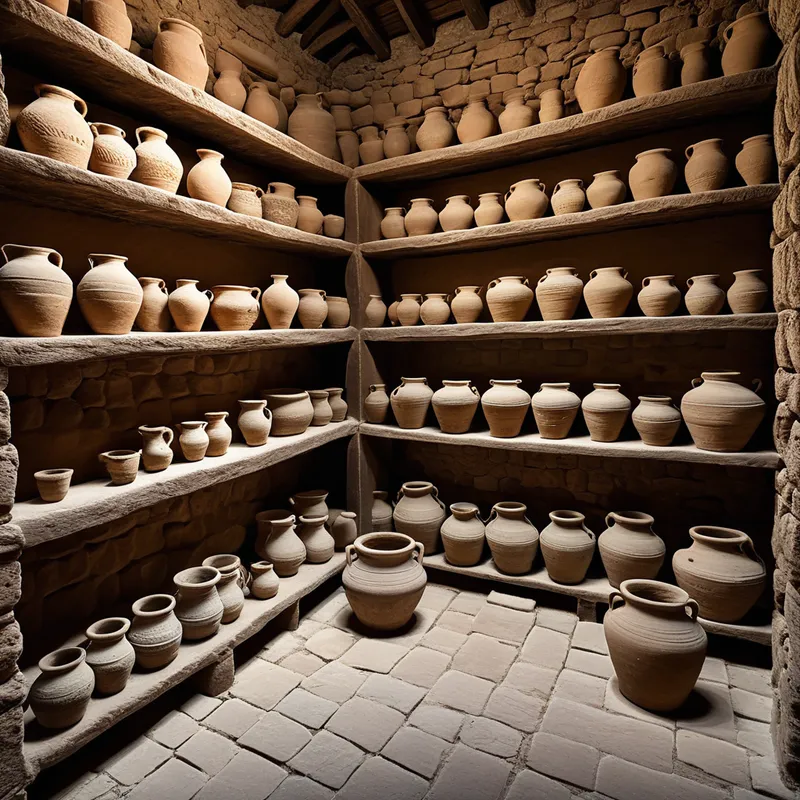
This was no mere cupboard. It was a cavern of potential, a silent womb of the family. Here, in the cool, earthy dark, rested the amphorae of glistening olive oil, the sacks of spelt grain that whispered of future bread, the clay jars preserving wine and dried fruit. It was the fortress against hunger, the archive of survival. And in this deepest, most intimate chamber dwelt the Penates.
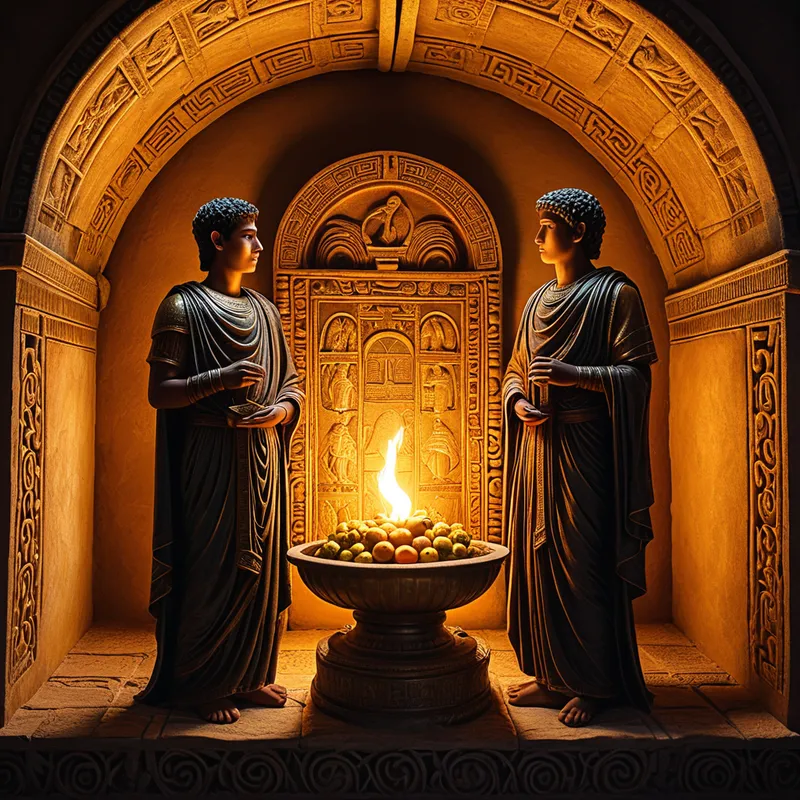
They were not seen, not in [the way](/myths/the-way “Myth from Taoist culture.”/) we see stone or wood. They were felt—a presence as certain as the weight of the grain, as vital as the sheen of the oil. They were the spirit of the store itself. Some said they were two, youthful and benevolent. Others felt them as a gentle multitude. They had no grand temple on the hill, for their temple was this very storeroom. Their altar was the shelf, their offering the first fruits of the harvest, poured as libation or placed with silent gratitude beside the provisions they guarded.
Every dawn, before the sun gilded the public statues, the materfamilias would slip into this sanctum. Her hands, soon to be busy with the loom and the management of the house, first performed this quiet rite. A pinch of salt, a few grains of wheat, a drop of precious oil—these were given not in fear, but in partnership. It was a covenant whispered in the dark: “As you preserve this, our substance, preserve us. As we honor you, let abundance remain.”
And when the family gathered for the main meal, the first morsel from the communal plate was cast into the hearth’s flame for the [Lares](/myths/lares “Myth from Roman culture.”/) and the Penates. The flame consumed it, and the smoke carried the essence upward, a thread connecting the daily bread to the divine guardians of the bread’s very source. The Penates were there in the warmth of the full belly, in the security of a winter larder that was not empty. They were the silent, nurturing pulse within the walls, the gods of the inside, whose primary concern was not the glory of Rome, but the continuity of this hearth, this line, this home.
Cultural Origins & Context
The Penates belong to the oldest stratum of Roman religion, the di indigetes. Their worship was fundamentally domestic, not state-sponsored. They existed before the grand syncretism with Greek mythology gave Jupiter a personality and family dramas. Their origin is telling: they are named for the penus, the storeroom. They are deities of function, of a fundamental human need—preservation and sustenance.
This myth was not passed down in epic poems but in daily ritual, in the unbroken tradition of the family. The father, as paterfamilias, was the chief priest of this domestic cult. The knowledge of how to honor the Penates was taught by mother to daughter, by father to son, not in lectures, but in the doing. Their societal function was anchoring. In a world of political upheaval, military service, and economic uncertainty, the Penates represented an unshakeable core. They symbolized the family’s autonomy and its sacred right to its own continuity and nourishment.
Interestingly, the Penates also had a public dimension. The Roman state claimed to possess its own sacred Penates, rescued from burning Troy by Aeneas and brought to Italy, eventually housed in [the temple](/myths/the-temple “Myth from Jewish culture.”/) of [Vesta](/myths/vesta “Myth from Roman culture.”/). This created a powerful symbolic link: just as the family’s well-being depended on its domestic Penates, the state’s survival depended on its celestial ones. The public cult mirrored the private, grounding the empire’s fate in the same logic of sacred guardianship that governed the humblest household larder.
Symbolic Architecture
Psychologically, the Penates represent the [archetype](/symbols/archetype “Symbol: A universal, primordial pattern or prototype in the collective unconscious that shapes human experience, behavior, and creative expression.”/) of the inner sanctum—the protected, nourishing core of the [psyche](/myths/psyche “Myth from Greek culture.”/). They are not the gods of aspiration (Jupiter) or love ([Venus](/myths/venus “Myth from Alchemical culture.”/)), but the gods of [foundation](/symbols/foundation “Symbol: A foundation symbolizes the underlying support systems, values, and beliefs that shape one’s life, serving as the bedrock for growth and development.”/). They symbolize all that we store away to ensure our survival and continuity: not just physical [food](/symbols/food “Symbol: Food in dreams often symbolizes nourishment, both physical and emotional, representing the fulfillment of basic needs as well as deeper desires for connection or growth.”/), but emotional reserves, ancestral wisdom, core values, and psychic [energy](/symbols/energy “Symbol: Energy symbolizes vitality, motivation, and the drive that fuels actions and ambitions.”/).
The true sanctuary is not a place one visits, but a depth one inhabits. The Penates guard the larder of the soul, where the grain of experience is stored to become the bread of meaning.
The penus is the unconscious, not as a dark [cellar](/symbols/cellar “Symbol: A cellar represents the subconscious mind, hidden emotions, and unacknowledged aspects of the self; it is a place of storage, preservation, and sometimes decay.”/) of repressed [trauma](/symbols/trauma “Symbol: A deeply distressing or disturbing experience that overwhelms the psyche, often manifesting in dreams as unresolved emotional wounds or psychological injury.”/), but as a vital storehouse of resources. The [grain](/symbols/grain “Symbol: Represents sustenance, growth cycles, and the foundation of civilization. Symbolizes life’s harvest, patience, and transformation from seed to nourishment.”/) and oil are primal symbols of potential [life](/symbols/life “Symbol: The symbol of ‘Life’ represents a journey of growth, interconnectedness, and existential meaning, encompassing both the joys and challenges that define human experience.”/) and sustaining richness. To honor the Penates is to practice conscious [relationship](/symbols/relationship “Symbol: A representation of connections we have with others in our lives, often reflecting our emotional state.”/) with one’s inner resources. It is the act of “making offerings”—of paying [attention](/symbols/attention “Symbol: Attention in dreams signifies focus, awareness, and the priorities in one’s life, often indicating where the dreamer’s energy is invested.”/), of expressing gratitude for one’s foundational strengths, of tending to one’s psychic and physical well-being before expending energy in the outer world.
The Penates’ [location](/symbols/location “Symbol: The symbol of ‘Location’ signifies a sense of place, context, and the environment in which experiences unfold.”/)—deep within the house—is crucial. They represent what is most intimate, most private, and most essential. A person who is “at home” with themselves has a well-tended inner penus. Their Penates are honored, meaning their core needs are recognized and their inner reserves are replenished. [Anxiety](/symbols/anxiety “Symbol: Anxiety in dreams reflects internal conflicts, fears of the unknown, or stress from waking life, often demonstrating the subconscious mind’s struggle for peace.”/) and a sense of existential [hunger](/symbols/hunger “Symbol: A primal bodily sensation symbolizing unmet needs, desires, or emotional voids. It represents craving for fulfillment beyond physical nourishment.”/) often stem from a neglected inner sanctum, where the psychic Penates are forgotten.

The Dreamer’s Resonance
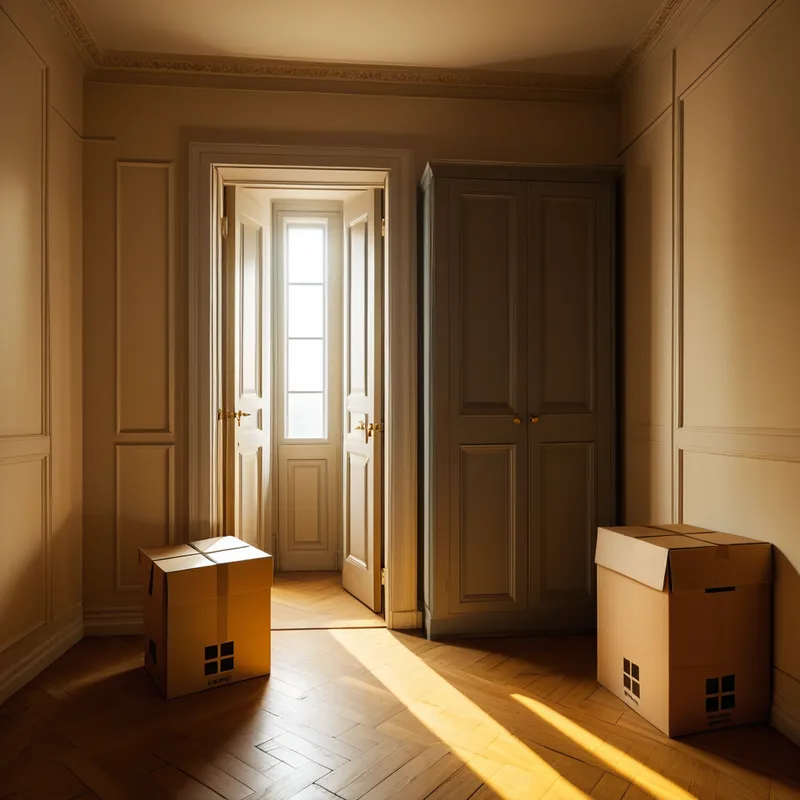
When this myth stirs in the modern unconscious, it rarely appears as ancient Roman figurines. Instead, it manifests as dreams of forgotten rooms, discovered cellars, or hidden closets in one’s own home. The dreamer might find a door they never noticed, leading to a space filled with wholesome, nourishing objects—canned goods, blankets, heirlooms—all radiating a profound sense of safety and sufficiency.
These dreams often surface during times of transition, loss, or external stress. The psyche is pointing to its own storehouse. The somatic feeling is one of deep relief, warmth, and grounding. It is the body remembering it has reserves. Conversely, dreams of a barren, empty, or locked storeroom signal a depletion of these inner resources. The dreamer may be running on empty, having forgotten to “honor the Penates”—to tend to their foundational needs for rest, nutrition, emotional security, and connection to personal history.
The process is one of remembering. It is the psyche’s attempt to re-orient the conscious ego away from the exhausting demands of the [persona](/myths/persona “Myth from Greek culture.”/) (the public face) and back toward the nourishing depths of the soul’s own hearth. The dream is an invitation to go inward, to take inventory, and to gratefully receive the sustenance that has been quietly held in reserve.
Alchemical Translation
The alchemical process mirrored in the myth of the Penates is coagulatio—the making solid, the grounding of spirit into matter, and the creation of a stable, nourishing base. In the journey of individuation, we must move from the massa confusa of unexamined life to a structured, habitable inner dwelling.
The first step is Locating the Inner Penus. This is the psychological work of identifying what truly sustains us—not just physically, but emotionally and spiritually. What are our non-negotiable needs? What values form our bedrock? What memories and traditions feed us? This is an excavation of the personal and ancestral unconscious to find the nourishing grain, not the chaff.
The second is The Daily Rite of Attention. Alchemy is not a one-time event but a sustained practice. Honoring the Penates translates to the modern discipline of self-care, gratitude journaling, mindful eating, and the conscious preservation of family rituals or personal traditions. It is the small, daily offering that maintains the covenant between the conscious ego and the sustaining unconscious.
Individuation is not only about becoming who you are, but about building a home for who you are. The Penates are the divine custodians of that construction site, ensuring the foundation is sound and the larder is full for the long journey ahead.
Finally, the process culminates in Becoming the Sanctuary. When the inner Penates are consistently honored, the individual no longer seeks security and nourishment primarily from the external world. They carry their penus within. They become their own source of stability and sustenance. This is the alchemical gold: a psyche that is a self-renewing sanctuary, capable of weathering outer famine because its inner storehouse, guarded by its own attentive spirit, is eternally rich. The myth teaches that the ultimate journey is not outward to conquer, but inward to cultivate, preserve, and finally, to dwell in peace within one’s own sacred, provisioned depth.
Associated Symbols
Explore related symbols from the CaleaDream lexicon: