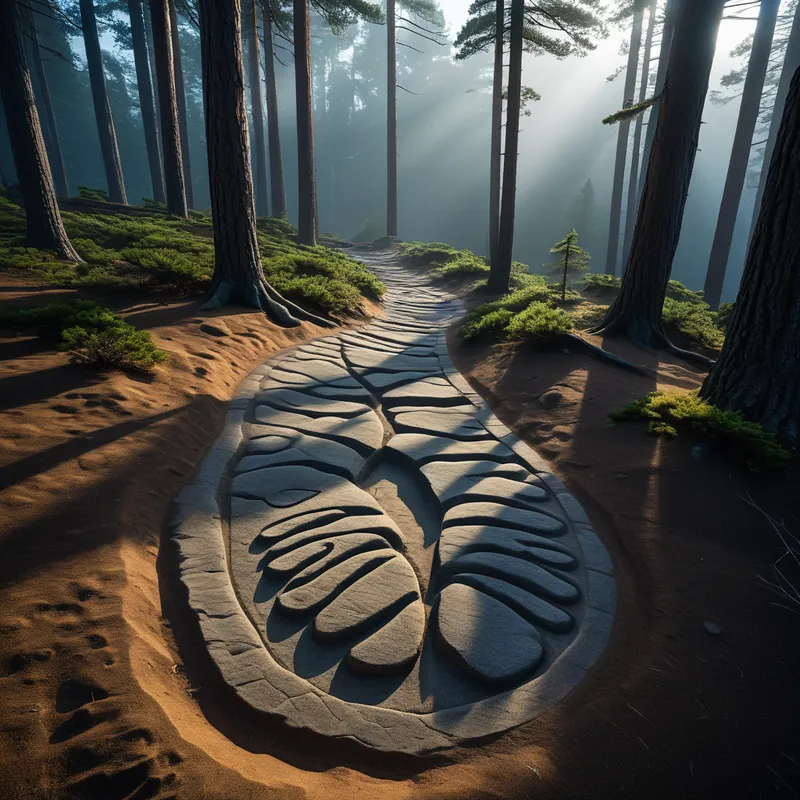
Pangu's Footprint Myth Meaning & Symbolism
The myth of the cosmic giant Pangu, whose final act of sacrifice left a sacred footprint, imprinting the principle of order onto the newborn world.
The Tale of Pangu's Footprint
In the time before time, there was only a formless, swirling chaos, a great cosmic egg. Within it slept a being of unimaginable potential, the giant Pangu. For eighteen thousand years he grew, nurtured by the essence of Yin and Yang themselves. Then, with a roar that was the first sound, he awoke.
He stretched his colossal limbs, and with a mighty axe—some say born from his own will—he struck the shell of the egg. It shattered. All that was light and pure, the yang qi, rose shimmering to become the vault of Heaven. All that was heavy and dark, the yin qi, sank, groaning, to form the broad body of Earth. But Heaven and Earth, newborn and trembling, yearned to collapse back into each other, to return to the comforting void of the undifferentiated egg.
So Pangu placed himself between them. He planted his feet upon the yielding Earth and pushed his hands and head against the descending sky. Each day, Heaven rose ten feet higher, and Earth grew ten feet thicker, and Pangu grew ten feet taller to keep them apart. For another eighteen thousand years he held his vigil, his body the pillar of all creation. The wind howled around him. Stars were born in the sweat of his brow. Rivers began to trace the lines of his straining muscles.
Finally, the work was complete. Heaven was firmly aloft, vast and distant. Earth was solid and vast beneath. Knowing his task was done, the great giant Pangu let out a final, weary sigh. His body began to dissolve, returning to the world he had midwifed. His breath became the wind and clouds. His voice became the rolling thunder. His left eye became the radiant sun; his right eye, the gentle moon. His blood poured out to form the great rivers and seas. His flesh became the fertile soil, his bones the mountains and precious stones, his hair the forests and grasses.
But as his spirit departed, in his last conscious act, Pangu took one final, firm step upon the Earth he had birthed. It was not a step of travel, but of sealing. A step of blessing. His foot pressed down into the soft, new crust of the world, and there it remained—not as decaying flesh, but as a perfect, indestructible impression in stone. A single, sacred footprint. It was his final gift: not just a world, but a mark upon it. A signature. A promise of order, a testament that from the sacrifice of the One, the Many could find their footing and begin.

Cultural Origins & Context
The myth of Pangu is a foundational narrative in Chinese cosmology, though its literary recording is relatively late compared to other classical myths. It first appears in texts from the Three Kingdoms period onward, most notably in the Sanwu Liji (Records of the Three Sovereign Divinities and the Five Gods). Scholars suggest it may synthesize earlier, fragmented creation stories and possibly incorporate influences from other cultural traditions along the Silk Road.
It functioned as an etiological myth, explaining the origin of the world's physical features—mountains, rivers, weather—through the anthropomorphic transformation of a cosmic body. More importantly, it provided a metaphysical framework. The story was not merely told by bards for entertainment; it was a philosophical anchor. It illustrated the principle of transformation (hua) and the sacred interdependence of all things, all stemming from a single, sacrificial act. The footprint, as a specific motif, connects this cosmic myth to local earth and ancestor veneration practices. It grounds the infinite in a specific, tangible place—a mountain pass, a riverbank—making the act of creation immanent and accessible. It tells people that the world is not an accident, but a deliberate, embodied act, and that they walk upon a body that is sacred.
Symbolic Architecture
The footprint is the central, condensed symbol of the entire myth. It is the interface between the infinite act of creation and the finite, perceivable world.
The footprint is the cosmos in miniature: the map of a sacrifice that became the territory of existence.
Pangu himself symbolizes the primordial Self, the undifferentiated psyche containing all potential. The chaotic egg is the unconscious prima materia. His awakening is the first spark of consciousness, and his separation of Heaven and Earth represents the fundamental psychic act of making distinctions—light from dark, spirit from matter, conscious from unconscious. His enduring labor is the sustained effort required to maintain a coherent psyche, to prevent a collapse back into chaos or psychosis.
His dissolution is not a death, but a participation mystique—a pouring of the Self into the fabric of the world, meaning that the world we perceive is, psychologically, an extension of our own being. The footprint, then, is the archetypal imprint. It is the first pattern, the first law, the first "way" (Dao) pressed into the formless clay of possibility. It signifies that true creation always leaves a mark of the creator's essence, a foundational template from which all subsequent growth and order must reference.
The Dreamer's Resonance
When the image of a giant's footprint, or a single, overwhelming human impression, appears in a modern dream, it rarely speaks of literal mythology. It speaks of foundation. The dreamer is likely at a pivotal point where a long period of inner labor—holding something apart, sustaining a difficult tension—is concluding.
Somatically, one might feel a profound sense of grounding or, conversely, of being dwarfed and insignificant. Psychologically, this dream marks the end of a heroic, perhaps lonely, act of conscious differentiation and the beginning of a new phase: integration. The giant (the dreamer's own vast potential or effort) has finished its work and is now dissolving, its energy returning to nourish the dreamer's inner world. The footprint is the evidence that this labor was real. It is the dream-ego confronting the undeniable, permanent mark of its own transformative struggle. It asks: "What foundational principle have you, through great sacrifice, now stamped upon the landscape of your soul? What chaos have you finally ordered?"
Alchemical Translation
The myth of Pangu's Footprint is a perfect allegory for the Jungian process of individuation—the journey toward psychological wholeness.
The initial chaos is the unexamined life, the merged and conflicted state of the unconscious. The ego's awakening (Pangu's awakening) is the first, often violent, rupture into self-awareness. The long labor of holding heaven and earth apart is the enduring, exhausting work of building and maintaining a conscious personality structure, differentiating thought from feeling, spirit from instinct, holding the tension of opposites without collapsing into one-sidedness.
The climax of the work is not in the holding, but in the sacred surrender—the willing dissolution of the heroic ego into the greater Self.
Pangu's dissolution is the alchemical solutio—the stage where the hardened, separated elements are dissolved back into a unified solution, but now at a higher level of complexity. The ego that fought so hard to build a world must learn to die to its separateness, to see that its substance is the world itself. Its insights become the winds of inspiration; its old pains become the fertile soil for new growth; its vision becomes the guiding lights of sun and moon.
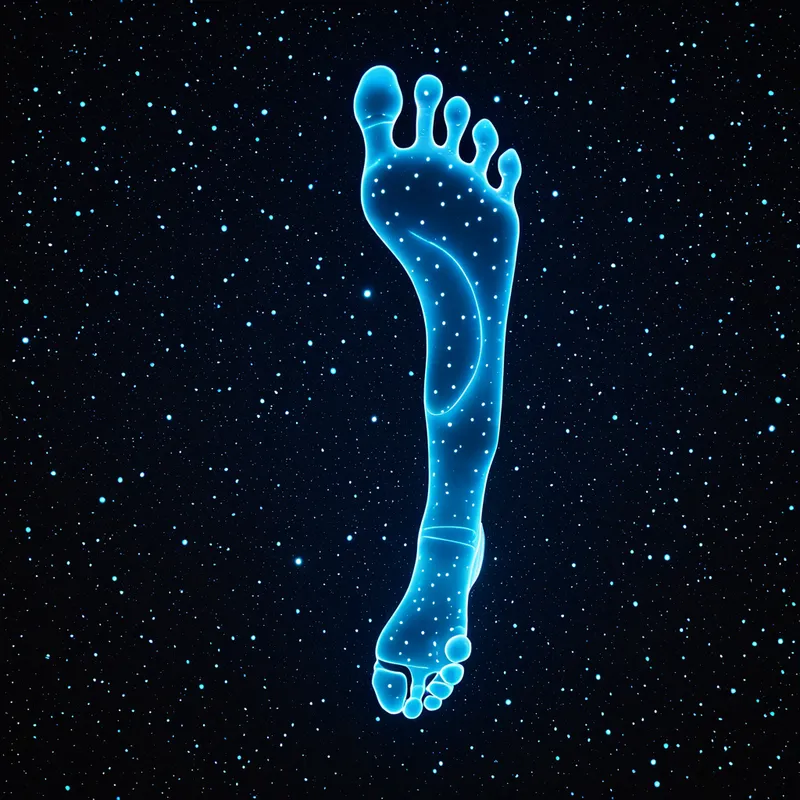
And the footprint? It is the lapis philosophorum, the philosopher's stone. It is the enduring, incorruptible symbol of the process itself, left behind as a guide. For the modern individual, this "footprint" is the core, non-negotiable value, the inner law, or the artistic style that emerges authentically from a life of struggle and integration. It is the unique mark you leave on the world, not through force of will alone, but through the ultimate act of creative self-sacrifice, where you become what you were meant to be by giving yourself back to the life you are shaping. You do not own the footprint; you are the footprint, and the world rises from it.
Associated Symbols
Explore related symbols from the CaleaDream lexicon: