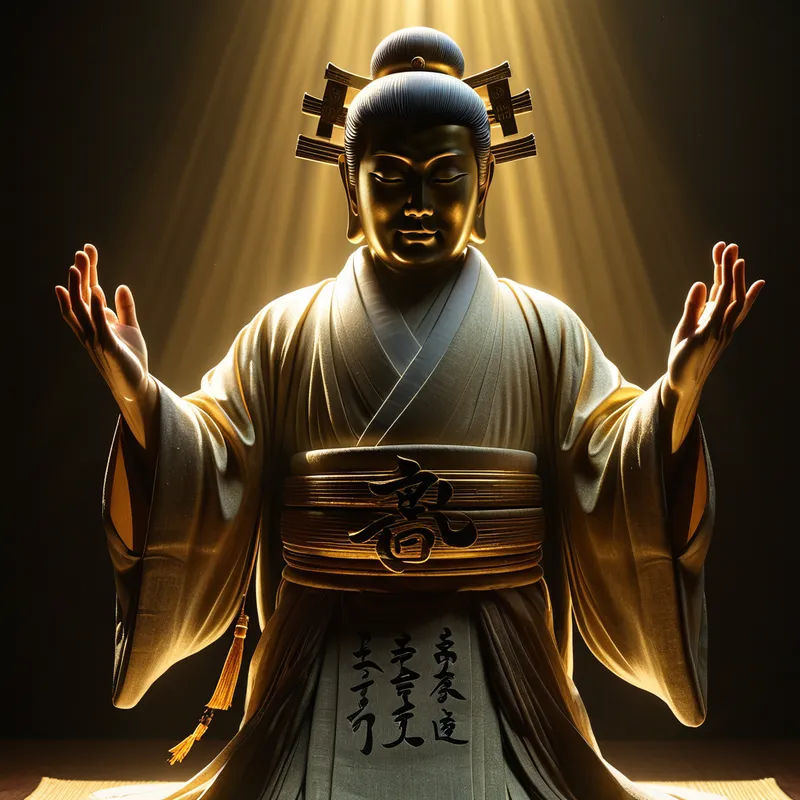
Omamori Myth Meaning & Symbolism
A sacred pact between the human and divine, Omamori are talismans of concentrated intention, weaving protection, fortune, and the soul's connection to the unseen.
The Tale of Omamori
Listen, and let the silence of the ancient cedar grove settle upon you. The air is thick with the scent of moss and old prayers. Here, at the threshold of the jinja, the world is thin. The rustle of leaves is the whisper of the kami, and the cool stone of the torii is a doorpost between realms.
In the beginning, there was only the great, humming web of life—the mountains, the rivers, the wind in the bamboo. The kami flowed through all things, vast and formless as the sky. Humans lived in awe and terror of this boundless power. A storm could shatter a village; a benevolent spirit could bless a harvest. But how does one speak to the wind? How does one ask a blessing of the mountain?
The people brought offerings of rice and salt, they chanted and bowed, but their hearts remained anxious, their pleas felt like leaves scattered on a rushing river. They yearned for a token, a tangible thread to tether the divine benevolence to their fragile, mortal lives. They cried out not in words, but in the silent language of need: for safety on a journey, for health for a child, for courage in a dark wood.
And the kami heard. Not as a voice, but as a resonance—a softening in the fabric of the world. A great, compassionate spirit, perhaps Amaterasu-Ōmikami herself in her aspect as protector, or a local ujigami who loved its people, turned its attention. It saw the beautiful, desperate fragility of human hope.
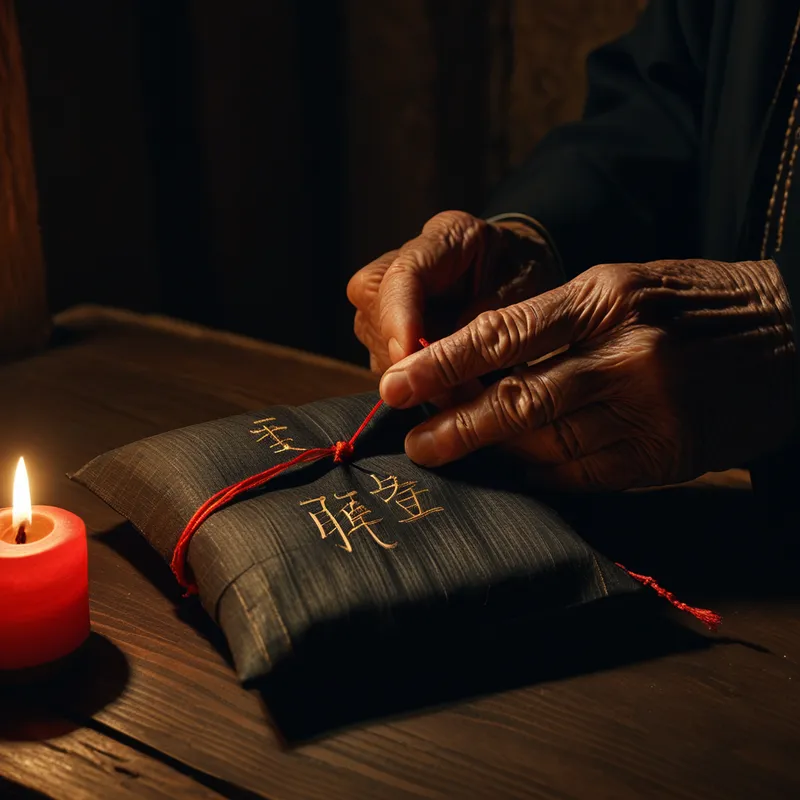
The answer did not come as a thunderclap, but as an inspiration in the heart of a wise kannushi. In a dream, he saw a simple square of cloth, pure and unadorned. He saw a sliver of sacred wood, inscribed with the true name of the kami and the secret of the petition. He saw the cloth folded, the wood placed within, and the pouch sealed with a complex knot—a labyrinth that would hold the blessing and keep misfortune out. The final act was the breath of the priest, his own focused spirit and prayer, breathed into the pouch to awaken the slumbering power within.
When he awoke, he performed the ritual. And as he placed the first small pouch into the trembling hands of a mother, something shifted. The mother’s fear did not vanish, but it found a home. It was met. The pouch was cool and slight in her palm, yet it carried the weight of a promise. It was a compact—a silent pact between her faith and the kami’s grace. The Omamori was born: not a magic charm, but a vessel. A concentrated point where the infinite care of the unseen world could be carried, quite literally, in the palm of a human hand.
Cultural Origins & Context
The mythic origin of the Omamori is not a single story etched in one ancient text, but a living narrative woven into the very fabric of Japanese spiritual practice, primarily Shinto and Buddhism. Its roots are in the animistic heart of Shinto, where every force of nature and human endeavor contains a kami. The practice evolved from earlier forms of talismans, like ema (votive tablets) and ofuda (paper charms).
The “story” is transmitted not by bards, but by ritual. It is told each time a priest at a shrine like the grand Ise Jingū or a local neighborhood sanctuary conducts the harae purification, inscribes the nōkyō, and seals it within the brocade. The societal function is profound: it democratizes access to the sacred. One does not need to be a scholar or a monk; for a small offering, one can carry a personalized fragment of divine protection. It bridges the communal ritual of the shrine with the intimate, individual journey of daily life, formalizing a personal relationship with the protective forces of the universe.
Symbolic Architecture
At its core, the Omamori is a masterpiece of symbolic containment. The cloth pouch represents the human vessel—the body, the life, the conscious self—which is beautiful but permeable. The hidden nōkyō inside is the divine word, the latent spiritual power, the unconscious archetype of protection and order. The intricate knot is the boundary of the self, the ego that both contains our essence and, if tied wrongly, can constrict it.
The Omamori is a paradox: it makes the intangible tangible by agreeing to keep it hidden. Its power lies in its secrecy, in the faith that something of immense value exists unseen within a humble exterior.
Psychologically, the Omamori represents the transitional object par excellence. It is not the kami itself, but a symbol that holds the relationship to the kami—and, by extension, to the internalized archetype of the Caregiver or Protector. It externalizes an inner need for security, allowing the individual to project their anxiety onto the object, thereby managing it. The act of carrying it is a somatic ritual, a physical anchor for a psychological state. The prohibition against opening it is critical: it honors the mystery of the unconscious. To open it is to demand the numinous become literal, to dissect the symbol and kill its transformative power, leaving only empty signifiers—the “broken words” of the myth.

The Dreamer’s Resonance
When the motif of the Omamori arises in modern dreams, it seldom appears as a literal charm from a shrine. Instead, it manifests as the experience it represents. One might dream of finding a small, locked box with immense personal significance, of discovering a secret, protective compartment within one’s own home (the psyche), or of being given a simple, weightless object that nonetheless makes the dreamer feel profoundly safe.
Such dreams often surface during periods of transition, vulnerability, or anxiety—a new job, a health scare, a journey into the unknown. The psyche is instinctively reaching for a container, a temenos or sacred space, to hold the fragile new growth of the self or to shield a wounded part. The somatic sensation accompanying these dreams is often one of relief, a literal easing in the chest, as if an internal knot has been loosened. The dream Omamori symbolizes the dreamer’s own nascent ability to self-soothe, to call upon inner resources of resilience and protection that feel, in the waking world, out of reach. It marks the moment the psyche begins to weave its own spiritual pouch, placing within it the inscribed core of self-worth or courage it has received, often from an internalized “wise other” or the Self.

Alchemical Translation
The journey of the Omamori is a precise map for the alchemical process of psychic integration, or individuation. The initial state is one of dissolution: the individual feels exposed, beset by the chaotic “storms” of life, their pleas to the universe (or their own deeper self) feeling unheard. The call is the recognition of need—the first, crucial step.
The conjunction occurs in the ritual act—both the mythic one and our modern equivalent. This is the conscious decision to create a container. In therapy, this might be the therapeutic frame itself. In personal work, it might be a journal, a meditation practice, or a committed ritual of self-care. This container (the pouch) holds the nōkyō—the insight, the healing word, the hard-won truth discovered in the depths. One must inscribe it clearly (understand it), and then one must seal it away.
The final, alchemical step is not in possessing the truth, but in carrying it faithfully without needing to constantly examine it. The sealed Omamori represents the internalized change that has become part of the fabric of the personality, no longer an object of analysis but a source of grounded being.
This is the coagulation: the integration. We do not solve anxiety by obsessively analyzing it; we transmute it by creating a sacred pact with our own protective Self. We place the insight into the container of a new habit or belief, we “tie it shut” with commitment, and we carry it forward. The power is not in the constant reassurance of looking inside, but in the faith that it is there. To open it prematurely is to regress, to doubt the alchemical transformation. The true Omamori, when its work is done, is returned to the source—ritually burned at the shrine. So too, in individuation, the once-crucial coping mechanism or conscious symbol may dissolve as the protection it offered becomes an innate, lived quality of the soul. We no longer need the charm because we have, at last, become the sanctuary.
Associated Symbols
Explore related symbols from the CaleaDream lexicon: