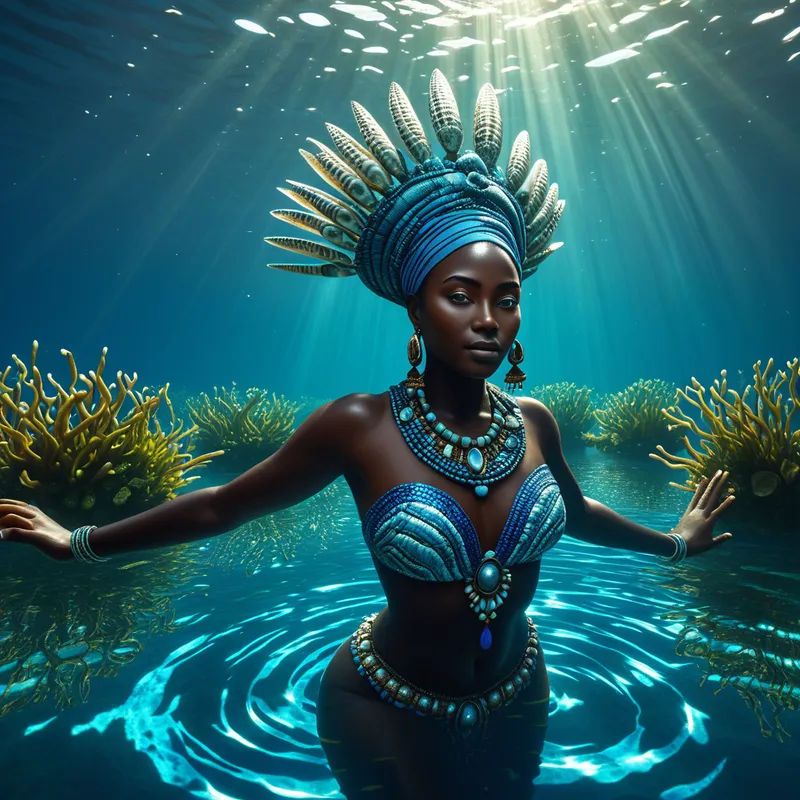
Olosa Goddess of Lagoons Myth Meaning & Symbolism
A Yoruba myth of Olosa, goddess of lagoons, whose deep waters hold both life-giving abundance and terrifying, transformative power.
The Tale of Olosa Goddess of Lagoons
Listen, and let the salt-air of the coast fill your lungs. Let the sound of lapping, brackish water be the drum to this tale. In the beginning, where the great river Oya meets the embrace of the endless ocean, there is a place of neither. A place of in-between. Here, the waters are neither fresh nor salt, but a mingling of both—a vast, shimmering lagoon. And this lagoon was not empty. It was the body of Olosa.
She was not born but became, coalescing from the mist that rose at dawn and the sighs of the earth. Olosa was the lagoon: its calm, glassy surface that mirrored the sky, and its dark, unknowable depths where catfish stirred the mud. She was abundance, her waters teeming with shrimp and crab, her shores rich with mangroves where birds nested. The people who lived by her banks knew her as mother and provider. They cast their nets and she filled them. They offered songs of praise, and she answered with calm waters.
But a lagoon is a threshold, a holder of contradictions. One season, the rains did not come from the sky, but the great ocean grew restless. A tempestuous energy, a husband’s quarrel from the deep sea, pressed against Olosa’s domain. The balance of her brackish peace was shattered. The ocean’s salt invaded; the freshwater retreated. The fish grew sick and fled. The mangroves began to wither.
The people, in their fear and hunger, forgot their songs. They took more than they offered, dredging her muddy bed in desperation, violating her stillness. And Olosa, whose nature was the tension of two waters held in harmony, felt that tension snap.
Her serenity curdled into a silent, cold wrath. It did not begin with a storm, but with a stillness more terrifying than any wave. The lagoon’s surface became like polished obsidian, refusing to reflect even the moon. Then, from the profound depths, a groaning arose—the sound of earth shifting underwater. The waters themselves began to churn from below, boiling up without wind, pulling the desperate canoes into sudden, swirling vortices. Her bounty turned to poison; her nurturing depths became a hungry, swallowing maw. She did not rage like the ocean; she consumed in perfect, terrible silence, reclaiming the life she had given.
It was not a warrior or a king who faced her, but an old fisherwoman named Iya Awo. Iya Awo, whose bones knew the rhythm of the tides, who had sung to Olosa since she was a child. While others fled, she walked to the very edge of the vengeful water. She carried no weapon, only a calabash. Into it, she placed the most precious things: white kaolin clay from the riverbank, a handful of the ripest berries from the forest, and seven perfect cowrie shells—the currency of the spirit world.
She did not shout. She sang. A song not of praise for bounty, but of understanding for pain. A song that acknowledged the violation, the taking, the broken balance. She sang of the lagoon’s loneliness, caught between river and sea, forever a bridge that is also a boundary. As she sang, she let the water, now dark and menacing, lap at her feet. She poured the contents of the calabash into the lagoon, an offering not to placate, but to remember the original pact: reciprocity.
The churning slowed. The obsidian surface softened. From the center of the lagoon, a gentle, warm current emerged, carrying the scent of fertile mud and blooming water lilies. Olosa’s face did not appear in the water, but her presence shifted. The silent consumption receded, replaced by the familiar, brackish sigh. The fish returned, cautiously. The balance—precarious, dynamic, and alive—was restored. Not because a goddess was appeased, but because the connection, the relationship, was remembered. The lagoon was once again a mother, but now all knew she was also a potent, untamable force of the in-between.

Cultural Origins & Context
This myth originates from the Yoruba people, one of Africa’s most influential and philosophically rich cultures. Olosa is specifically venerated among the Egbado and other lagoon-dwelling communities. Her story is not a singular, canonical text but a living narrative passed down through oral tradition—by griots, elders, and ritual specialists during festivals, initiations, and communal gatherings.
Its societal function was multifaceted. Practically, it encoded vital ecological knowledge, teaching respect for the fragile lagoon ecosystem and sustainable fishing practices. Spiritually, it explained the capricious nature of coastal life, where abundance and disaster could arise from the same source. Olosa, often considered a wife or companion to the mighty sea god [Olokun](/myths/olokun “Myth from Yoruba culture.”/), represents a more accessible, yet still formidable, aspect of aquatic divinity. She governed the immediate, life-sustaining waters, making her a central figure in daily ritual and community identity. Her myth reinforced a core Yoruba cosmological principle: <abbr title=“A Yoruba concept meaning “coolness,” representing calmness, composure, life, health, and beneficent power”>Itutu (coolness/balance) must be maintained through right action and reciprocity with all forces, seen and unseen.
Symbolic Architecture
Olosa is the archetypal embodiment of the <abbr title=“A Latin term meaning “threshold,” a space of transition and ambiguity”>liminal. The [lagoon](/symbols/lagoon “Symbol: A lagoon often represents tranquility, a sanctuary, or deep introspection, inviting a sense of calm amidst chaos.”/) itself is the perfect [symbol](/symbols/symbol “Symbol: A symbol can represent an idea, concept, or belief, serving as a powerful tool for communication and understanding.”/): neither [river](/symbols/river “Symbol: A river often symbolizes the flow of emotions, the passage of time, and life’s journey, reflecting transitions and movement in one’s life.”/) nor [ocean](/symbols/ocean “Symbol: The ocean symbolizes the vastness of the unconscious mind, representing deeper emotions, intuition, and the mysteries of life.”/), neither fully fresh nor [salt](/symbols/salt “Symbol: Salt represents purification, preservation, and the essence of life. It is often tied to the balance of emotions and spiritual cleansing.”/), a place of mingling, transition, and profound [fertility](/symbols/fertility “Symbol: Symbolizes creation, growth, and abundance, often representing new beginnings, potential, and life force.”/) that exists at a [boundary](/symbols/boundary “Symbol: A conceptual or physical limit defining separation, protection, or identity between entities, spaces, or states of being.”/).
The greatest creative power often resides not in the pure source, but in the dynamic, muddy mingling of opposites.
Psychologically, Olosa represents the creative, nourishing, but potentially overwhelming [depths](/symbols/depths “Symbol: Represents the subconscious, hidden emotions, or foundational aspects of the self, often linked to primal fears or profound truths.”/) of the unconscious—specifically the feminine principle that gives [life](/symbols/life “Symbol: The symbol of ‘Life’ represents a journey of growth, interconnectedness, and existential meaning, encompassing both the joys and challenges that define human experience.”/) but can also reclaim it if disrespected. Her [wrath](/symbols/wrath “Symbol: Intense, often destructive anger representing repressed emotions, moral outrage, or survival instincts.”/) is not evil; it is the natural consequence of exploitation, of taking without giving, of violating a sacred balance. The myth warns against viewing the nourishing [mother](/symbols/mother “Symbol: The symbol of ‘Mother’ represents nurturing, protection, and the foundational aspect of one’s emotional being, often associated with comfort and unconditional love.”/) (the environment, the unconscious, the [body](/symbols/body “Symbol: The body in dreams often symbolizes the dreamer’s self-identity, personal health, and the relationship they have with their physical existence.”/)) as an endless resource to be mined. She has a threshold of tolerance, and beyond it lies not malice, but a terrifying, rebalancing withdrawal.
The [hero](/symbols/hero “Symbol: A hero embodies strength, courage, and the ability to overcome significant challenges.”/), Iya Awo, embodies the [Senex](/symbols/senex “Symbol: The wise old man archetype representing spiritual authority, ancestral wisdom, and the integration of life experience into transcendent knowledge.”/) [aspect](/symbols/aspect “Symbol: A distinct feature, quality, or perspective of something, often representing a partial view of a larger whole.”/) of wisdom. Her [solution](/symbols/solution “Symbol: A solution symbolizes resolution, clarity, and the overcoming of obstacles, often representing a sense of accomplishment.”/) is not conquest but ritualized acknowledgment. She offers symbols of purity ([clay](/symbols/clay “Symbol: Clay symbolizes malleability, creativity, and the potential for transformation, representing the foundational aspect of life and the ability to shape one’s destiny.”/)), [sweetness](/symbols/sweetness “Symbol: Represents pleasure, reward, and positive experiences, often linked to emotional satisfaction and life’s enjoyable moments.”/) (berries), and sacred exchange (cowries). She does not fight the [water](/symbols/water “Symbol: Water symbolizes the subconscious mind, emotions, and the flow of life, representing both cleansing and creation.”/); she lets it touch her, demonstrating [vulnerability](/symbols/vulnerability “Symbol: A state of emotional or physical exposure, often involving risk of harm, that reveals authentic self beneath protective layers.”/) and respect. Her act symbolizes the ego’s necessary surrender to and renegotiation with the deeper, autonomous powers of the psyche.

The Dreamer’s Resonance
When this myth pattern stirs in the modern dreamer, it often manifests as dreams of ambiguous, brackish, or stagnant waters. Dreaming of a once-familiar pond or lake that has become dark, eerily still, or conversely, unnaturally turbulent, points to a relationship with the inner Olosa—the deep, feminine, creative source—that is out of balance.
Somatically, this may correlate with feelings of creative blockage, emotional stagnation, or a sense that one’s inner resources have been depleted or poisoned. The dream may feature being drawn into or swallowed by such waters, indicating a fear of being overwhelmed by unconscious material—perhaps grief, repressed anger, or a neglected intuitive faculty. Alternatively, finding precious objects or unexpected life in such waters signals the beginning of a healing dialogue. The dream is the psyche’s lagoon, showing the current state of the pact between conscious life and unconscious depth.

Alchemical Translation
The individuation process modeled here is the transmutation of exploitation into relationship. The modern individual often approaches their own creativity, intuition, or inner life as a resource to extract: produce content, generate ideas, fuel productivity. This is the “fishing without singing” that leads to the lagoon’s silent wrath—burnout, depression, a sense of inner barrenness.
The alchemical work is Iya Awo’s ritual. First, one must approach the edge of the turmoil (confront the symptom, the block, the depression) without fleeing. Second, one must offer a “calabash” of acknowledgment: honest self-reflection (the white clay), genuine appreciation for what has been given (the sweet berries), and a commitment to sacred inner exchange (the cowrie shells). This is the practice of active imagination, journaling, or therapy—not to “fix” the unconscious, but to re-establish respectful dialogue.
Healing is not the cessation of storm, but the restoration of a living, breathing tension where giving and receiving flow in both directions.
The goal is not to drain the lagoon (achieve sterile control) but to restore its natural, brackish balance. The transformed individual learns to live at the threshold, honoring both the fresh waters of conscious intention and the salt waters of the deep, impersonal unconscious, allowing them to mingle creatively within the vessel of the self. One becomes, in a sense, both the caretaker of the lagoon and the lagoon itself—a self-sustaining ecosystem of soul.
Associated Symbols
Explore related symbols from the CaleaDream lexicon:
- Goddess — The divine feminine principle as both creator and potential destroyer, representing the autonomous, cyclical power of nature and the unconscious that demands relationship, not domination.
- Water — The universal symbol of the unconscious, emotion, and life itself; here specifically in its brackish, liminal form, holding the tension between known and unknown realms.
- Lagoon — The central symbol of the myth, representing a fertile, creative space that exists at a threshold, a place of mingling, transition, and profound, contained depth.
- Fish — The bounty and vitality that emerges from the nourishing depths, symbolizing the creative ideas, insights, and psychic energy that flow from a healthy relationship with the unconscious.
- Mother — The nurturing, life-giving aspect of Olosa, representing the source of sustenance and abundance that forms the foundation of life and community.
- Ocean — The vast, impersonal, and often tempestuous realm of the collective unconscious or overwhelming fate, against whose influence the lagoon must maintain its delicate balance.
- River — The flowing, freshwater source of conscious life and direction, which meets and mingles with the salt of the deep in the lagoon’s alchemical container.
- Bridge — Olosa’s domain as a transitional space, a connector between two states (river/ocean, conscious/unconscious, life/death), which one must cross with awareness and respect.
- Sacrifice — Not of blood, but of ego and entitlement; the ritual offering made by Iya Awo that restores the sacred exchange and acknowledges a debt to the source.
- Balance — The core theme and goal of the myth, the dynamic, ever-adjusting state of Itutu that must be maintained between taking and giving, action and reflection, humanity and nature.
- Dream — The modern internal lagoon where this mythic drama plays out, a space where the conscious mind can encounter and renegotiate its pact with the deep waters of the psyche.
- Ritual — The prescribed act of remembrance and reconnection, symbolized by Iya Awo’s offering, which is the practical technology for maintaining psychological and spiritual equilibrium.