Nuwa Repairs the Sky Myth Meaning & Symbolism
The primal goddess Nuwa mends a shattered heaven, restoring cosmic harmony through sacred ritual and selfless, creative action.
The Tale of Nuwa Repairs the Sky
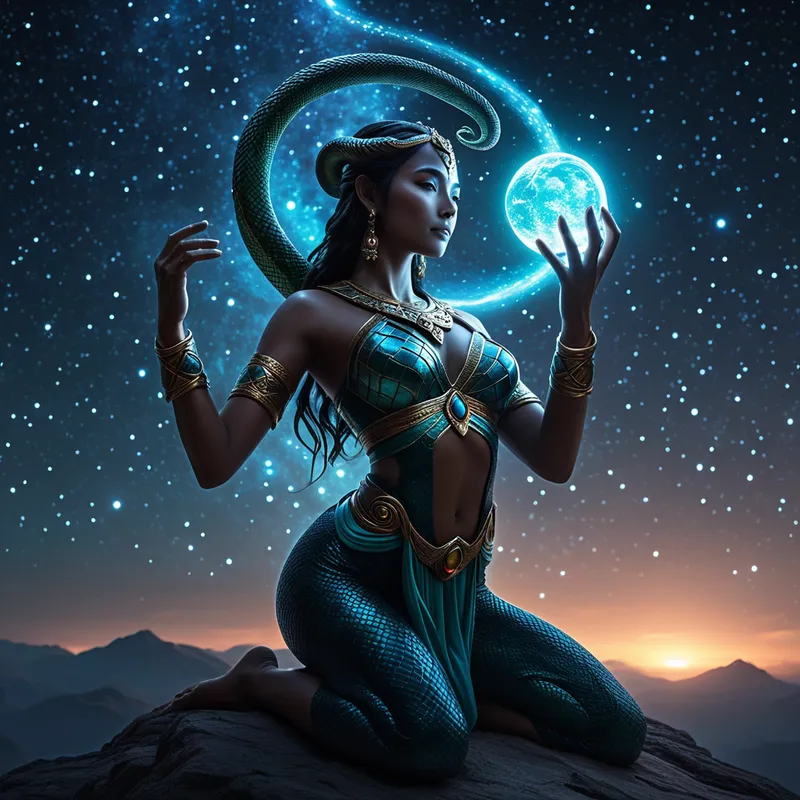
In the time before time was measured, when the world was young and the pillars of heaven were still soft, there was a harmony so profound it was a song. The Dao flowed unimpeded, and the goddess Nuwa, she who fashioned humanity from yellow earth, walked a world of pristine beauty.
But harmony is a balance, not a permanence. In the far north, two titans, Gonggong and Zhurong, clashed in a rage that shook the roots of creation. Their battle was not of armies, but of elements—raging flood against devouring flame. Defeated and mad with shame, Gonggong, the water demon, flung his massive skull against the great pillar that held up the northwest corner of the sky, the mountain Buzhou.
The sound was the shattering of a world-dream. The celestial pillar cracked, then sheared away. A portion of the sky tore open, a vast, ragged wound leaking darkness and cold. The earth, now unbalanced, split along its seams. Fires burst from the cracks, and endless waters, no longer held in check, rose in a great deluge. Savage beasts, emerging from the deep places, preyed upon the terrified people. The cosmic song became a cacophony of despair.
Witnessing the suffering of her creation, Nuwa’s heart, vast as the cosmos, ached. She would not allow the world to unravel into primal Hundun. Setting her will against the chaos, she began her great work. First, she slew the great black Ao, cutting its four mighty legs to replace the shattered pillar of heaven, steadying the sky’s dome. But the tear remained, a gateway to void.
So, she journeyed across the wounded world, gathering stones of five sacred colors from riverbeds and mountain hearts—green, red, yellow, white, and black, embodying the five phases and the essence of all matter. She built a divine furnace at the foot of a mythical peak and with a breath born of the Qi of creation itself, she kindled a fire that burned with the heat of stars. For nine and forty days and nights, she smelted the stones until they fused into a luminous, molten amalgam of celestial repair.
Then, lifting the glowing substance in her hands, she ascended. With infinite care and the focused love of a mother mending her child’s garment, she began to patch the gaping hole in the firmament. Stone by stone, she placed and sealed, weaving the colors back into the fabric of the sky. To secure her work, she slew the giant jiāo dragon and used its sinews as cords, and gathered the ash of burning reeds to stem the wild floods, giving the waters back their courses.
Finally, the sky was whole. The fires died, the floods receded, and the beasts retreated. The world, though scarred, was saved. Order was restored, not as it was, but renewed—a testament to the power of compassionate, creative action in the face of catastrophic rupture. Nuwa, her task complete, faded into the landscape, becoming one with the mountains and rivers she had saved, her essence forever part of the mended world.
Cultural Origins & Context
The myth of Nuwa is ancient, with roots stretching back to the Warring States period and fragments found in texts like the <abbr title=""An early collection of Chinese myths and legends”>Shan Hai Jing (Classic of Mountains and Seas) and the <abbr title=""A philosophical text from the late Warring States period”>Huainanzi. While Nuwa predates organized Taoism, her story was profoundly absorbed and interpreted through its lens. She embodies the Yin aspect of the Dao—the nurturing, generative, and restorative force.
Taoist sages and alchemists saw in her act not just a cosmic event, but a template for inner cultivation. The myth was passed down not merely as history, but as a sacred parable. It functioned as a societal anchor, explaining cosmic vulnerability and the necessity of ritual, virtue (De), and harmonious action (Wu Wei) to maintain the balance between Heaven (Tian) and Earth (Di). Nuwa’s repair was the ultimate act of Wu Wei—a decisive, perfectly aligned intervention to restore the natural flow.
Symbolic Architecture
The myth is a profound map of psychic catastrophe and restoration. The sky represents the overarching [structure](/symbols/structure “Symbol: Structure in dreams often symbolizes stability, organization, and the framework of one’s life, reflecting how one perceives their environment and personal life.”/) of [consciousness](/symbols/consciousness “Symbol: Consciousness represents the state of awareness and perception, encompassing thoughts, feelings, and experiences.”/), [identity](/symbols/identity “Symbol: Identity represents the sense of self, encompassing personal beliefs, cultural background, and social roles.”/), and cosmic order. Its [rupture](/symbols/rupture “Symbol: A sudden break or tear in continuity, often representing abrupt change, separation, or the shattering of established patterns.”/) signifies a traumatic shattering of one’s worldview, a collapse of meaning, or a descent into psychological [chaos](/symbols/chaos “Symbol: In Arts & Music, chaos represents raw creative potential, uncontrolled expression, and the breakdown of order to forge new artistic forms.”/).
The broken sky is the shattered self-concept; the five-colored stone is the integrated psyche, forged in the furnace of suffering.
Nuwa herself is the archetypal [Magnum](/symbols/magnum “Symbol: A powerful spiritual symbol representing divine authority, ultimate truth, and transformative force that transcends ordinary reality.”/) Mater, the Self in its [aspect](/symbols/aspect “Symbol: A distinct feature, quality, or perspective of something, often representing a partial view of a larger whole.”/) as [healer](/symbols/healer “Symbol: A figure representing restoration, transformation, and the integration of physical, emotional, or spiritual wounds. Often symbolizes a need for care or a latent ability to mend.”/) and integrator. Her serpentine [body](/symbols/body “Symbol: The body in dreams often symbolizes the dreamer’s self-identity, personal health, and the relationship they have with their physical existence.”/) connects her to the chthonic, instinctual wisdom of the [earth](/symbols/earth “Symbol: The symbol of Earth often represents grounding, stability, and the physical realm, embodying a connection to nature and the innate support it provides.”/), while her [human](/symbols/human “Symbol: The symbol of a human represents individuality, complexity of emotions, and social relationships.”/) torso reaches for the celestial. She is the bridge between chaos and order. The five-colored stones are not random minerals; they are the essential, differentiated elements of existence that must be gathered, sacrificed (smelted), and recombined to create a new, stronger wholeness. This is the [alchemy](/symbols/alchemy “Symbol: A transformative process of purification and creation, often symbolizing personal or spiritual evolution through difficult stages.”/) of the [soul](/symbols/soul “Symbol: The soul represents the essence of a person, encompassing their spirit, identity, and connection to the universe.”/)—[disintegration](/symbols/disintegration “Symbol: A symbol of breakdown, loss of form, or fragmentation, often reflecting anxiety about personal identity, control, or stability.”/) followed by a more conscious reintegration.
The Dreamer’s Resonance
When this myth stirs in modern dreams, it speaks to a psyche undergoing a foundational crisis. The dreamer may experience imagery of collapsing ceilings, shattered glass domes, or terrifying holes opening in the fabric of their dream-reality. These are somatic echoes of the “broken sky”—a feeling that one’s psychological containment has failed.
The dream may present a daunting, seemingly impossible task of repair. This is the call of the Nuwa archetype within. The process is not intellectual but deeply somatic and emotional: the gathering of scattered “stones” (lost parts of the self, fragmented memories, neglected talents), the enduring of the “furnace” (the painful heat of introspection and emotional processing), and the final, careful act of “patching” (making new connections, establishing new neural and emotional pathways). It is the psyche’s innate drive toward healing and re-organization after trauma.
Alchemical Translation
For the individual, the myth models the complete cycle of Individuation. The battle of Gonggong and Zhurong represents the inner conflict of opposing complexes—perhaps emotion versus intellect, passion versus duty—that, left unchecked, can destroy our inner stability (the pillar Buzhou).
The repair is not a return to a naive, pre-traumatic state, but the creation of a more resilient, conscious order, sealed with the wisdom won from the rupture.
The alchemical work begins with “slaying the dragon”—confronting and harnessing the raw, chaotic energy (the jiāo dragon’s sinews) that caused the flood. The gathering of the five-colored stones is the conscious work of Abreaction and analysis, identifying the core elements of one’s being. The smelting is the crucible of therapy, meditation, or deep reflection, where these elements are stripped of their old forms and made malleable. Finally, the act of repairing the sky is the slow, patient work of reconstruction: building a new worldview, a new ego-Self axis, that incorporates the lessons of the break. One becomes, like the mended sky, both scarred and whole, a testament to the creative, self-healing power of the psyche.
Associated Symbols
Explore related symbols from the CaleaDream lexicon:
- Goddess — Nuwa embodies the divine feminine as creator, sustainer, and healer, representing the unconscious Self’s capacity to restore wholeness from fragmentation.
- Sky — Represents the overarching structure of consciousness, order, and meaning; its rupture signifies catastrophic psychological or spiritual collapse.
- Stone — The five-colored stones symbolize the fundamental, differentiated elements of the psyche and world that must be consciously gathered and fused to create repair.
- Water — The uncontrolled floods represent overwhelming emotion, the unconscious contents unleashed, which must be channeled and given new courses.
- Fire — The furnace fire is the transformative heat of the alchemical process, the necessary suffering and energy required for psychic transmutation.
- Earth — The source of the stones and Nuwa’s serpent-body connection, representing the grounded, instinctual, and material basis from which healing arises.
- Dragon — The chaotic, primal power that must be confronted and its energy (sinews) harnessed for the work of reconstruction and binding.
- Circle — The mended sky restores the cosmic circle, the Taiji, representing the return to psychic wholeness and cyclical integrity.
- Healing — The core action of the myth, modeling a deep, cosmological process of repair that is both an external act and an internal, alchemical journey.
- Order — The desired state restored from chaos, representing the psyche’s innate drive toward equilibrium, structure, and meaningful pattern.
- Sacrifice — Nuwa’s relentless labor and the slaying of the turtle Ao and dragon represent the necessary sacrifices of time, energy, and old forms required for renewal.
- Rebirth — The world and the sky are not merely fixed but reborn into a new, more conscious state of harmony, mirroring the psyche’s renewal after crisis.