Njord Myth Meaning & Symbolism
A god of the sea marries a goddess of the mountains, a sacred union of opposites that brings peace at the price of a profound, unending longing.
The Tale of Njord
Listen, and hear the tale of the one who commands the sigh of the sea and the whisper of wealth. In the time after the great war, when the blood of giants and gods had cooled to a fragile truce, the realms sought a binding. The Aesir and the Vanir, once bitter foes, exchanged hostages to seal their peace.
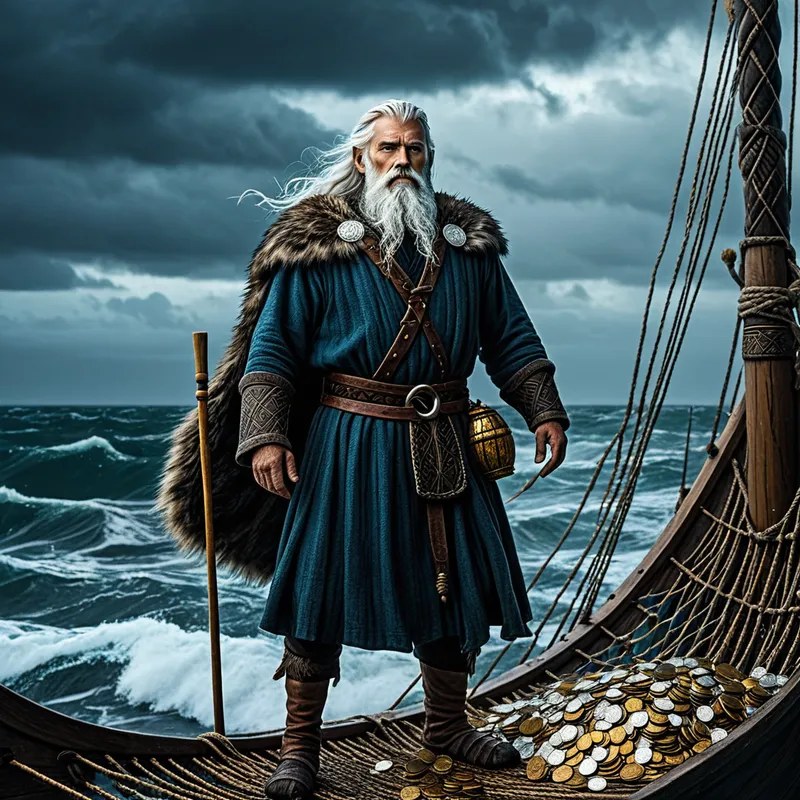
From the shimmering shores of Vanaheim came Njord. He did not arrive with thunder, but with the deep, rolling calm of a summer sea. His hair was the color of sea foam and his cloak smelled of salt, pine tar, and the rich, damp earth of a riverbank. He was given a hall in the high realm of Asgard, a place called Noatun, "The Place of Ships." Its timbers were carved from driftwood, and its windows opened not to the golden fields of the gods, but to the endless, grey horizon of the sea. There, he stilled the wild tempests sent by angry giants and guided the prows of vessels to safe harbor, his presence a balm of safe passage and abundance.
As part of the sacred exchange, a marriage was forged. Njord was wed to Skadi, daughter of the slain giant Thiazi. She came from the high, frozen fastnesses, her eyes the blue of glacier ice, her heart a wolf's howl echoing in a stone valley. She wore skis of ancient wood and carried a bow strung with sinew. She had come for vengeance but accepted a husband as her weregild.
Their union was the marriage of the world's deepest opposites. He was the fluid, giving sea; she, the unyielding, demanding mountain. For nine nights, they agreed to dwell in his home by the shore. The cry of gulls was a constant shriek to Skadi's ears. The sighing of the waves, which sang a lullaby to Njord, kept her awake with a restless, nagging pull. She could not bear the smell of salt and decaying seaweed, nor the flat, endless vista that offered no challenge to her climb.
Then, for nine nights, they retired to her inheritance, Thrymheim, high in the raw-boned mountains. The wind here did not whisper; it screamed through the firs. The wolves sang their nightly hymns. Njord, lord of the gentle swell, lay awake on a bed of pelts, his soul aching. The wolf-song was a dirge, the shivering of the pines a mockery of the waves' rhythm. The cold bit to his marrow, and he longed for the soft lap of water on a wooden hull.
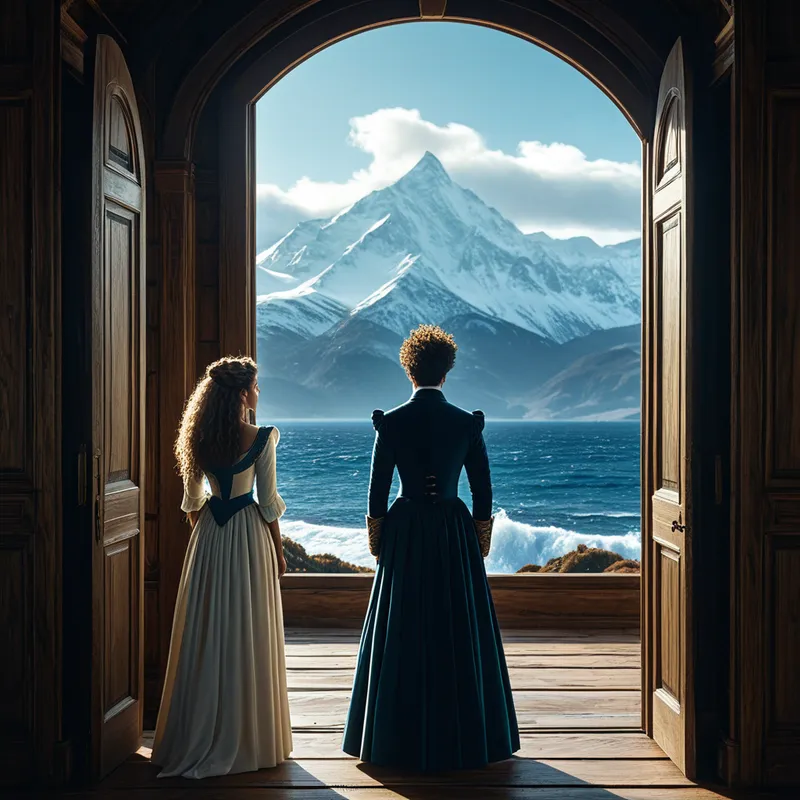
When the nine nights in each home were done, they stood facing one another, a chasm of longing between them. "I cannot sleep," confessed Njord, his voice rough with a homesickness for the deep, "for the howling of the wolves in the woods." Skadi, her face a mask of stark beauty and sorrow, replied, "I could find no rest by the shore, for the screaming of the birds that come from the sea." The peace they brought to the gods was a peace they could not find for themselves. So, they lived apart—she in her high halls, chasing the aurora on her skis; he in his ship-house, calming the waves for sailors. Their marriage remained, a sacred bond of reconciled realms, but its home was the space between the mountain and the sea, a space filled with the quiet, eternal sound of yearning.
Cultural Origins & Context
The myth of Njord is preserved primarily in the Poetic Edda and the Prose Edda, texts compiled in 13th-century Iceland but drawing from a much older, oral tradition of the Viking Age and earlier. As a Vanir god, Njord represents an older stratum of deities concerned with fertility, prosperity, and the untamed forces of nature—the sea, the wind, the yield of the land. His integration into the Aesir pantheon mirrors historical cultural integrations and the necessity of balancing sovereign power (Aesir) with the generative, sometimes chaotic forces of nature and fortune (Vanir).
The myth was likely told by skalds and elders, not merely as entertainment, but as a foundational narrative explaining the world's structure. It modeled the sacredness of exchange (hostages, marriage) as the foundation of social and cosmic order. For a seafaring, coastal, and also mountainous people, the myth gave divine sanction to the two pillars of their existence: the perilous, wealth-bringing sea and the harsh, resource-providing interior. The story validated the deep, somatic longing a sailor might feel for the solidity of land, and the claustrophobia a hunter might feel away from the high, open vistas.
Symbolic Architecture
At its core, the myth of Njord is a profound allegory of the conjunctio oppositorum—the sacred marriage of opposites. Njord and Skadi are not just individuals; they are cosmological principles made personal.
The sea does not judge the mountain for its stillness, nor the mountain the sea for its restlessness. In their eternal gaze across the shoreline, the world finds its breath.
Njord symbolizes the principle of fluid abundance. He is not a warrior god but a provider. His domain is the realm of flow, trade, connection, and the unconscious depths—what yields its treasures not through force, but through patience, skill, and a respectful relationship with capricious forces. Skadi embodies the principle of sovereign isolation. She is the archetype of the resilient, self-contained individual, aligned with clarity, height, personal boundaries, and the conscious will that carves its path against resistance.
Their marriage is the necessary union of these opposites for wholeness: the flow of life (sea) requires a container (mountain); the steadfastness of identity (mountain) requires the nourishing tides of relationship and emotion (sea). The tragedy—or perhaps the profound realism—of the myth is that this union does not result in a comfortable fusion. The resolution is not a cozy cottage halfway up a coastal cliff. It is a conscious, enduring tension.
The peace of the world is bought with the personal longing of the gods. The union that heals the collective often asks the individual to live with an irreducible ache.
The nine nights in each home signify an incomplete cycle, a trial that does not end in adaptation but in respectful recognition of irreconcilable difference. The peace between the Aesir and Vanir, the symbolic end of a war, is maintained precisely because Njord and Skadi agree to honor their own natures, even at the cost of conjugal unity. The sacred bond is maintained in the separation, in the acknowledgment that some opposites are not meant to merge, but to relate across a respectful distance.

The Dreamer's Resonance
When this myth stirs in the modern psyche, it often manifests in dreams of profound spatial and somatic tension. The dreamer may find themselves in a beautiful yet agonizing location—a stunning beach they cannot enjoy because they are desperately looking for a path inland, or a majestic mountain cabin where they feel trapped and suffocated, staring out at a distant, unreachable sea.
This is the dream of the unlived life. It signals a critical point of choice between two core, authentic aspects of the self that feel mutually exclusive. The "Njord" aspect may call for surrender, flow, engagement with the emotional and relational depths, perhaps a career or life path focused on nurturing and providing. The "Skadi" aspect may call for independence, ascent, focus on personal goals, clarity, and a need for emotional or physical altitude and solitude.
The somatic feeling is one of being pulled in two directions by the heart itself. It is not anxiety about external demands, but a deep, archetypal longing for two different kinds of wholeness. The dream presents the impossible choice not as a problem to be solved, but as a condition to be consciously inhabited. It asks the dreamer: Can you acknowledge that both the sea and the mountain are your homes, and that you may never fully reside in either without longing for the other? The psychological process is one of moving from a desire for a neat solution to the capacity to hold a sacred tension.

Alchemical Translation
The individuation process modeled by Njord's myth is not one of heroic conquest or final synthesis. It is the alchemy of conscious sacrifice and sacred distance.
The first stage is the recognitio—the recognition of one's fundamental opposites. The individual must spend their "nine nights" in each domain, fully experiencing the gifts and the costs of both the fluid, nurturing persona (the Caregiver) and the bounded, sovereign self (the individual will). This is not a test to see which one "wins," but to feel, in the bones and the blood, the truth of each.
The second stage is the separatio—the conscious, painful decision to let go of the fantasy of perfect integration. This is the crucible. The ego wants a single home, a unified identity. The Self, the greater psyche, often requires us to live in the creative tension between our core contradictions. To sacrifice the ego's desire for seamless unity is to make room for a transpersonal reality.
The gold is not found in the merging of sea and stone, but in the luminous, mist-hung space between them, where the breath of one becomes the substance of the other.
The final stage is the stabilization of this tension as a source of creativity, not suffering. Njord, in his ship-house, and Skadi, on her mountain, are not failed spouses; they are deities who have found a mode of relating that honors their essence and serves a function greater than their personal comfort. Their marriage is intact because of the distance.
For the modern individual, this translates to building a life architecture that allows both core aspects to exist. It may mean a career that involves travel (sea) but is based on a highly specialized skill (mountain). It may mean a relationship dynamic that honors profound periods of connection and equally profound periods of autonomous pursuit. It is the understanding that our deepest contributions to the "peace of the realms"—our communities, families, and inner worlds—often come from our willingness to live with, and bless, the unending call of the other shore. We become whole not by erasing the longing, but by recognizing it as the very rhythm of a soul that is vast enough to contain both the mountain and the deep.
Associated Symbols
Explore related symbols from the CaleaDream lexicon: