
Ninmah and the Creation of Humans Myth Meaning & Symbolism
The goddess Ninmah shapes humanity from clay to relieve the gods' labor, creating flawed beings whose very imperfections become the ground of their sacred purpose.
The Tale of Ninmah and the Creation of Humans
In the beginning, when the world was young and the great gods still walked the earth, there was a great weariness in the heavens. The Abzu and the Ki had borne the younger gods, the Anunnaki. But these divine children, born of power and light, found the work of the world beneath them. They groaned under the labor of digging canals to channel the life-giving waters, of tilling the hard earth to make it yield, of building the temples that would anchor heaven to earth. Their divine backs ached; their luminous spirits grew dim with toil.
Their lament rose like smoke to the ears of Enki, the clever one, the lord of the sweet waters and of all cunning arts. He heard their cries and his heart was stirred, not with pity alone, but with a spark of ingenious resolve. He summoned the great mother, Ninmah, she who fashions all life, she whose womb is the mountain from which all things spring.
In the quiet, fertile chamber beside the Abzu, where the air was thick with the scent of damp earth and possibility, Enki spoke his plan. "Let us create a new being," he said, his voice a low murmur like underground streams. "Let us mix the blood of a god who understands this grievance with the clay of the Apsu. From this union, let us fashion a Lullu, a primitive worker, to bear the yoke of the gods. They shall toil so that the divine ones may rest."
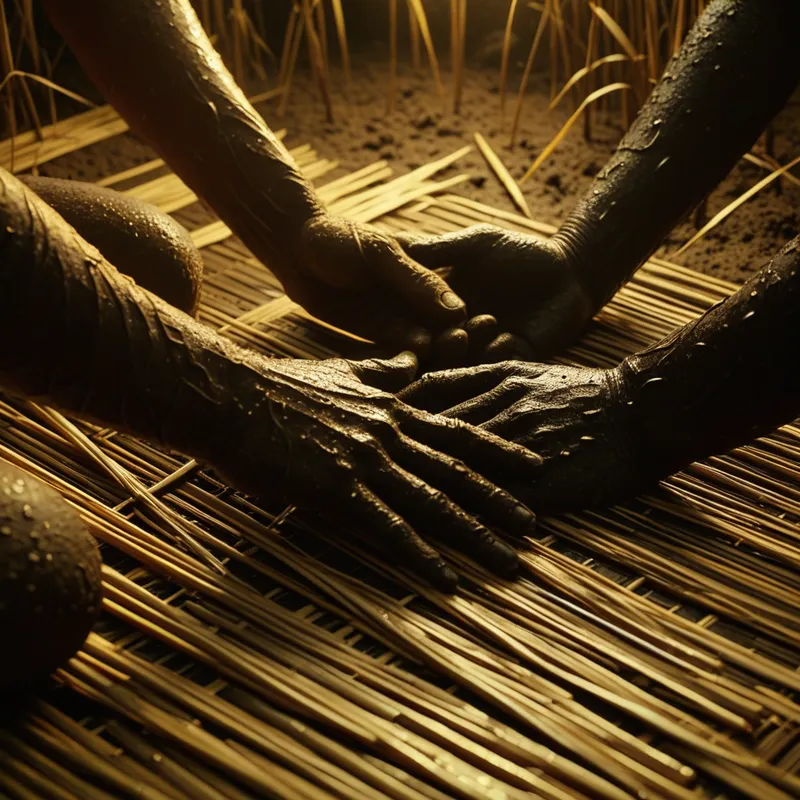
Ninmah, her hands already knowing the shape of life, nodded. The substance was prepared: the rich, dark clay from the bank of the primordial water, and the essence, the life-spark, from a god who had rebelled against the labor. With infinite care, Ninmah knelt. She took the clay into her hands, feeling its cool, pliable weight. She did not simply command it into being; she shaped it. Her fingers, wise and strong, pressed and formed, hollowed and smoothed. She pinched the limbs, carved the features, breathed into the hollow of its chest. One by one, the first humans emerged from her hands—awkward, breathing, their eyes still clouded with the dust of the earth from which they were born.
But the story does not end with a perfect creation. Seeing the new beings, Enki, in his playful and challenging wisdom, proposed a fateful game. He called for a feast. As the divine ale flowed, he turned to Ninmah. "Great mother, you have shaped these beings well. But can you find a destiny, a place, for whatever being I might fashion? Can your wisdom provide for even the most flawed of forms?"
Ninmah, confident in her creative power, accepted the challenge. Then Enki, the trickster-smith, took clay and began to shape beings of his own. But his were not the whole and hale workers. He fashioned one whose hands could not grasp a tool, one whose eyes could not see the sun, one whose mind could not understand a command. He created the weak, the infirm, the seemingly broken. One by one, he presented them to the mother goddess.
And here, Ninmah’s true divinity shone. She did not reject them. She did not cast them back into the mud. For each flawed being, she found a purpose. To the one with weak hands, she gave the role of court singer, to please the gods with melody. To the blind one, she gave the gift of prophecy, to see the unseen. She found a place, a dignity, for every one. She wove their limitation into their function, making their very brokenness the thread of their sacred purpose. In that moment, humanity was not just created; it was accepted. The covenant was sealed not in perfection, but in compassionate adaptation. The toil would be theirs, but so too would be the strange, particular grace of their existence.
Cultural Origins & Context
This myth, found in the Babylonian composition sometimes called "The Creation of Man" or embedded within the epic of Gilgamesh, is not a singular, dogmatic text but a fluid narrative tradition. It was recited by temple scribes and likely performed during certain festivals, serving to explain humanity’s fundamental place in the cosmos. Its primary function was theodicy—justifying the ways of the gods to humans. It answered the perennial questions: Why do we work? Why are we here? Why are we imperfect?
The answer it provides is profoundly integrated into the Mesopotamian worldview. Humans are not the pinnacle of creation but a necessary, functional component of a divine hierarchy. We are literally born from the earth (Ki) and the divine essence, making us simultaneously mortal and touched by the eternal. Our purpose is to maintain the world-order (Me) through labor, specifically the agricultural and civic labor that sustained the temple-cities, the dwelling places of the gods. The myth legitimized social structure and the hard realities of agrarian life, framing them as part of a primordial, divine plan established by Ninmah and Enki themselves.
Symbolic Architecture
At its core, this myth is a profound meditation on the nature of creation as an act of relationship rather than mere manufacture. Ninmah is not an aloof demiurge but an engaged, hands-on mother. The clay is not inert matter; it is the primal substance of the Apsu, the body of the world itself. Humanity is thus a literal amalgam of the earthly and the divine, a walking paradox of spirit and soil.
The first human was not spoken into existence, but kneaded into being. Our origin is tactile, intimate, and messy—an imprint of the divine hand in the mud of the real.
Enki’s challenge introduces the essential element of limitation. The "flawed" beings he creates are not mistakes, but manifestations of the inherent variability and vulnerability of embodied existence. Ninmah’s responses are the myth’s masterstroke. She represents the archetypal principle of adaptation, of finding meaning and function within constraint. This transforms the narrative from one of subjugation to one of sacred assignment. Our weaknesses are not curses to be overcome, but potential sites of unique purpose, if we have the wisdom to see it.
Psychologically, Ninmah embodies the Anima in her creative, nurturing, and adaptive capacity. Enki represents the Animus in his logical, challenging, and boundary-testing role. The creation of humanity is the child of this inner marriage—the ego, born from the dialogue between our deep, formative instincts (the Mother) and our structuring, problem-solving consciousness (the Trickster-Sage).
The Dreamer's Resonance
When this myth stirs in the modern unconscious, it often surfaces in dreams of profound making or unmaking. You may dream of desperately trying to mold something—a pot, a figure, a home—only to have it collapse or form strangely in your hands. This is the somatic memory of the clay, the feeling of being both creator and created, struggling with intractable material (your own life, your body, your relationships).
Dreams of being presented before a council of silent, judging figures, feeling inherently "flawed" or unfit for a purpose you cannot comprehend, echo Enki’s challenge. The dream-ego is the flawed being awaiting its destiny. The psychological process here is one of moving from a state of shame over one’s limitations to a search for one’s unique, assigned niche. The healing resolution, guided by the Ninmah within, is not the dream of becoming perfect, but the dream of being seen and placed—of having your specific form of brokenness recognized as integral to your function in the grander scheme.
Alchemical Translation
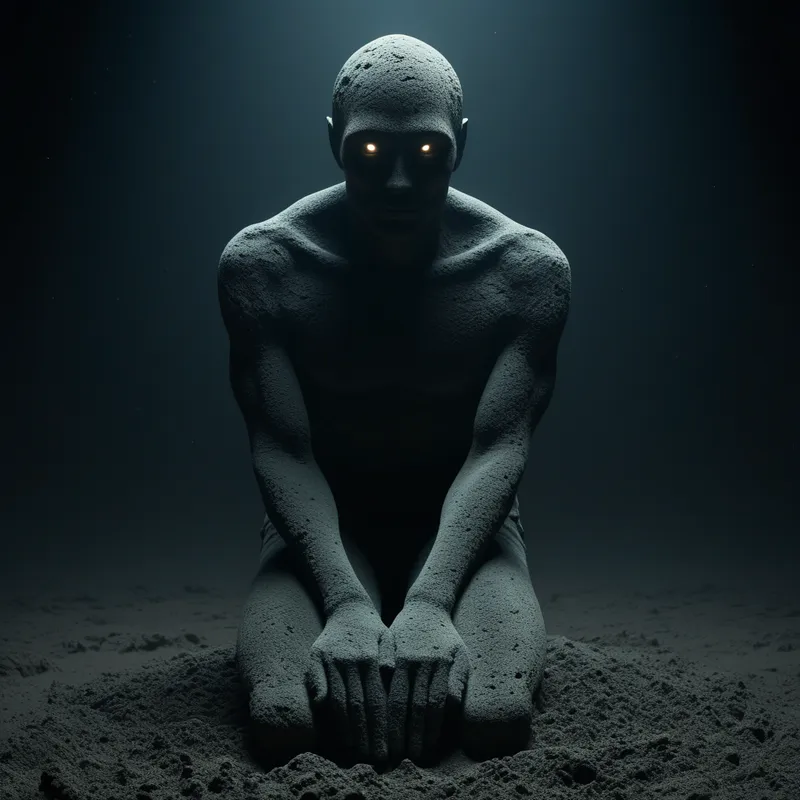
The alchemical process mirrored here is the opus contra naturam—the work against nature, which is really a work of transcendent refinement. The base matter is the primal clay of our unexamined, instinctual existence. Ninmah’s shaping is the separatio and coagulatio: separating the divine spark (potential consciousness) from the muddy mass of chaos, and coagulating it into a distinct form—the persona, the ego.
Enki’s intervention represents the essential stage of mortificatio and putrefactio. He "kills" the ideal of the perfect, generic worker. He introduces disease, disability, and distortion—the shadow elements, the things the ego wants to disown. This is the crisis point in individuation, where one confronts one’s own weaknesses, neuroses, and "unacceptable" parts.
Individuation is not the creation of a perfect being, but Ninmah’s act: the compassionate finding of a destiny for the very parts of ourselves we wished the gods had never made.
Ninmah’s final responses are the sublimatio and projectio. She sublimates the raw suffering of limitation into a higher function (the blind seer, the weak-handed artist). She then projects this redeemed form back into the world, giving it a place. For the modern individual, this is the process of integrating the shadow. It is not about curing your anxiety, but discovering how your sensitivity makes you a keen observer. It is not about fixing your "flaw," but understanding how it carved the unique channel through which your soul must flow. The goal is not to cease being a Lullu, burdened with toil, but to become a conscious Lullu who understands that their specific labor is the very thread they contribute to the tapestry of the Me. We achieve our divine purpose not by escaping our earthly clay, but by allowing the wise hands of our own deepest self to shape it, flaw and all, into a vessel for a singular destiny.
Associated Symbols
Explore related symbols from the CaleaDream lexicon:
- Clay — The primal substance of the Apsu, representing the malleable, earthly foundation of human nature, our connection to the soil, and the raw material of potential awaiting form.
- Mother — The archetypal embodiment of Ninmah as the shaping, nurturing, and life-giving force who finds purpose for all created things, especially the imperfect.
- God — Represents the divine essence (the blood of the god) mixed with the clay, symbolizing the immortal spark or transcendent potential within the mortal human frame.
- Earth — The source of the clay and the domain of human toil (Ki), representing the grounded, material reality and labor that defines the human condition.
- Water — The Abzu of Enki, necessary to mix and enliven the clay, symbolizing the fluidity of wisdom, subconscious potential, and the source of life.
- Creation — The central act of Ninmah and Enki, representing the primordial moment of bringing form from chaos and the ongoing human task of self-creation and world-building.
- Destiny — The specific function or place Ninmah finds for each flawed being, representing the idea that our purpose is often woven from the very threads of our limitation.
- Labor — The foundational reason for humanity's creation, symbolizing the burden, necessity, and potential sacredness of work and earthly struggle.
- Imperfection — The "flawed" beings shaped by Enki, representing human vulnerability, limitation, and the shadow aspects that demand integration and compassionate understanding.
- Purpose — The outcome of Ninmah's wisdom, representing the discovery of meaning and unique function within the constraints of one's existence.