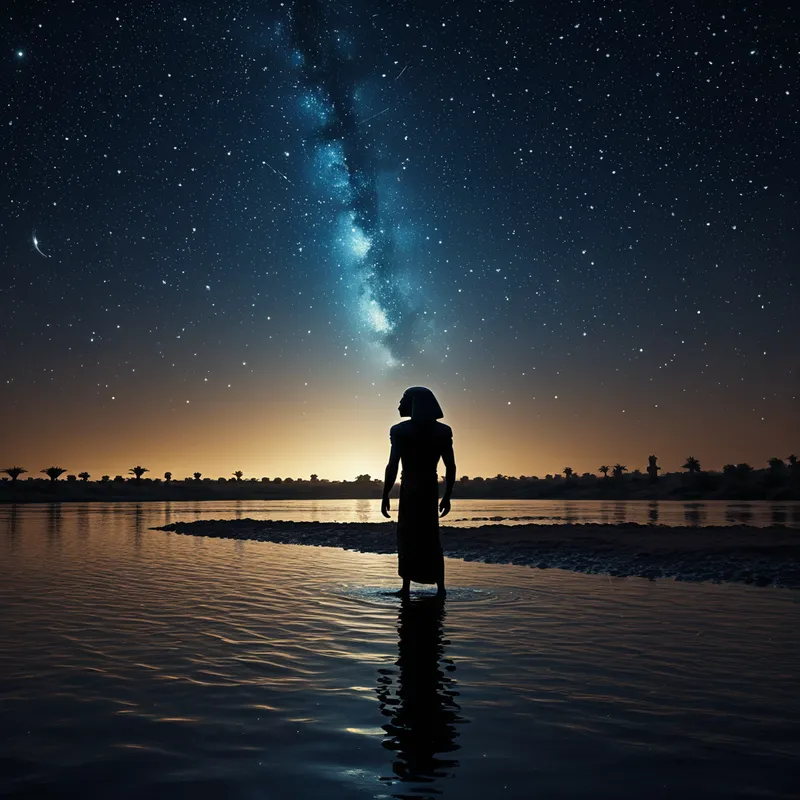
Nile River Myth Meaning & Symbolism
The story of the Nile's annual flood, a divine drama of sacrifice and rebirth, mirroring the cycles of the human psyche.
The Tale of Nile River
In the time before time, when the sky was a belly pressed close to the earth, there was only the dark, coiled waters of Nun. From its stillness, the first mound of earth rose, and upon it, the sun god wept. His tears fell, and where they touched the fertile black soil, humanity sprang forth. But the land was parched, and the people thirsted.
Then came the promise, not in a single form, but in a rhythm as old as the stars themselves. It was whispered that the life of the Two Lands was bound to a great, sleeping serpent that wound through the realm of the dead. This was the celestial Hapi. He did not walk among men but flowed beneath their feet and through their veins. Each year, as the dog star, Sopdet, pierced the dawn’s veil after a long absence, a great lament would rise in the south. It was the sound of the goddess Isis, weeping for her slain husband, Osiris.
Her tears were so copious, so profound in their grief, that they flooded the caverns of the underworld where Osiris’s body was kept. The waters, charged with her sorrow and her magic, could not be contained. They surged northward, seeking the sea. This was no gentle rain, but a divine inundation. The river would swell, turning from its clear green to a rich, turbulent red—the very blood of Osiris, spilled by his brother Set, now returning to nourish the land that was his body.
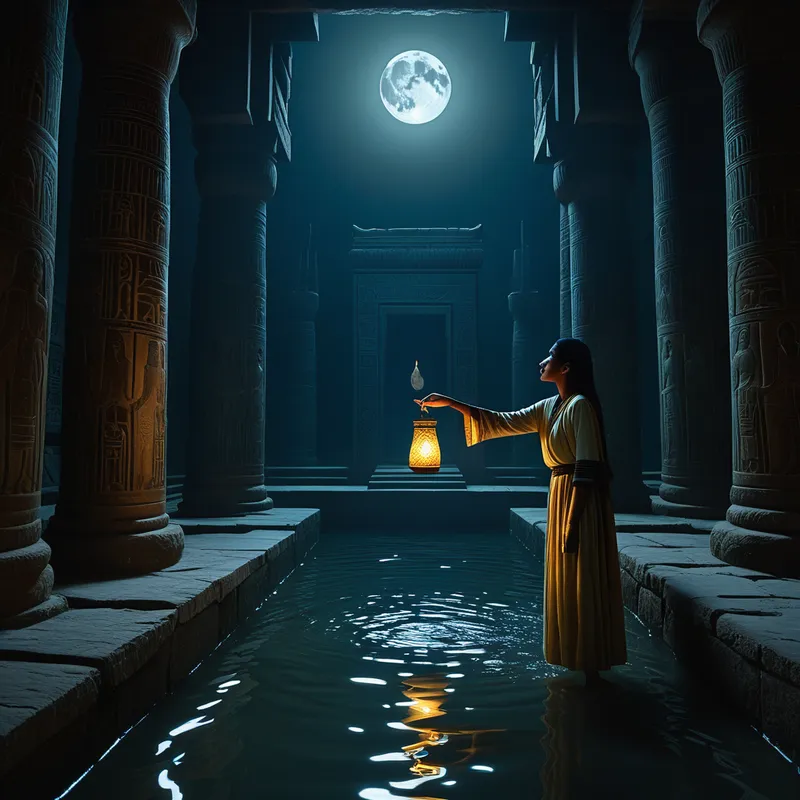
In the temples, the priests watched the nilometers. The air grew thick with the scent of damp earth and blooming lotus. When the first surge was seen at Elephantine, a cry would go up: “Hapi comes!” The waters would rise, swallowing the boundaries between fields, a churning, silt-laden chaos. For weeks, the world was half-water, a primordial soup. Then, as mysteriously as it came, the flood would recede, retreating back into its channel. And in its wake, it left not destruction, but a miracle: a layer of black, fecund silt, kemet, the “Black Land,” ready to receive the seed.
And at his potter’s wheel in the cataracts, the ram-headed god Khnum would take this very silt, this divine sediment of life and death, and shape the bodies of new children and the kas of the pharaohs, ensuring the cycle would begin again. The river was not just a source of water. It was a funeral procession, a resurrection, and a birth, all in one endless, flowing hymn.
Cultural Origins & Context
This was not a single myth recited from a papyrus, but the living, breathing cosmology of a civilization. The story of the Nile’s flood was woven into the very fabric of Egyptian time, religion, and statecraft. It was observed in the heliacal rising of Sopdet, calculated by astronomer-priests, and enacted in massive state rituals led by the Pharaoh, who was seen as the earthly counterpart to Hapi. The Pharaoh’s duty was to maintain Ma'at, and the predictable return of the flood was the ultimate sign of his success and the gods’ favor.
The myth was passed down through temple liturgies, such as the “Hymn to the Nile” from the Middle Kingdom, and was depicted on tomb walls and temple reliefs. It was told by farmers who read the river’s height on the nilometers and by mothers who explained why the water turned red. Its societal function was absolute: it explained the inexplicable bounty of their land in the midst of a desert, provided a theological framework for the cycle of life and death, and legitimized the Pharaonic state as the necessary intermediary between the chaotic, life-giving waters and the ordered, fertile land.
Symbolic Architecture
The Nile myth is a master symbol of the psyche’s own necessary rhythms. It represents the foundational truth that life is not a state of perpetual fullness, but a cycle dependent on a periodic, chaotic influx from the depths.
The river that gives life is the same that carries the dead; the source of nourishment is born from the waters of grief.
The Flood (Inundation) symbolizes the unconscious itself, breaking its banks and flooding the ordered consciousness (the cultivated land). This is not a disaster, but a vital fertilization. The red, silt-laden water is the symbolic blood of the sacrificed god—the old king, the old self, the past year—whose dissolution is necessary for new growth. Osiris, dismembered and scattered, represents the fragmented psyche or the endured trauma, while Isis’s tears represent the conscious, feeling engagement with that pain—a grief that is not sterile, but magically potent and creatively fertile.
The god Hapi, with his female breasts and male potency, embodies the ultimate union of opposites: chaos and order, male and female, death and life. He is the archetype of the nourishing container, the Caregiver who provides not from a place of simple kindness, but from the deep, often turbulent, wellspring of the primal world.
The Dreamer's Resonance
When this mythic pattern stirs in the modern dreamer, it often manifests as dreams of overwhelming floods, rising basement waters, or finding unexpected fertility in a wasteland. Somaticly, one might feel a profound, almost cellular, sense of heaviness, lethargy, or emotional saturation—the “silt” settling in the body. Psychologically, this is the process of a necessary depression.
This is not a clinical depression, but what the alchemists called the nigredo. It is the psyche’s inundation. The dream-ego may feel drowned by memories, unresolved grief, or a tidal wave of feeling that threatens the neat structures of one’s identity. The dream is signaling that the conscious land is too dry, too rigid, and requires the messy, chaotic, life-giving waters from the underworld of the personal and collective unconscious to soften it and make it fertile again.

Alchemical Translation
The journey of the Nile myth is the alchemical opus of the soul. It models the process of psychic transmutation—individuation—not as a linear ascent, but as an eternal, sacred round.
The first stage is Dissolution (The Flood). The conscious ego, the “kingdom of the day,” must be dissolved. Old attitudes, rigid self-concepts, and dammed-up emotions are overwhelmed by the contents of the unconscious. This feels like a crisis, a death—the murder of Osiris. The key is to not resist the flood, but to learn, like Isis, to grieve it fully. To let the tears flow and work their magic.
The second stage is Separation (The Receding Waters). After the saturation, a boundary re-forms. The waters retreat, leaving their essence—the rich, black silt. Psychologically, this is the moment of insight that follows the emotional storm. One separates the nourishing wisdom (the silt) from the chaotic waters of raw affect. This is the formation of the kemet within, a new, fertile ground of the soul.
The goal is not to stop the flood, but to build your life on the soil it deposits.
The final stage is Coagulation (The Sowing). Here, the god Khnum goes to work. With the new, fertile psychic material, the individual consciously begins to reshape their identity. They “plant the seed” in the black land—taking intentional action, creating new works, living from a renewed center. The Pharaoh, the ruling consciousness, now mediates this fertile ground, ensuring the internal Ma'at is maintained until the next necessary inundation.
Thus, the myth teaches that the soul, like Egypt, is a gift of the river. Our deepest growth depends not on avoiding the chaotic, grieving, overwhelming floods of the unconscious, but on learning their sacred timing, honoring their source, and building our lives upon the fertile darkness they leave behind.
Associated Symbols
Explore related symbols from the CaleaDream lexicon: