Nessus' Shirt Myth Meaning & Symbolism
Heracles is killed by a poisoned shirt, a gift from his wife Deianira, unwittingly crafted from the venom of the centaur Nessus he slew.
The Tale of Nessus' Shirt
The river Evenus ran cold and swift, a silver scar through the land. Upon its bank stood Deianira, a princess of such beauty that the river god himself desired her. Her heart, however, was given to the lion-skinned giant, Heracles, whose labors had carved his name into the bones of the world. He had won her, but the journey home was a gauntlet of earth’s raw chaos.
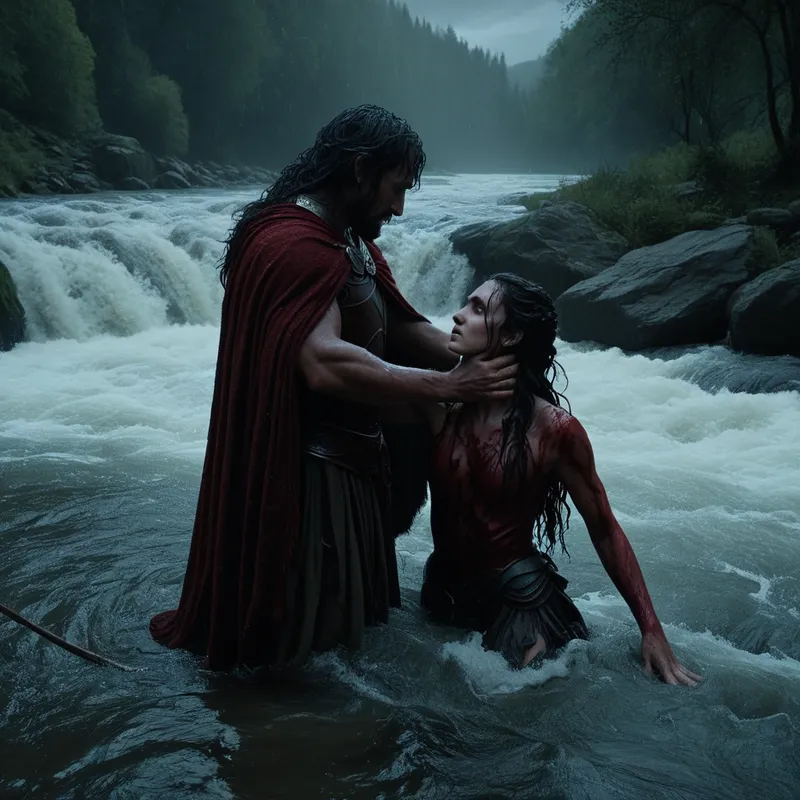
Their path was blocked by the raging Evenus. From the pine-scented shadows emerged Nessus, a ferryman of monstrous form. “For a fee,” he rasped, “I bear all across.” Trust, or necessity, made the choice. Heracles went first, swimming the mighty current with his club held high. Then Nessus returned for Deianira. But as the chill water swirled around the centaur’s equine flanks, a darker hunger swirled in his heart. Midstream, he seized her, his intent as clear as the mountain air, and bolted for the far woods.
A roar split the sky. Heracles, seeing his love stolen, nocked one of his arrows—arrows tipped with the black, hydra-venomed blood from his second labor. The bowstring sang a note of pure fate. The missile flew, a streak of inevitable death, and pierced the centaur’s back. Nessus stumbled, fell, his life seeping into the riverbank mud. As the poison’s fire ate his veins, deceit blossomed in its place. With his dying breath, he called Deianira close. “Princess,” he gasped, a trickle of dark blood at his lips. “Take my blood… this last gift. It is a powerful philtre. Should your hero’s love ever grow cold, anoint his garment with it. It will bind his heart to yours, forever aflame.” Deianira, trembling, collected the centaur’s vital fluid in a vial, a seed of future ruin.
Years passed. Heracles, ever the hero, waged wars and founded cities. In the kingdom of Oechalia, he saw Iole, and an old fire was rekindled. Word reached Deianira, and the cold fear of abandonment gripped her. She remembered Nessus’s gift. She took a magnificent white linen chiton, woven for Heracles’s sacrifice to the gods, and carefully anointed its inner folds with the preserved, clotted blood of the centaur. She sent it with a trusted messenger, a vessel of desperate hope.
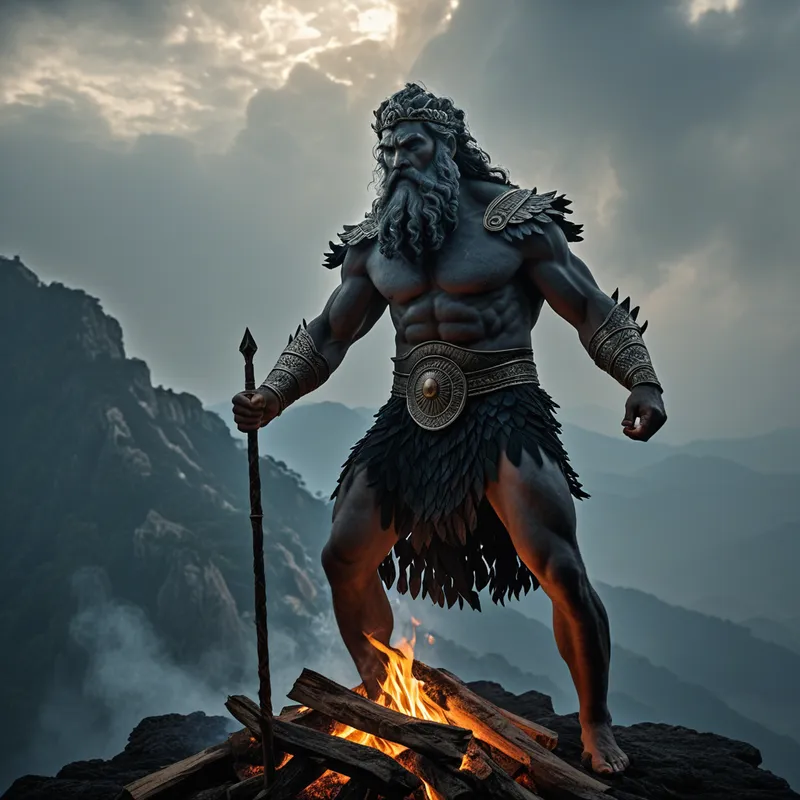
Heracles donned the shirt for the sacred rite. As his body heat warmed the fabric, a change began. Not the fire of love, but the fire of the Hydra. The venom, dormant in the centaur’s blood, awoke. It seared into his skin, a pain beyond any monster’s blow. He screamed, tearing at the cloth, but it clung like a second skin, burning deeper, fusing agony to flesh. In his torment, he uprooted trees and shattered altars. He understood the betrayal’s source—not from his wife’s malice, but from the dead centaur’s vengeance, delivered by the hand of love itself. There was no cure, no river cool enough. Seeing his endless suffering, he commanded a pyre built on Mount Oeta. As the flames climbed, consuming the mortal shell poisoned by deceit, only his immortal essence remained, ascending to Olympus, freed at last by an apotheosis of agony.
Cultural Origins & Context
This myth is a late, potent strand in the vast tapestry of Heracles lore, most completely preserved in the Trachiniae by Sophocles and referenced in later works like Ovid’s Metamorphoses. It functions as the capstone to the hero’s mortal narrative. Unlike tales of direct monster-slaying, this story explores the indirect, psychological consequences of a hero’s past actions. It was told not just to glorify strength, but to illustrate the inescapable web of moira and the tragic fragility of human relationships, even for a demigod.
In a culture deeply concerned with concepts of pollution (miasma), hospitality (xenia), and unintended consequence, the myth served as a profound caution. The poison is not a weapon faced in battle, but a “gift” passed through a chain of betrayal (Nessus’s violation of xenia), heroic violence (Heracles’s shot), and desperate love (Deianira’s application). It shows how violence, even justified, can generate a toxic residue that lingers, waiting to re-enter one’s life through the most intimate channels. The myth was a societal meditation on the fact that the greatest threats are often not the monsters we confront, but the poisoned garments we willingly, unknowingly, put on.
Symbolic Architecture
The shirt is the central symbol—an object of supposed love and protection that becomes an instrument of torment and death. It represents the poisoned gift, the lethal inheritance from a past we thought we had conquered.
The most venomous substances are not those we keep at a distance, but those we are persuaded to wear next to our skin, believing them to be garments of salvation.
Heracles, the hero, symbolizes the conscious will, the ego that overcomes external obstacles through sheer force. Yet he is helpless against this internal, clinging poison. His strength, which solved every prior problem, only accelerates the venom’s work. Nessus represents the violated instinct—the bestial, untamed aspect of nature (the centaur) that, when wounded and betrayed, plots a revenge that operates on a level the conscious hero cannot comprehend. His poison is the concretized spirit of resentment, the alastor of a defeated shadow.
Deianira is the unconscious intermediary. She is the soul’s vulnerable, trusting aspect that receives and stores the toxic “solution” offered by the wounded shadow. Her application of the poison is not evil, but a misguided attempt at preservation, showing how love, when infected by fear and insecurity, can become the delivery system for destruction. The final pyre is the only resolution: the total, sacrificial destruction of the old identity, the heroic ego, to be reborn at a higher, divine level.
The Dreamer's Resonance
When this myth stirs in the modern psyche, it rarely appears as a classical tableau. Instead, one may dream of a beloved piece of clothing—a sweater from an ex-lover, a uniform from a past life—that, when worn, causes a creeping paralysis or a burning rash. The dreamer might be in a social situation, feeling a smile “stuck” on their face, a pleasant facade that begins to chemically burn them from within. The somatic signature is one of adhesive agony—something that should be protective or decorative has become a fused, inescapable source of pain.
Psychologically, this signals a moment of recognizing a “poisoned garment” one has been wearing. This could be an identity (the “dutiful child,” the “tough guy”), a relationship pattern, or a belief system adopted from a “Nessus”—a past wound, a toxic parent, a cultural norm—that was presented as a gift, a tool for survival or love. The dream marks the point where the psyche’s own heat (living authentically, experiencing true passion) activates the long-dormant poison, creating a crisis. The pain is the truth of the betrayal—both the original betrayal and the betrayal of self by wearing the false solution.

Alchemical Translation
The alchemy of Nessus’ Shirt is the nigredo pushed to its absolute extreme. It is the process where the prima materia of the personality—here, the heroic ego—is subjected not to an external fire, but to a corrosive, internal one. The myth models the brutal necessity of ego death as a prerequisite for individuation.
Individuation often requires not that we slay the dragon, but that we willingly don the shirt woven from its venom, and endure the conflagration that follows.
The first step is Recognition of the Poison: realizing that a core part of one’s identity or strategy for love is itself the source of suffering. This is Heracles understanding the shirt’s origin. The second is the Agony of Adhesion: the painful, futile struggle where the old methods of “ripping it off” (force, willpower, rationalization) fail utterly. The ego confronts its absolute limitation.
The final, alchemical stage is the Pyre of Apotheosis. This is the conscious, willed surrender. It is not suicide, but the sacrificial offering of the entire contaminated structure of the self to a transformative fire. One must build one’s own pyre on the mountain of solitude and let it burn. From this total dissolution, the caelum, the imperishable essence, is freed. For the modern individual, this translates to the courageous dissolution of a life-built persona, a career, or a relationship that, though once a “gift,” has become a prison of slow poison. The triumph is not in surviving the shirt, but in having the courage to call for the flame that consumes it utterly, making way for a more authentic, integrated existence to arise from the ashes.
Associated Symbols
Explore related symbols from the CaleaDream lexicon: