Nasruddin Hodja Myth Meaning & Symbolism
A wandering sage cloaked in folly, Nasruddin Hodja's paradoxical tales reveal the absurd wisdom hidden in the cracks of logic and the heart of human nature.
The Tale of Nasruddin Hodja
Listen, and let the dust of the caravan road settle. In the land where the sun bakes the earth and the call to prayer weaves through the cypress trees, there lived a man who was no man, a fool who was no fool. His name was Nasruddin Hodja.
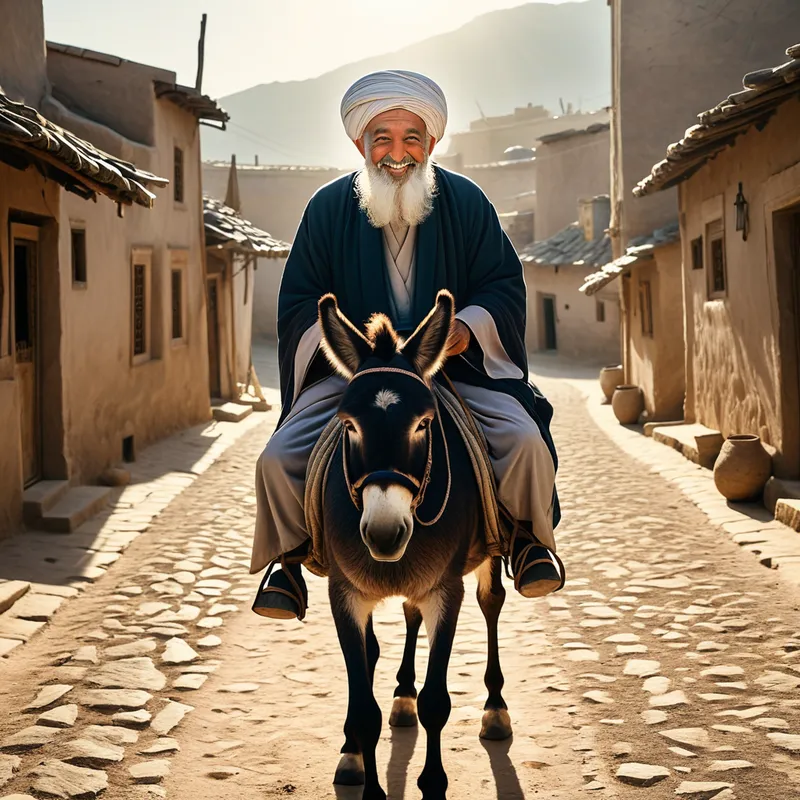
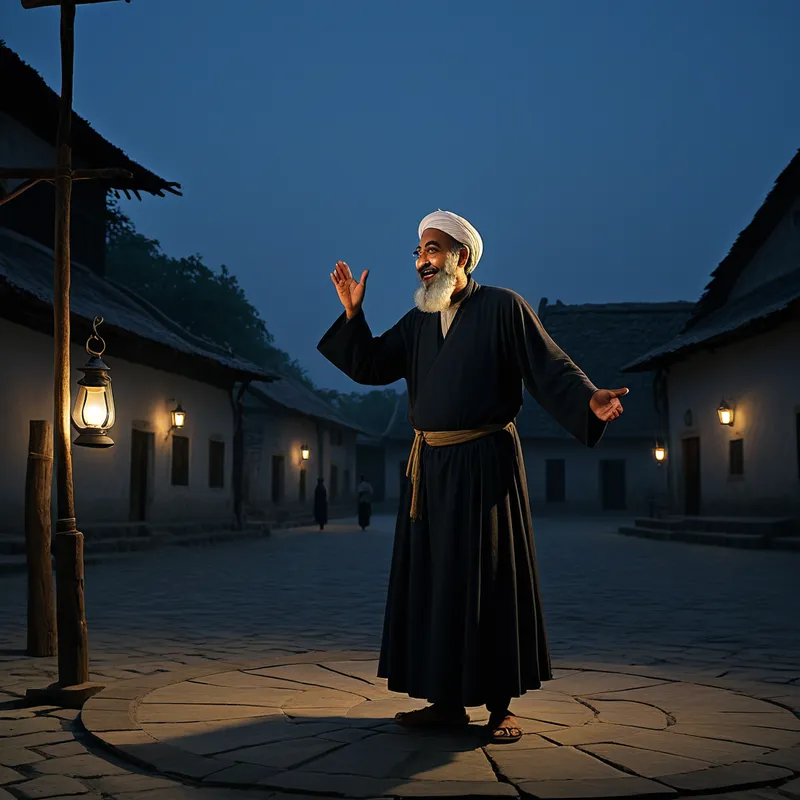
He rode a donkey so small his feet scraped the ground, yet he claimed it was the world that had grown too large. One day, he was seen searching frantically under a streetlamp. A neighbor asked, “Hodja, what have you lost?” “My key,” he groaned, patting the dust. The neighbor joined the search, but after a fruitless hour, asked, “Are you sure you dropped it here?” Nasruddin pointed into the darkness. “No, I lost it over there, in my house.” “Then why search here?” the man cried. Nasruddin blinked, his face a canvas of perfect, serene logic. “Because the light is better here.”
Another time, a great scholar cornered him in the teahouse. “Hodja,” he sneered, “you speak in circles. What is the shape of the earth?” Nasruddin did not hesitate. “It is flat, like a plate.” The scholar laughed. “Fool! All learned men know it is round, like an orange!” Nasruddin nodded gravely. “Ah, but have you considered the bread?” The scholar was silent. “When you bake your flatbread,” Nasruddin continued, “do you not call it ‘round bread’? And when you slice your orange, do you not see flat circles? You see, my friend, it is not the world that has one shape, but our words that are too small to hold it.”
His greatest trial came not from scholars, but from his own hunger. Invited to a wealthy man’s feast wearing his humble cloak, he was ignored and shown to a corner. He left, returned clad in a magnificent fur robe, and was ushered to the head of the table, served the finest meats. As the soup was served, he began to spoon it onto the sleeves of his fur. The host gasped. “Hodja, what are you doing?” Nasruddin looked at the man, his eyes holding a deep, quiet ocean. “When I came in my cloak, the food was for my cloak. Now I have come in my fur, so clearly, the food is for my fur. I am merely feeding the guest of honor.”
And so he moved through the world—a mirror held up to pride, a key that unlocked doors in the ceiling when everyone looked at the floor. He was the man who looked for a lost ring in the river because the water was clearer, though he had dropped it in the forest. He was the wisdom that arrives sideways, dressed in the robes of a fool, riding backwards to arrive exactly where he needs to be.
Cultural Origins & Context
Nasruddin Hodja is not a myth of gods and monsters, but a living folklore of the human spirit, rooted in the soil of the Turco-Persian world. While often claimed by many nations, his spiritual homeland is the Anatolian heartland, emerging around the 13th century, a time of Sufi mysticism and social flux. He is a figure of the awan, the common folk.
His stories were not penned in illuminated manuscripts but breathed into life in caravanserais, around village hearths, and in coffeehouses. They were told by traveling dervishes, merchants, and grandparents, serving as social glue and a pressure valve. In cultures with deep respect for formal religious and scholarly authority, Nasruddin provided a sanctioned space for questioning, satire, and the celebration of intuitive, earthy wisdom over rigid dogma. He is the beloved fool who speaks truth to power without being beheaded, because his truth is wrapped in an enigma, served with a smile. He embodies the Sufi principle that divine wisdom (ma'rifah) often comes through breaking the mind’s habitual patterns.
Symbolic Architecture
Nasruddin is the archetypal Trickster as Sage. His stories are not mere jokes; they are koans, psychological traps meant to spring the listener from the prison of literal-mindedness.
The path to wisdom is not a straight road built by reason, but a spiraling track left by a donkey that knows the way home by feeling the earth.
His donkey is his steadfast companion, representing the humble, instinctual, bodily self—the nafs in its raw, untrained state—that the intellectual ego either ignores or despises. Yet, it is this very creature that carries him. Searching for a key in the light, not where it was lost, is a perfect metaphor for the human tendency to seek solutions only within the comfortable, illuminated realms of conscious understanding, avoiding the shadowy, unknown interiors of our own being (the unconscious).
The feast where he feeds his fur robe lays bare the painful human truth that we often honor the symbol (status, wealth, appearance) over the substance (the human soul within). His actions perform a radical alchemy: by taking the metaphor literally, he forces a confrontation with the absurdity of the social code itself.
The Dreamer's Resonance
To dream of Nasruddin Hodja, or of a figure who embodies his essence, is to encounter the psyche’s own inner jester. This dream figure appears when the dreamer’s conscious attitude has become too rigid, too sure of itself, or too burdened by a one-sided perspective.
Somatically, this might accompany a feeling of constriction in the chest or a buzzing frustration—the feeling of a logic puzzle that cannot be solved with the given rules. The Hodja dream is the psyche’s immune response to psychic stagnation. He arrives on his little donkey (a feeling of awkward, undignified movement) and performs an act of sublime irrationality. The dreamer may wake with a sense of bafflement that slowly gives way to a profound relief, as if a knot they didn’t know they were tied in has been loosened. The laughter he provokes, even in the dream, is not trivial; it is the sound of a paradigm cracking, making space for a more complex, paradoxical, and whole understanding to emerge.

Alchemical Translation
The individuation process, the journey toward psychological wholeness, is not a heroic conquest but often a humbling, even humorous, series of corrections. Nasruddin Hodja models this alchemical translation.
The first stage is Calcinatio—the burning of pretension. His jokes are the fire that reduces the leaden weight of our self-importance to ash. When we identify with our “fur robe” of status or our fixed ideas, he appears to spoon soup on it, forcing a confrontation with our own vanity.
Next is Solutio—the dissolution in the waters of paradox. The search under the streetlamp is the ego’s stubborn attempt to stay in the known (the light). True transformation requires being dissolved in the “dark water” of the unknown, the part of the house where the key was actually lost. This is the uncomfortable, shadowy work of looking where we do not wish to see.
The gold of the Self is not found by following the map, but by laughing when the map is upside down and discovering you are already there.
Finally, Coagulatio—the embodiment of new insight. Nasruddin doesn’t just talk about paradox; he lives it, riding his donkey backwards. The new consciousness that emerges from his tales is not a pure, abstract wisdom, but a coagulated, earthy, embodied knowing. It is a wisdom that includes the fool, the body (the donkey), and the absurd, integrating them into a functioning whole. The goal is not to become a sage on a mountain, but to become the man who can be both the fool at the feast and the one who, through his folly, reveals the feast’s true nature.
Associated Symbols
Explore related symbols from the CaleaDream lexicon:
- Trickster — The archetypal force embodied by Hodja, who breaks rigid structures of thought and society to reveal deeper, often uncomfortable, truths through humor and inversion.
- Donkey — Hodja’s humble mount, symbolizing the instinctual self, patience, stubborn endurance, and the unglamorous but essential vehicle for the soul’s journey.
- Key — Represents the solution or wisdom sought, but often searched for in the wrong place (the light of consciousness) instead of where it was lost (the shadows of the unconscious).
- Feast — The arena of social norms and material rewards, which Hodja’s actions expose as a theater where symbols are often mistaken for substance.
- Light — The illuminated, conscious, and socially acceptable realm where we prefer to search for answers, contrasted with the necessary darkness of inner exploration.
- Shadow — The disowned or unseen parts of the self, represented by the dark house where the key is truly lost, which must be entered for genuine recovery.
- Mirror — Hodja himself acts as a mirror, reflecting the absurdities and contradictions of those he encounters, forcing self-recognition.
- Door — The threshold between conventional logic and paradoxical wisdom, which Hodja’s stories open, often by using the door in an unexpected way.
- Fool — The guise worn by deep wisdom, a persona that allows truth to be spoken without immediate rejection, representing the innocence that sees through complexity.
- Journey — The meandering, non-linear path of self-discovery and understanding, modeled by Hodja’s perpetual travels and his backwards ride on the donkey.