Nanuq the Polar Bear Master
In Inuit mythology, Nanuq is the master of polar bears, embodying respect, survival, and the sacred bond between humans and the Arctic's fiercest predator.
The Tale of Nanuq the Polar Bear Master
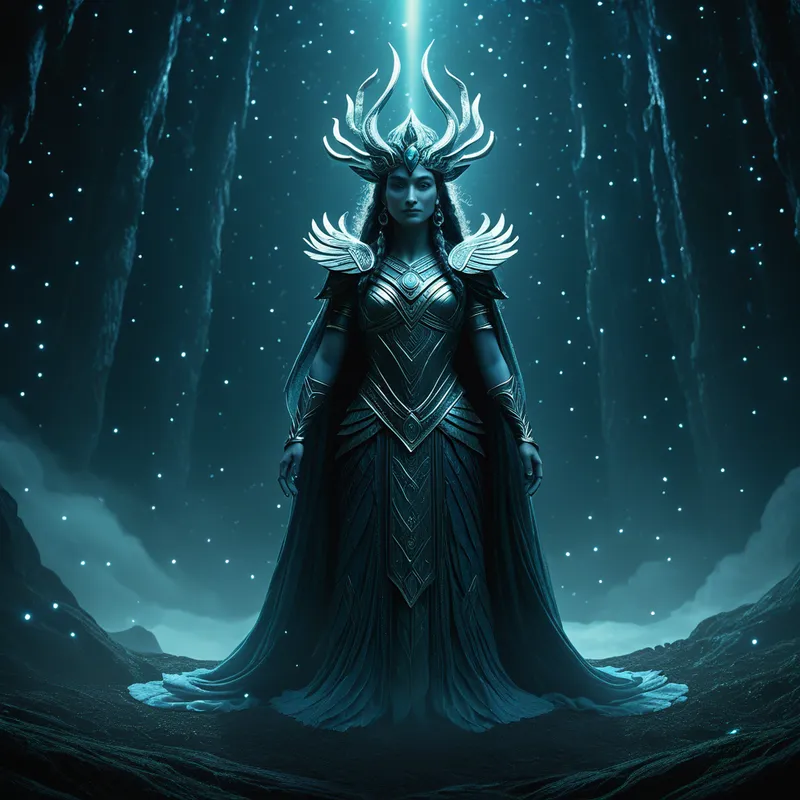
In the time before time, when the ice sang and the wind had a name, there lived Nanuq. He was not merely the largest of the white bears that roamed the endless white; he was their master, their inua. His breath was the blizzard, his stride measured the distance between one star and the next on the frozen sea. He was the absolute ruler of the silent, lethal world at the top of the Earth.
The people, the Inuit, knew him. They saw his tracks, great saucer-like impressions leading into the mist, and felt the weight of his gaze from afar. To hunt the polar bear was to survive—its meat filled the belly, its fat fed the lamps, its pelt clothed the family against the killing cold. But to hunt Nanuq’s children was no simple act of predation. It was a sacred dialogue, a negotiation with the master himself.
The tale is told of a hunter, skilled and respectful, who followed a trail for three days. His spirit was humble, his intentions clear. On the third day, as the weak sun bled on the horizon, he found not a bear, but Nanuq in a form both bear and more. The great one stood on his hind legs, a mountain of living ice, and spoke without words. The message flowed into the hunter’s heart: You may take what you need, for my children are also my gift. But you must show no waste, no arrogance, no cruelty. Their spirit returns to me, and I watch.
In another telling, a hunter who boasted of his skill and killed for pride alone found his world turning barren. The seals vanished, the caribou paths grew cold. In a dream, Nanuq came, his white fur stained with the red of wasted life. The hunter awoke knowing he had offended the master. Only through a shaman’s intervention and profound acts of atonement—offering songs and tools to the sea—was the balance restored. Nanuq’s law was the law of the ice itself: absolute, impartial, and essential for the continuity of all life.
Cultural Origins & Context
Nanuq’s mythology is not a story told for entertainment beside the fire; it is the bedrock of survival ethics in one of the planet’s most extreme environments. For the Inuit, the polar bear (Ursus maritimus) is the ultimate sovereign of the Arctic ecosystem, a peer predator of astonishing power and intelligence. The myth of Nanuq formalizes this observable reality into a spiritual and social framework.
This belief is rooted in a worldview where animals possess souls (inua) and willingly give themselves to respectful hunters. The polar bear, as the apex, holds a special status. Nanuq is the guardian of this covenant. Hunting rituals—from the treatment of the bear’s skull to the words spoken after a kill—are direct communications with him. They are acts of diplomacy with a non-human person of immense power. To dishonor the bear is to dishonor Nanuq, and to risk the withdrawal of his consent, which means starvation and death for the community. Thus, the myth enforces a sustainable, reverential relationship with a keystone species, weaving ecological necessity into the fabric of the sacred.
Symbolic Architecture
Nanuq’s symbolism is a complex architecture built from ice, blood, and spirit. He is the archetypal Ruler, but his sovereignty is not one of tyranny. It is the governance of natural law, of brutal necessity tempered by a sacred reciprocity. He embodies the paradox of the Arctic itself: a landscape of breathtaking beauty and annihilating harshness, a giver of life and a bringer of death, inseparable.
He represents the ultimate Mirror for humanity. In his silent, powerful presence, the hunter sees reflected his own courage, his fear, his need, and his capacity for respect or hubris. The encounter with Nanuq (or his children) is a profound test of character.
The bear’s white coat symbolizes camouflage, yes, but on a spiritual level, it represents purity of purpose and the blank, unjudging face of the cosmos. The red of its mouth and the black of its nose and eyes are the vital, stark truths of life and death against that white void. Nanuq is the Bridge between the human world and the raw, untamed spirit of the wild. He is not a god to be worshipped from afar, but a master to be engaged with in the most direct and dangerous terms.
The Dreamer's Resonance
To dream of Nanuq is to confront the sovereign power within one’s own psyche. Psychologically, he represents the awesome, often feared, authority of the instinctual Self—the part of us that knows, without doubt, how to survive, how to fight, and when to be still. He is the ruler of our inner Arctic: the frozen, neglected, or terrifyingly potent realms of primal emotion and innate wisdom.
A modern individual may never face a polar bear on the ice, but they face Nanuq when they encounter an overwhelming challenge that demands absolute presence and respect. He appears when we must negotiate with our own fierce power (our rage, our will) or when we must approach a daunting authority figure or life circumstance with humility and clarity. Ignoring Nanuq’s lesson—the necessity of respect in the face of power—leads to psychological "starvation," a feeling of being cut off from one’s own vital instincts and strength. Honoring him means integrating that fierce sovereignty with conscious responsibility, becoming the respectful hunter of one’s own destiny.

Alchemical Translation
The alchemical process embodied in the myth of Nanuq is the transmutation of predation into sacrament. The base matter is the raw, biological fact of the hunt: kill or be killed, consume to avoid being consumed. The spiritual discipline imposed by Nanuq—the rituals, the taboos, the songs of thanks—acts as the alchemical fire.
This process transforms the act from one of mere taking into one of sacred exchange. The physical meat nourishes the body, while the respectful practice nourishes the soul and the cosmological order. The bear’s life is not ended; it is translated—from animal to sustenance, from flesh to spirit, returning to Nanuq’s care.
The hunter, too, is transformed. He is alchemized from a simple predator into a priest of the ice, a participant in a cycle far greater than himself. The terror of the encounter becomes awe; the guilt of the kill becomes gratitude. This is the gold that Nanuq’s law produces: a sustainable, meaningful, and spiritually coherent existence in a world that offers no margin for error. It is the ultimate survival wisdom, forged in the crucible of necessity.
Associated Symbols
Explore related symbols from the CaleaDream lexicon:
- Bear — The primal embodiment of solitary strength, hibernation cycles, and ferocious maternal protection, serving as a universal anchor for the archetype of instinctual power.
- Master — A figure representing consummate skill, absolute authority, and the daunting responsibility that comes with profound knowledge or control over a domain.
- Survival Instinct — The deep, non-negotiable drive to persist and thrive, often emerging as a fierce, intelligent force that overrides civilized niceties in moments of existential threat.
- Ritual — Prescribed actions and words that create a sacred container, transforming mundane acts into meaningful exchanges with the unseen world and solidifying communal bonds.
- Mirror — An object or encounter that reflects not just appearance, but the true state of one’s soul, revealing hidden truths, virtues, and flaws with unflinching clarity.
- Bridge — A liminal structure spanning a divide, facilitating dangerous or sacred passage between two separate realms, states of being, or aspects of the self.
- Sacrifice — A voluntary offering of something precious, enacting a cosmic principle of exchange to maintain balance, secure favor, or fuel a profound transformation.
- Gift — Something bestowed without guaranteed return, representing grace, obligation, and the sacred flow of sustenance and fortune within a web of relationships.
- Respect — The essential attitude of profound regard and honor, which in mythic terms is often the key that unlocks safety, wisdom, or alliance with powerful forces.
- Cycle — The eternal, repeating pattern of death and rebirth, hunting and regeneration, which structures time and meaning in a world of constant change.
- Ice — A substance symbolizing purity, preservation, stillness, and lethal beauty, representing both a barrier to be crossed and a foundational reality of existence.
- Dream — The nocturnal realm where the spirit travels, receiving visions, warnings, and teachings from the animal masters and ancestors who guide the waking world.