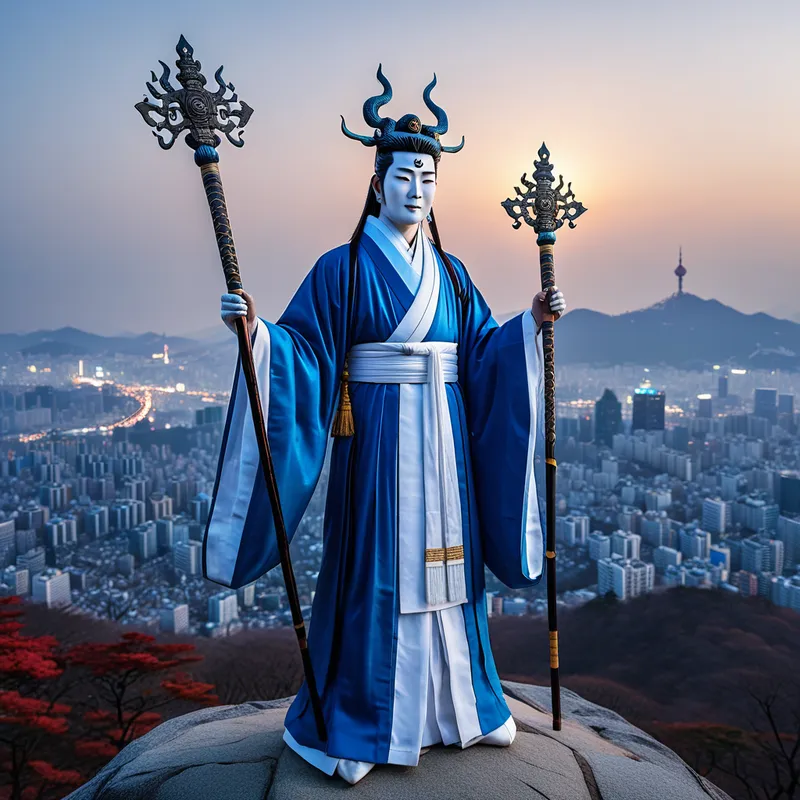
Namsan Mountain Spirit of Seoul Myth Meaning & Symbolism
The myth of the Namsan Mountain Spirit tells of a protective deity who guards Seoul, embodying the sacred covenant between the land and its people.
The Tale of Namsan Mountain Spirit of Seoul
Listen, and hear the whisper in the wind through the pines. Feel the ancient stone beneath the modern path. Before the towers of glass, before the river of lights, there was the mountain. Namsan was not just earth and rock; it was a living breath, a great, slumbering guardian whose dreams shaped the valleys and whose sighs became the morning mist.
In the time when kings ruled from Gyeongbokgung and the city walls were still wet with new mortar, the people knew a truth. The mountain was watched over. Not by a beast, nor a ghost, but by a Sansin—a spirit of profound dignity and quiet power. He was often seen as a venerable elder, his beard as white as the first winter snow on the peak, his robes the deep blues and greens of the forest shadows. In one hand, he might hold a staff of twisted pine, in the other, a peach of immortality. By his side, always, was a loyal hoju, a tiger whose stripes held the darkness of the deepest cave and whose eyes held the wisdom of the wild.
This spirit did not dwell in a palace. His court was the grove of ancient trees, his throne a sun-warmed rock overlooking the Hangang. His duty was not to command, but to protect. He was the covenant made visible—the promise that if the people respected the mountain, the mountain would hold them safe. He ensured the springs flowed clean, that the forests gave game and medicine, that the landslides spared the villages at the foot of his slopes. The city, Hanyang, grew in the palm of his hand.
But a covenant is a two-edged sword. When the people forgot—when they took from the mountain without offering thanks, when they cut too many trees or polluted the streams—the spirit’s countenance would darken. The tiger would growl, a sound felt in the bones before it was heard in the ears. The mist would turn cold and clinging. The mountain itself would feel restless, as if turning in its sleep. This was not wrath, but a profound sorrow, a reminder of the broken bond.
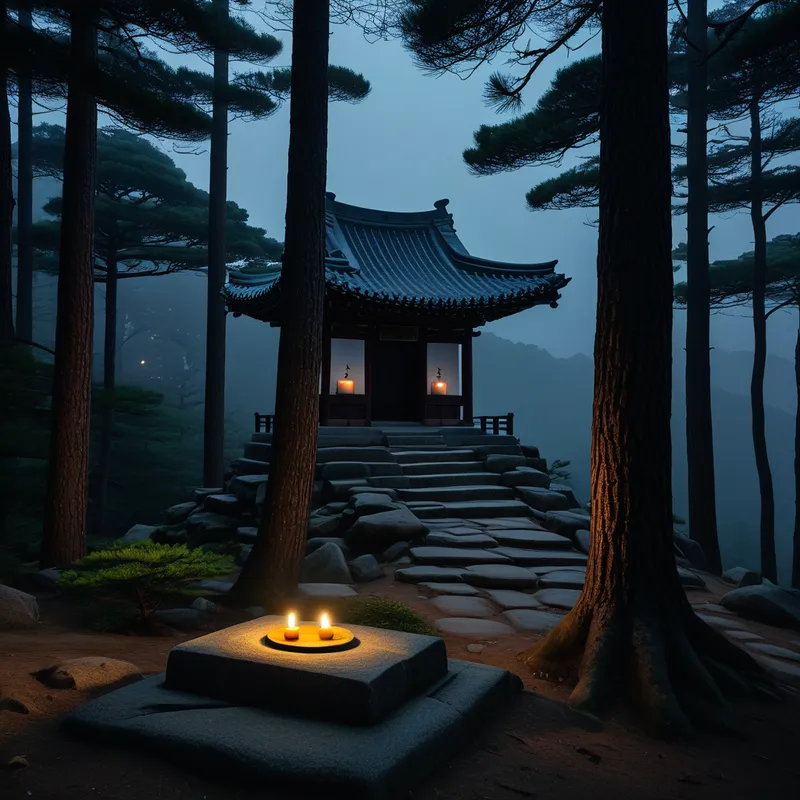
The resolution was never a grand battle. It was a quiet returning. A village elder, sensing the disquiet, would lead a humble procession up the winding paths. They would cleanse a simple sadang, make offerings of clear water, rice, and fruit. They would bow, not in fear, but in respect, acknowledging their place within the whole. And slowly, the mist would lift. The tiger would settle. The spirit’s gaze would soften, watching once more over the sleeping city, the balance restored, the sacred promise remembered. The mountain breathed, and the people lived within its breath.
Cultural Origins & Context
The myth of the Namsan Sansin is not a single, codified epic but a living tradition woven into the fabric of Korean musok and Mugyo. It finds its roots in the ancient East Asian worship of Sansin, which predates the arrival of organized Buddhism and Confucianism to the peninsula. Every mountain was believed to have its own spirit, a local sovereign of the terrain.
Namsan’s particular prominence stems from its geographical and geomantic (Pungsu) role. As the southern guardian of the Joseon capital’s fortifications, it was integral to the city’s protective energy. The myth was perpetuated not by royal scribes but by Mudang in their rituals, by local elders telling stories, and through the maintenance of countless small shrines (Sansindang) along its slopes. Its societal function was multifaceted: it explained the benevolence and occasional perils of the natural world, enforced ecological ethics through spiritual sanction, and provided a profound sense of psychological security. The city was not built on the land, but with it, under the watchful eye of a paternal guardian. This myth served as the spiritual cornerstone of communal identity, binding the people to their specific place in the world through a narrative of reciprocal care.
Symbolic Architecture
At its core, the myth symbolizes the archetypal relationship between the Human and the Anima Mundi—the World Soul—as manifested in a specific locale. The Sansin is not a distant god but the genius loci, the indwelling spirit of the place. Psychologically, he represents the Self in its aspect as the organizing, protective, and nourishing center of a psychic ecology.
The mountain spirit is the psyche’s own foundational ground, the immutable, ancient core of identity that watches over the bustling, often forgetful, conscious city of the ego.
The hoju tiger is the instinctual power and raw vitality of the unconscious, tamed and aligned in service of the Self’s protective function. It is the fierce loyalty of the somatic psyche, the gut-feeling that signals when the ego has strayed from its authentic path. The covenant between spirit and people mirrors the essential pact between the conscious personality and the deeper Self: honor the depths, and they will provide stability and meaning; exploit or ignore them, and you invite disorientation and psychic unrest (landslides, cold mists). The myth presents a model of governance based not on domination, but on stewardship and reciprocal relationship.

The Dreamer's Resonance
When this mythic pattern stirs in the modern dreamer, it often signals a process of re-grounding and a need to re-negotiate one’s inner covenant. To dream of a benevolent but stern mountain figure, or to find oneself on a forested mountain path in a cityscape, points to a somatic calling from the foundational layers of the psyche.
The psychological process underway is one of reconnection with the instinctual base. The dreamer may be experiencing life as unrooted, chaotic, or spiritually barren—a state of living "outside the covenant." The mountain spirit in the dream appears not to punish, but to remind. The accompanying emotions are often a mix of awe and a quiet, profound guilt or shame for having neglected something essential. This is the psyche’s attempt to restore ecological balance. The dream is an invitation to make the "offering"—to dedicate time, attention, or a change in action to that which feels most foundational and sacred: one’s health, one’s creative core, one’s connection to nature, or one’s cultural roots. The resolution in the dream, as in the myth, is the feeling of the cold mist lifting, symbolizing the relief that comes with acknowledging the debt to the deeper Self.

Alchemical Translation
The alchemical process modeled here is that of coagulatio—the making solid, the return to earth. In the journey of individuation, we often must ascend to abstract heights or plunge into chaotic depths. The Namsan myth calls for the essential, grounding stage of coming back to one’s own "mountain," one’s irreducible, localized being.
Individuation is not only about becoming who you are, but remembering where you are from—the psychic soil that nourishes your unique growth.
The struggle is against the modern spirit of forgetting: the ego’s inflation, its belief in its own independence from the nourishing unconscious. The triumph is the realization of interdependence. The "alchemical offering" is the conscious act of sacrifice—surrendering the ego’s claim of total autonomy and dedicating a portion of its energy back to its source. This transmutes leaden neglect into golden relatedness. The protective spirit, once acknowledged, becomes an internal compass, a source of resilience and authentic authority. The individual no longer lives on their psyche, exploiting its resources, but with it, in a state of sacred reciprocity. The mountain does not move, but one learns to build one’s life in harmony with its contours, finding shelter in its eternal presence.
Associated Symbols
Explore related symbols from the CaleaDream lexicon:
- Mountain — The foundational, enduring Self; the psychic ground and immutable core of identity that provides perspective and stability.
- Spirit — The animating, conscious presence within the natural world and the psyche; the genius loci or indwelling soul of a place or a person's deepest nature.
- Protective Spirit Animal — The instinctual, somatic intelligence (represented by the tiger) that is loyal to the Self and serves as a guardian and early-warning system for the ego.
- Mountain Temple — The sacred, inner sanctuary or shrine where communion with the deeper Self occurs; a place of ritual, offering, and restored covenant.
- Ancestral Spirits — The collective, cultural, and familial layers of the unconscious that inform identity and are protected by the mountain spirit's covenant.
- Earth — The principle of groundedness, nourishment, and the physical/instinctual base to which the myth calls for a return.
- Covenant — The sacred, reciprocal agreement between the conscious ego and the unconscious Self, requiring honor and offering to maintain psychic balance.
- Guardian — The archetypal role of the Self as protector and steward of the totality of the psyche, watching over the ego's development.
- Mountain Path — The journey of approach to the Self; often winding, humble, and requiring respectful effort, leading to the place of offering and reconnection.
- Balance — The central goal of the mythic dynamic; the harmonious state achieved when the ego's actions are in alignment with the needs and laws of the deeper psychic ecology.