
Nadis Myth Meaning & Symbolism
The myth of the Nadis describes the subtle, luminous channels within the body, mapping the flow of life force and the hidden architecture of consciousness itself.
The Tale of Nadis
Listen, and let your breath become still. For within the silence of your own form lies a universe more vast than the star-strewn sky. This is not a story of gods on distant mountains, but a map written in light upon the very substance of your being.
In the beginning, before form took shape, there was only a single, boundless vibration—Aum. From this sound, a spark of conscious life, Jiva, was born, yearning to know itself. To grant this wish, the universe provided a vessel: the human body. But this coarse flesh was merely the outer temple. Within, the architects of existence wove a second, luminous body—the Sukshma Sharira.
And within this body, they crafted the rivers of life.
Imagine, if you can, the first human form, lying supine upon the dawn of time. From a point of molten-gold sun at the base of the spine, a thousand, then seventy-two thousand, then countless more filaments of light began to emerge. They were the Nadis, finer than spider-silk, brighter than moonbeams. They branched and flowed like the roots of a celestial tree, like the tributaries of a great, internal Ganges, carrying not water, but the very breath of existence—Prana.
Yet this luminous network was in chaos. The rivers of light crossed and tangled, flowing in every direction without order. The Jiva within felt scattered, pulled apart by a thousand currents of sensation, thought, and desire. It could not find its center. It slept, a prisoner in its own radiant maze.
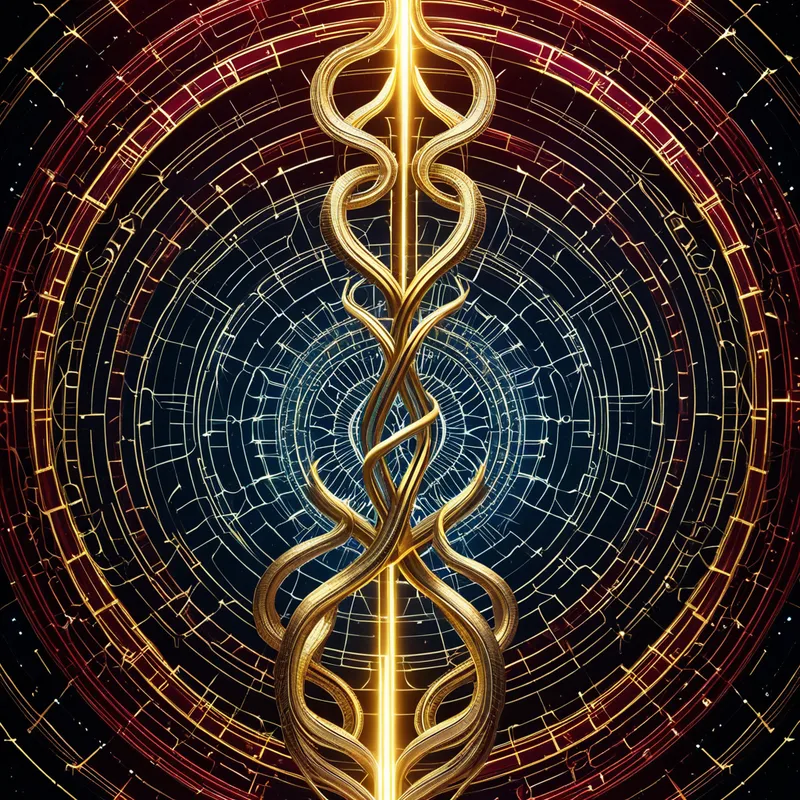
Then, from the cosmic depths, a triad of forces descended to bring order. Along the central axis of the spine, a pillar of pure, colorless fire awakened—the Sushumna. It lay dormant, a sealed royal road. To its left, a river of cool, silver light began to pulse—the Ida. To its right, a river of warm, crimson light surged—the Pingala.
These two great Nadis, Ida and Pingala, began their eternal dance. They spiraled around the silent Sushumna, crossing at key junctions, forming sacred whirlpools of power—the Chakras. With each crossing, a knot of ignorance was tied, and the Jiva slept more deeply. The dance was beautiful, a perfect rhythm of night and day, moon and sun, inhalation and exhalation. But it was a rhythm of duality, of eternal alternation, that kept the central fire locked away.
The myth whispers that the hero’s journey is not outward, but inward. The quest is to still the beautiful, distracting dance of Ida and Pingala. Through the alchemy of breath, posture, and fierce concentration, their opposing flows are balanced. In that moment of perfect equilibrium, a great silence falls. The knots are loosened. The sealed gate of the Sushumna flares open.
And when the central channel awakens, the scattered light of the seventy-two thousand Nadis turns inward, like rivers flowing back to their source. They feed the rising fire, which climbs the royal road, piercing each luminous wheel, until it reaches the crown of the head. There, the sleeping Jiva is bathed in a dawn that has no end. The map becomes the territory. The traveler arrives home, having never left.

Cultural Origins & Context
The myth of the Nadis is not a single narrative etched in one epic, but a living, breathing anatomical map of the subtle body developed over millennia within the traditions of Yoga, Tantra, and Ayurveda. Its most detailed early expositions are found in texts like the Yoga Yajnavalkya, the Shiva Samhita, and, most famously, the Hatha Yoga Pradipika.
This knowledge was never meant for the public square. It was transmitted in the hushed tones of the guru-disciple relationship, within the confines of ashrams and forest retreats. The "myth" was a technical, experiential reality for the yogi. The storytellers were the adepts and sages who had, through direct perception (Pratyaksha), charted these inner landscapes. Their societal function was profound: to provide a precise cartography for the ultimate human quest—liberation (Moksha). It framed the human body not as a prison of flesh, but as a precisely engineered vehicle for transcending that very flesh.
Symbolic Architecture
The Nadis represent the fundamental architecture of our lived experience. They are the symbolic substrate where the intangible—thought, emotion, energy, consciousness—meets the tangible body.
The body is not a thing we have, but a process we are. The Nadis are the luminous circuitry of that ongoing creation.
The chaotic web of 72,000 Nadis symbolizes the scattered, fragmented nature of ordinary awareness, pulled in countless directions by sensory input and mental chatter. The three primary channels—Ida, Pingala, and Sushumna—model the core dynamics of the psyche. Ida, the lunar channel, governs the receptive, intuitive, cooling aspects: the unconscious, the feminine principle, the mind. Pingala, the solar channel, governs the active, analytical, heating aspects: the conscious will, the masculine principle, the physical body. Their eternal, alternating dance is the drama of our waking life—the swing between thought and action, rest and exertion, empathy and assertion.
The dormant Sushumna is the ultimate symbol of potential wholeness, the unified field of consciousness that exists when the duality of the psyche is reconciled. The Chakras, where the Nadis intersect, are not mere energy centers but symbolic storehouses of psychic complexes, developmental stages, and archetypal powers. The "knots" they represent are the core samskaric impressions—the psychological and karmic granthis—that bind us to identificaton with the fragmented self.
The Dreamer's Resonance
When the pattern of the Nadis stirs in the modern unconscious, it often manifests not as a literal vision of Indian iconography, but as dreams of intricate internal systems. One might dream of discovering a hidden network of glowing wires or fibers within their own home (the body), of subway maps that chart emotions instead of locations, or of technological implants that regulate conflicting flows of data (Ida and Pingala as software processes).
Somatically, this myth activates during periods of deep psychological re-integration. The dreamer may be processing a life where one aspect (e.g., hyper-rational, solar Pingala) has dominated, leaving the intuitive, lunar Ida starved. The dream-work attempts to re-balance the flow. One might experience dreams of being lost in a labyrinth (the tangled Nadis), followed by a profound sense of relief upon finding a straight, clear path (the awakening Sushumna). These dreams signal the psyche's innate movement toward homeostasis, its attempt to clear the channels so that life force, creativity, and insight can circulate without blockages, moving from a state of psychic congestion to one of psychic circulation.

Alchemical Translation
For the modern individual, the myth of the Nadis provides a non-literal but profoundly accurate model for the process of individuation—the alchemical transmutation of the lead of a fragmented personality into the gold of an integrated Self.
The initial state is one of identification with the dance of the opposites. We are Pingala in our ambition, Ida in our longing; we are torn. The work begins with observation—simply noticing these alternating currents within: the rush of anger (Pingala), the wash of melancholy (Ida). This is the mapping of the 72,000 Nadis of our personal psychology.
Individuation is the conscious sponsorship of the central channel. It is the act of becoming the silent witness in the space between inhalation and exhalation.
The practice of balancing—through therapy, art, relationship, or mindful discipline—is the modern equivalent of Pranayama. We consciously engage with one side to nourish the other, not to achieve a static balance, but to create a dynamic tension so perfect it becomes stillness. In that stillness, the identificatory knots (Granthis) begin to loosen. We no longer are our anger or our sadness; we have them as energy moving through a clear channel.
The awakening of the Sushumna is the moment when the ego, having mediated the opposites, steps aside. It is the birth of a new, central governing principle—the Self. Energy and attention, once scattered, now consolidate and ascend. This is the "kundalini" of our unique potential uncoiling. Each chakra pierced represents the integration of a deeper layer of the unconscious: survival, passion, power, love, expression, insight, until finally reaching the crown—the realization of one's intrinsic wholeness and connection to the totality. The myth concludes not with an end, but with a new mode of being: life lived as an unobstructed flow, where every experience moves through the central channel of a conscious, embodied Self.
Associated Symbols
Explore related symbols from the CaleaDream lexicon: