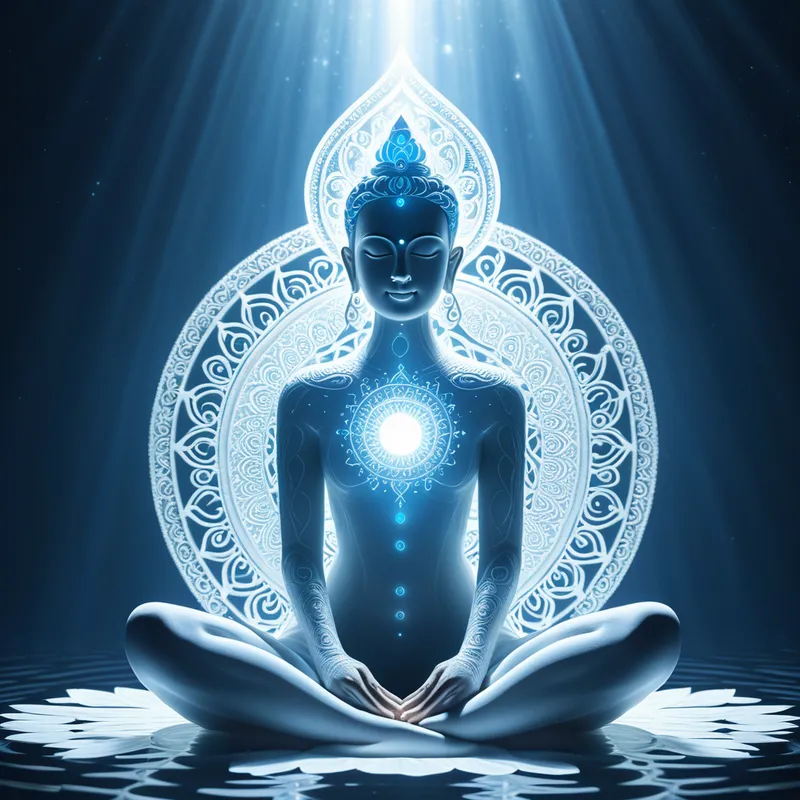
Sushumna Myth Meaning & Symbolism
The story of the central channel, where the divine feminine and masculine energies unite to awaken the dormant serpent power and illuminate the path to the crown.
The Tale of Sushumna
Listen. Close your eyes and journey inward, past the clamor of the world, past the fortress of the flesh, into the silent, unmapped country of the self. Here, in the deepest cavern at the root of your being, lies a power. She is Kundalini, the Serpent Queen, asleep in the dark. She dreams of a distant sun.
Above her, a vast and empty highway rises through the central axis of your subtle form. This is the Sushumna. It is not bone, nor vein, but a conduit of pure potential, a hollow reed waiting for the breath of the divine. It is the silent spine of the universe within you.
But the great road is blocked. To its left winds Ida, a river of silver moonlight, cool and reflective. To its right surges Pingala, a torrent of solar fire, hot and penetrating. These two great forces, the Goddess and the God within, flow in eternal, separate cycles, governing the tides of breath and consciousness. Their dance creates the world of duality—day and night, thought and feeling, self and other. Yet, in their separation, the central throne remains vacant. Sushumna sleeps, a king’s highway overgrown with the brambles of ordinary awareness.
The call to awakening begins not with a shout, but with a profound stillness. Through the disciplined rhythms of breath, the sacred posture, the focused mind, a great peace descends. The turbulent flows of Ida and Pingala begin to slow. Their opposing currents cease their struggle. In that holy pause, at the sacred junctions where they cross, a miracle occurs. The silver river and the golden fire do not clash; they surrender. They bow to the central emptiness, and from their union, a spark is born.
That spark travels down, a falling star into the depths. It touches the coiled Serpent in her dark cave. She stirs. A single, luminous scale catches the light. With a sound like the universe inhaling, she uncoils. She lifts her majestic head, and she begins to ascend.
Her path is Sushumna. The hollow channel is no longer empty; it is filled with her rising, fiery splendor. She moves not as flesh moves, but as lightning climbs a rod of crystal. As she ascends, she passes through luminous wheels of energy—the chakras. At each, a lotus unfurls its petals, a dormant faculty awakens: security, passion, will, compassion, expression, intuition. The Serpent purifies each in her passage, transmuting base instinct into refined perception.
Finally, she reaches the crown of the head, the thousand-petaled lotus. Here, the journey of ascent meets the descent of grace. The Serpent Queen, the embodied Shakti, meets her eternal consort, the pure consciousness of Shiva. In their union, a silent thunderclap echoes through every layer of being. The drop merges with the ocean. The individual spark dissolves into the boundless sun. Sushumna, now fully illuminated, becomes the axis mundi, the world tree, the bridge where the human and the divine are revealed to have never been separate. The story ends where all true stories begin: in the radiant silence of a truth remembered.

Cultural Origins & Context
The myth of Sushumna is not a tale told around a fire, but a map whispered from guru to disciple in the silent spaces between breaths. Its primary home is within the esoteric texts of Tantra and the practical manuals of Yoga, such as the Hatha Yoga Pradipika and the Shiva Samhita. It belongs to the adhyatmika (pertaining to the self) dimension of Indian thought, a sophisticated psycho-cosmology developed over millennia by rishis (seers) who turned their awareness inward as the ultimate laboratory.
This was experiential knowledge, transmitted orally and through direct initiation. Its function was utterly practical: to provide a symbolic framework for the profound and often terrifying process of spiritual awakening. The myth offered a landscape for the inner journey, naming the forces a practitioner would encounter—the cooling doubt (Ida), the burning ambition (Pingala), the central void (Sushumna), and the transformative power (Kundalini). It served as both a warning and a promise, charting a course through the potential perils of unbalanced energy toward the sublime goal of Moksha.
Symbolic Architecture
At its core, the myth of Sushumna is a grand allegory of consciousness itself. Sushumna represents the central pillar of awareness, the integrated Self that exists prior to and beyond the mind’s constant dichotomies.
Ida and Pingala are the twin children of duality, the endless debate between heart and mind, receptivity and action, the unconscious and the conscious. Sushumna is the silent witness that contains them both.
The blocked or dormant Sushumna symbolizes the ordinary, identified state of being—a consciousness caught in the pendulum swing of opposites, believing itself to be its thoughts (Pingala) or its emotions (Ida). The awakening is the cessation of this identification, the “still point of the turning world.” Kundalini is the latent totality of the psyche, the compressed potential of the Self. Her ascent is the process of integration, where repressed, instinctual, and sublime aspects of the psyche are brought into the light of conscious awareness and unified.
The chakras are not mere energy centers but profound symbolic strata of human experience—from the earthy domain of survival and tribe (Muladhara) to the ethereal realm of transpersonal unity (Sahasrara). The journey up Sushumna is the alchemical opus of turning the lead of fragmented personal history into the gold of a realized, whole personality.
The Dreamer's Resonance
When this myth stirs in the modern unconscious, it rarely appears as a literal serpent. Instead, it manifests as dreams of profound centrality and axis. One might dream of being in a vast, complex building (the psyche) and discovering a hidden, perfectly vertical elevator or staircase at its very core. The dreamer enters, and it ascends smoothly, offering new, panoramic views at each floor.
Other resonant dreams involve the reconciliation of powerful opposites: two warring figures or forces (often a silver and a gold light, a cold and a hot current) suddenly ceasing their conflict and merging into a single, stable pillar. There may be somatic sensations in the dream—a feeling of vibrational current rushing up the spine, or the blossoming of light at the crown of the head. These dreams point to a spontaneous process of psychic integration underway, where previously conflicting complexes (an ambition vs. a relationship, logic vs. intuition) are finding a resolution not through one defeating the other, but through the emergence of a third, transcendent position—the Self, the Sushumna.
Alchemical Translation
For the modern individual navigating a world of fragmentation, the Sushumna myth provides a master blueprint for individuation. The process is not about acquiring something new, but about clearing the central channel of one’s own being.
The first alchemical stage is recognizing the duality (Ida/Pingala). This is the honest inventory of one’s inner conflicts: the people-pleaser vs. the ruthless achiever, the logical critic vs. the vulnerable child. The second stage is the creation of the vessel—the disciplined practice (through therapy, meditation, art, or sincere self-reflection) that allows these opposites to be held in awareness without immediate reaction. This is the calming of the breath, the making of a sacred space within.
The fusion of opposites in the vessel does not create a compromise; it generates a transcendent third—the Philosopher's Stone, which is the illuminated consciousness of Sushumna.
The “awakening of Kundalini” is the moment when this integrated perspective gains its own motive power, autonomously reorganizing the psyche. Old traumas (lower chakras) are re-contextualized. Creative power (second and third chakras) is harnessed with compassion (fourth). Expression (fifth) aligns with inner truth, and intuition (sixth) clarifies. This is the ascent.
The final union is the realization that the seeker, the path, and the goal were one all along. The individual ego, having served as the necessary vessel, dissolves into its source. One does not become divine; one remembers that the central channel of one’s existence was always, and only, a filament of the infinite. The myth of Sushumna, therefore, is the ultimate map home—a map that is drawn on the very substance of the soul.
Associated Symbols
Explore related symbols from the CaleaDream lexicon: