Ganges Myth Meaning & Symbolism
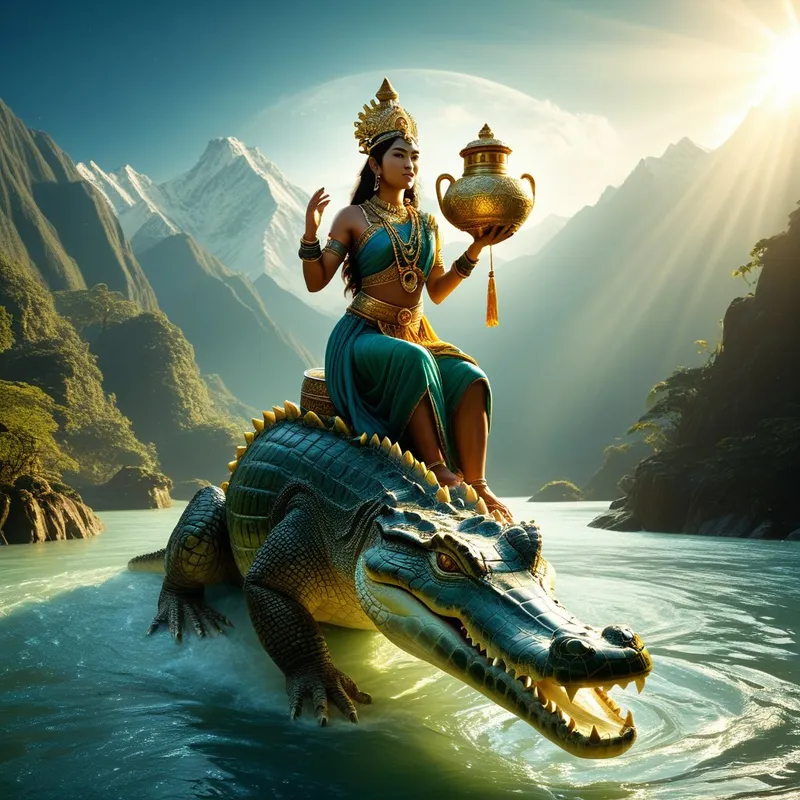
The celestial river Ganges descends to Earth, tamed by Shiva's hair, to purify the ashes of ancestors and bring life, symbolizing the descent of grace through sacrifice.
The Tale of Ganges
Hear now the story of the river that flows from the foot of Vishnu, through the matted locks of Shiva, to the dust of our world. It begins not with water, but with fire.
Long ago, the sixty-thousand sons of the great King Sagara, arrogant in their power, disturbed the meditation of the sage Kapila. With a single glance born of divine wrath, the sage reduced them all to a heap of ashes. Their souls were cursed, trapped in the mortal realm, unable to ascend to the heavens. Only the purifying touch of the celestial Ganga could wash their ashes clean and grant them liberation.
Generations passed. The burden of this ancestral debt fell upon a royal descendant, the king Bhagiratha. He renounced his throne and retreated to the Himalayas. For centuries, he stood on one foot, arms raised to the burning sun, his penance so fierce it shook the very foundations of the three worlds. The heavens grew hot with the fire of his devotion. Finally, the creator Brahma appeared, pleased. He granted the boon: Ganga would descend. But he issued a grave warning: "The force of her fall from the highest heaven would shatter the Earth. Only one being can bear that weight."
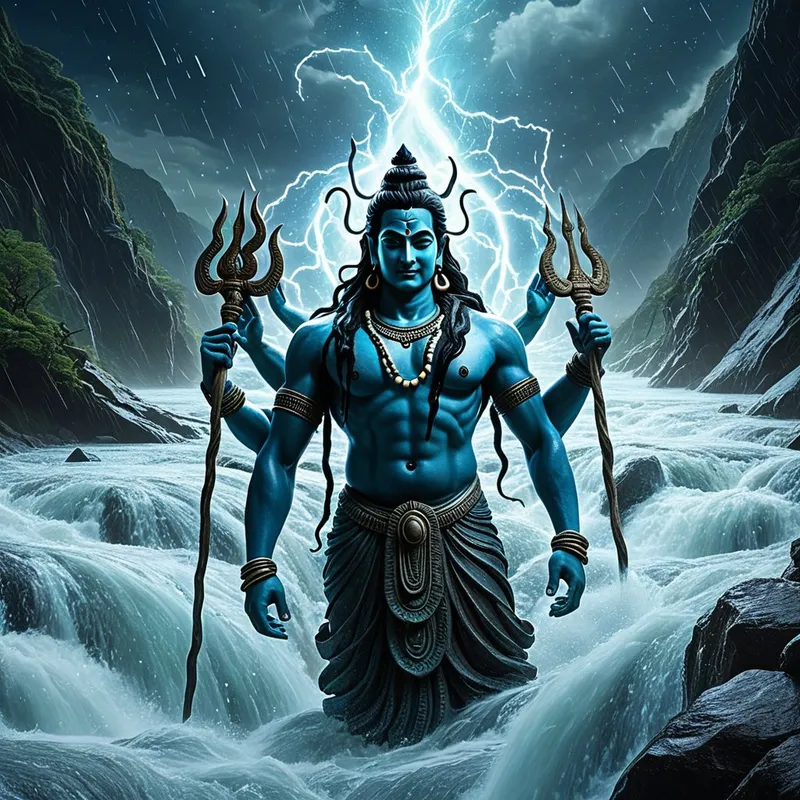
And so Bhagiratha prayed again, this time to the great ascetic, the lord of the wilds, Shiva. On the icy peaks of Kailasha, Shiva, moved by the king’s unwavering resolve, agreed. He positioned himself beneath the vault of heaven.
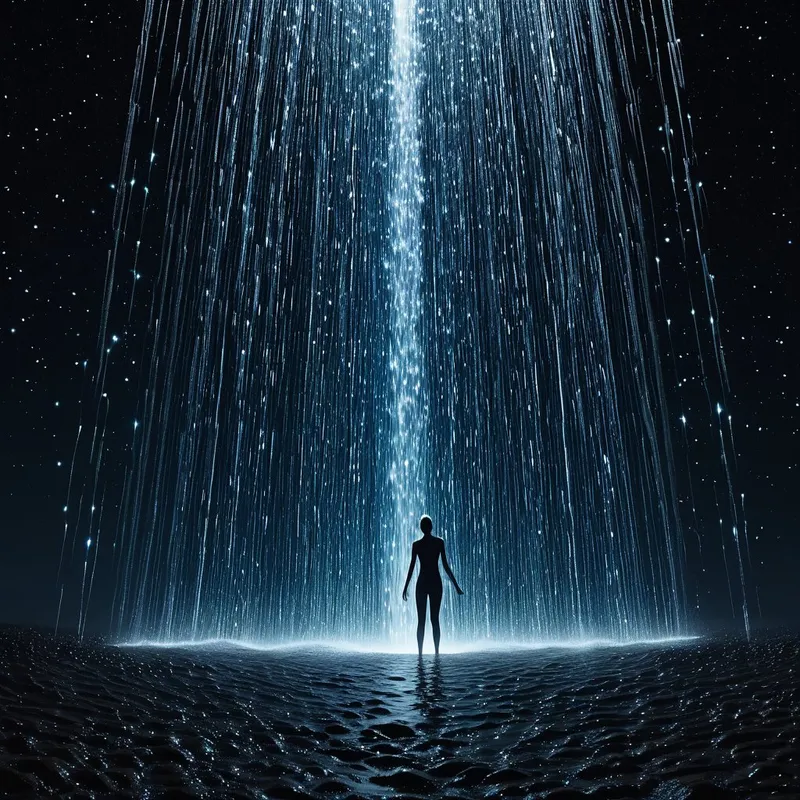
Then, from the highest realm, she came. Ganga, the daughter of the mountains, the liquid form of grace herself, arrogant in her celestial might. She thought to sweep this wild-haired god away with her torrential pride. She plunged downward, a tsunami of stars and liquid lightning, a roar that silenced the universe.
Shiva did not flinch. As the cataclysm approached, he simply smiled and raised his tangled, matted hair. The cosmic river crashed into that infinite, knotted labyrinth. The furious, deafening deluge was caught, tangled, slowed, and broken. For years, Ganga swirled in those locks, humbled, her fury tempered. Then, gently, Shiva let her slip free—not as a destroying flood, but as seven gentle streams. The first and greatest followed the chariot of the patient Bhagiratha, across the plains, to the sea, where the ashes of the ancestors lay.
Where her waters touched the charred remains, a miracle unfolded. Smoke rose, not of burning, but of release. Sixty-thousand luminous forms ascended, their sins washed away, their long torment ended. And where her waters flowed upon the earth, the barren land burst forth with life—forests, fields, and the breath of a new world. The river of heaven had become the artery of the Earth.
Cultural Origins & Context
This myth, primarily found in the Ramayana and Bhagavata Purana, is not merely a creation story for a river. It is a foundational narrative of dharma, ancestor worship (shraddha), and the interplay between royal duty (rajadharma) and divine grace. Passed down through bardic recitation and temple sculptures, it served a vital societal function: it sacralized the geography of the Indian subcontinent, transforming the Ganges from a physical river into a theological entity. The story explained why this particular river was considered supremely purifying—its waters carried the literal essence of divinity, tempered by sacrifice and channeled by penance. It established a model for human endeavor: even the impossible (bringing heaven to earth) could be achieved through relentless tapas (austerity) and the proper alignment with divine will.
Symbolic Architecture
The myth is a perfect symbolic engine. The Ganges represents unbridled, transcendent consciousness or grace—pure, potent, but in its raw form, destructive to the fragile structure of the embodied self (the Earth). Bhagiratha represents the human ego or will, driven by a profound obligation (to the past, to the ancestors, to unresolved karma) to seek that higher state.
The descent of grace is not a gentle rain but a cataclysm that must be mediated.
Shiva’s matted hair (Jata) is the master symbol. It is the chaotic, receptive, and transformative matrix of the unconscious psyche. It does not block the divine; it receives it, contains its annihilating force, and transforms it into a nourishing, manageable flow. The hair is neither ordered nor disordered, but a tertium quid—a third thing that transcends the binary of destructive power and passive earth.
The ashes of the ancestors symbolize the accumulated, unresolved psychic material of the past—our personal and collective karma, our guilt, our unprocessed history. The river’s final act of purification shows that true grace does not ignore this history but actively cleanses and liberates it.

The Dreamer's Resonance
To dream of a devastating, beautiful flood from the sky is to feel the approach of a potentially overwhelming psychic content—a surge of emotion, a spiritual awakening, or a demand from the depths of the unconscious. The dreamer may feel like Bhagiratha, tasked with an impossible responsibility, or like the Earth, fearing annihilation.
To dream of being caught in a labyrinthine, tangled forest that somehow slows a torrential downpour is to experience the Shiva function within. It is the psyche’s innate capacity to mediate a breakthrough. The somatic feeling is one of immense pressure followed by a paradoxical, contained release—a chaotic safety. The dream signals a process where a raw, undifferentiated energy (a trauma, a talent, a love) is being “combed out” and integrated into the structure of the personality, moving from a state of dangerous potential to one of viable life-force.
Alchemical Translation
The alchemical process modeled here is the solve et coagula—dissolve and coagulate. The arrogant, celestial Ganga (the spiritus in its volatile state) is dissolved into the chaotic medium of Shiva’s hair (the prima materia, the unconscious). There, it loses its destructive, singular form and is re-coagulated into the seven streams—the differentiated, nourishing waters that can sustain life.
For the modern individual, this is the process of channeling inspiration, spiritual experience, or profound emotion into daily life. A blinding insight (the descent) must be caught by the tangled, often messy complexities of our embodied existence—our relationships, our work, our creative struggles (the matted locks). If we try to let it hit our “earth” directly, it shatters us into fanaticism or burnout. But if we can develop the Shiva-like capacity to receive and contain—through practices like meditation, art, or deep reflection—that raw power is transformed. It becomes a sustaining flow that purifies our past (the ancestral ashes of habit and wound) and brings fertility to our present world.
Individuation is not about reaching heaven, but about creating the psychic apparatus to receive its river and, in receiving, transform both the river and the earth.
The ultimate triumph is Bhagiratha’s: the will, aligned not with personal ambition but with a debt to the whole chain of being, succeeds not by force, but by guiding the transformed grace to its destined purpose—the liberation of what was once burned and buried. Our personal penance is the focused attention that prepares the path for this alchemy to occur.
Associated Symbols
Explore related symbols from the CaleaDream lexicon: